RWA Tokenization Platforms: How Real Assets Are Going Digital on Blockchain

Dec, 16 2025
Imagine owning a piece of a Manhattan office building for just $500. Or investing in a wind farm in Scotland without needing a million dollars. That’s what RWA tokenization makes possible. Real-World Asset (RWA) tokenization platforms turn physical things - like buildings, machinery, invoices, or even royalties - into digital tokens you can buy, sell, and trade on blockchain networks. It’s not science fiction. It’s happening right now, and it’s changing how money moves across the globe.
What Exactly Is RWA Tokenization?
RWA tokenization means taking something real - something you can touch or see - and representing its ownership as a digital token on a blockchain. Think of it like cutting a cake into tiny slices, but instead of sharing it at a party, you’re selling those slices to people all over the world. Each slice is a token. Each token gives you a legal claim to a portion of the underlying asset.
Before this, if you wanted to invest in commercial real estate, you needed tens or hundreds of thousands of dollars. You dealt with lawyers, banks, paperwork, and months of waiting. Now, platforms like Securitize and a blockchain-based platform for security token offerings that connects traditional finance with digital assets let you buy a fraction of a building in minutes. The asset is still real. The ownership is just digital.
The magic happens through smart contracts - self-executing code on blockchains like Ethereum or Polygon. These contracts handle everything: who owns what, when dividends are paid, who can trade, and even tax rules. All of it automated, transparent, and tamper-proof.
How Does It Work? The 6-Step Process
Tokenizing a real asset isn’t as simple as uploading a photo to a website. It’s a legal and technical process that takes months. Here’s how it actually works:
- Asset Selection - You pick the asset. Real estate is the most common (62% of all tokenized assets), but also things like shipping containers, music royalties, or even fine art.
- Legal Structure - A Special Purpose Vehicle (SPV) is created. This is a legal shell company that holds the real asset. The tokens you buy represent shares in this SPV, not the asset directly. This keeps everything legally enforceable.
- Token Minting - Digital tokens are created on a blockchain. Most use ERC-20 standards, which means they’re compatible with wallets like MetaMask and exchanges like Binance.
- Smart Contract Setup - Rules are coded in. Who can buy? How are profits split? Is there a lock-up period? Are KYC checks required? All of this is built into the contract.
- Token Distribution - The tokens are offered to investors. This can be through private sales, regulated marketplaces, or even public offerings - depending on the jurisdiction.
- Secondary Trading - Once issued, tokens can be traded 24/7 on decentralized exchanges. No more waiting 30 days for a property sale to close. It’s instant.
Platforms like Mintology and a platform focused on commercial real estate tokenization with deep integration into property management systems automate parts of this, but the legal and compliance work still requires lawyers, auditors, and regulators.
Top Platforms Compared
Not all RWA platforms are the same. Some focus on real estate. Others on private credit. Some are built for Wall Street. Others for retail investors. Here’s how the leaders stack up:
| Platform | Focus Area | Key Strength | Best For | Regulatory Approach |
|---|---|---|---|---|
| Securitize | Security tokens, bonds, private equity | Integration with broker-dealers and institutional investors | Institutional investors, asset managers | U.S. SEC-compliant, strong legal framework |
| MANTRA Chain | Institutional-grade RWA, cross-border assets | Regulatory-first architecture, built-in KYC/AML | European and Middle Eastern institutions | Designed for global compliance, supports multiple jurisdictions |
| Mintology | Commercial real estate | Seamless property system integration, user-friendly interface | Real estate funds, property owners | U.S.-focused, evolving compliance |
| S-PRO | European assets, infrastructure | Strong EU regulatory alignment (MiCA) | European asset managers, public infrastructure | Full MiCA compliance, GDPR-ready |
Securitize leads in North America with 37% market share among institutional platforms. MANTRA dominates in Europe and the Middle East. Mintology is popular with real estate developers who want to avoid traditional fundraising. Each has trade-offs. Securitize is trusted by big names like BlackRock. MANTRA is built for scale. Mintology is easy to use - but less flexible for complex assets.

Why It Matters: The Real Benefits
Let’s cut through the hype. What do you actually get from RWA tokenization?
- Fractional Ownership - You don’t need $10 million to own a piece of a skyscraper. Platforms like RealT let you invest as little as $10 in prime U.S. property.
- 24/7 Liquidity - Traditional real estate takes 60 days to sell. Tokenized assets trade like stocks. Buy at 3 a.m. in New Zealand. Sell at 8 a.m. in London.
- Automated Payouts - Rent, dividends, or interest? The smart contract pays you automatically. No more chasing landlords or waiting for bank transfers.
- Global Access - An investor in Indonesia can buy a token in a German factory. No currency conversion headaches. No cross-border paperwork.
One European private equity firm tokenized €50 million in commercial property. Settlement time dropped from 45 days to 72 hours. That’s not a small win. That’s a revolution.
The Hidden Costs and Risks
It’s not all smooth sailing. RWA tokenization has serious downsides.
- Legal Complexity - Setting up an SPV, complying with securities laws, and navigating different jurisdictions can cost $100,000 to $300,000 upfront. For a small asset, that’s more than the asset’s value.
- Regulatory Fragmentation - The U.S. has state-by-state rules. Switzerland has clear laws. The EU has MiCA. Asia is still figuring it out. A platform that works in Singapore might be illegal in Texas.
- Limited Liquidity - Most tokenized assets trade under $50,000 per day. If you want to sell quickly, you might get a 10% discount. Real estate tokens are the exception - they’re the most liquid.
- Custody Challenges - Who holds the physical asset? The building? The machinery? If the SPV goes bankrupt, what happens to the asset? Insurance is still in its infancy.
- Tax Confusion - Is a tokenized asset a security? A commodity? A property? Tax authorities don’t agree. In New Zealand, Australia, or Canada, you might get hit with capital gains, income tax, or both.
According to user surveys, 65% of investors say regulatory uncertainty is their biggest worry. 52% say tax treatment is a nightmare. And 35% of implementations never achieve real liquidity - meaning the tokens sit unused.
Who’s Using This - And Why?
It’s not just tech startups. Big players are in:
- Asset Managers - 73 of the top 100 global asset managers are running RWA pilots. They use it to unlock liquidity in illiquid assets and attract new investors.
- Private Companies - Startups use tokenization to raise capital without giving up equity. They issue tokens backed by future revenue streams.
- Real Estate Developers - Instead of waiting for bank loans, they tokenize properties and sell directly to global investors.
- Retirees and Retail Investors - People with $500 to invest can now own a slice of a global portfolio - something once reserved for billionaires.
BlackRock tokenized $100 million in U.S. Treasury bonds. MANTRA launched its own Layer 1 blockchain just for RWAs. Chainlink’s oracles now feed real-time asset prices into smart contracts. This isn’t a side project. It’s infrastructure.
What’s Next? The Road Ahead
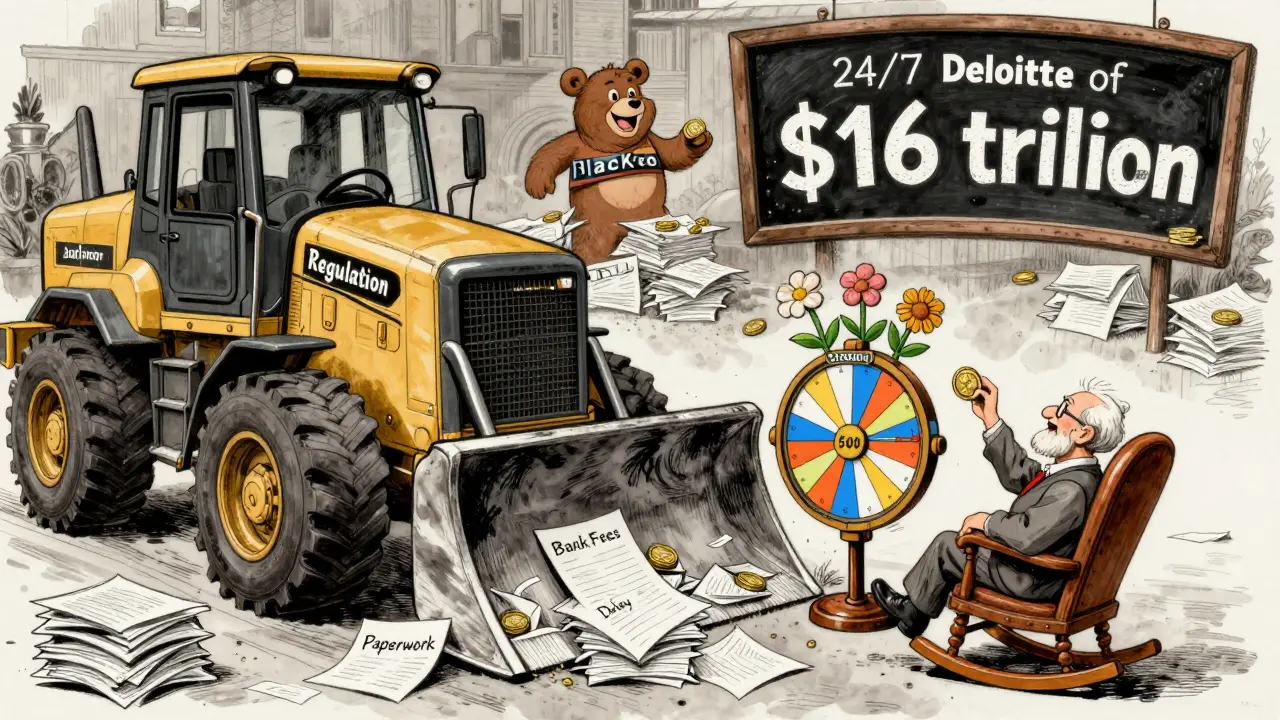
The market was worth $2.3 billion in 2023. Experts predict it could hit $16 trillion by 2030. That’s a 7,000x increase. But it won’t happen overnight.
Three big things will decide its fate:
- Regulation - Clear global standards are needed. The International Token Standardization Association (ITSA) released Version 3.0 of its RWA standard in April 2024 - a step forward.
- Custody Solutions - Who holds the physical asset? New insurance products like Nexus Mutual’s RWA coverage are starting to fill the gap.
- Integration with Traditional Finance - SWIFT is testing connections between its global payment network and RWA platforms. If that works, fiat-to-token transfers will become seamless.
Deloitte says there’s an 85% chance RWA tokenization becomes a $10 trillion market by 2030. But only if regulators stop playing catch-up.
Right now, it’s a hybrid system - part blockchain, part old-school finance. It’s messy. It’s slow in places. But it’s real. And it’s growing faster than almost anyone predicted.
Can anyone invest in RWA tokenized assets?
It depends on the platform and jurisdiction. Some platforms like RealT allow retail investors from many countries to buy tokens for as little as $10. Others, like Securitize, only allow accredited or institutional investors due to securities laws. Always check if the platform complies with your country’s rules - investing in unregulated tokenized assets can be risky or even illegal.
Are RWA tokens the same as cryptocurrencies?
No. Cryptocurrencies like Bitcoin or Ethereum are native to their blockchains and don’t represent real-world assets. RWA tokens are digital representations of physical assets - like a building, a machine, or a loan. They’re more like digital stocks than digital cash. Their value comes from the underlying asset, not speculation.
How are dividends paid on tokenized assets?
Dividends or rental income are paid automatically through smart contracts. When the asset generates income - say, rent from a building - the SPV collects it, then the contract distributes it proportionally to token holders. Payments happen in stablecoins or fiat, depending on the platform’s setup. No manual processing. No delays.
What happens if the asset gets damaged or destroyed?
The token’s value drops. If a building burns down, the SPV holding it may have insurance, but token holders are still exposed to loss. This is why due diligence matters. Reputable platforms require insurance, appraisals, and audits before tokenizing. Always check the asset’s risk profile before investing.
Is RWA tokenization legal in New Zealand?
New Zealand doesn’t have specific laws for RWA tokenization yet, but it falls under existing securities regulations. If a token represents ownership in an asset and promises returns, it’s likely considered a financial product under the Financial Markets Conduct Act. Platforms must comply with disclosure and licensing rules. Always verify if the platform is registered or has legal advice for NZ investors.
Can I use my crypto wallet to hold RWA tokens?
Yes - if the token is built on Ethereum or Polygon using ERC-20 standards, you can store it in MetaMask, Trust Wallet, or any compatible wallet. But be careful: some platforms require you to hold tokens in a custodial wallet they control for compliance reasons. Always check the platform’s requirements before transferring tokens.
Final Thoughts
RWA tokenization isn’t just about blockchain. It’s about fixing a broken system. For centuries, wealth has been locked up in things that can’t be easily traded - land, factories, patents. Now, those assets are becoming fluid, global, and accessible. The technology works. The demand is real. The question isn’t if it will grow - it’s whether regulators, banks, and investors can keep up.
If you’re an investor, it’s an opportunity. If you’re a business owner, it’s a new way to raise capital. If you’re watching from the sidelines, you’re seeing the future of finance being built - one token at a time.