SushiSwap Review 2025: Features, Fees, and SUSHI Token Outlook

Nov, 8 2024
SushiSwap Fee Calculator
Key Takeaways
- SushiSwap operates on over 40 blockchains, making it one of the most cross‑chain DEXes.
- The platform charges a standard 0.3% fee, with part of the fee rebated to SUSHI holders.
- Liquidity is lower than Uniswap but higher than many niche DEXes, leading to moderate slippage.
- SUSHI token sits around $0.74 (Oct 2025) with a market cap of ~$160 M.
- Security audits are clean, but users must watch gas fees on Ethereum and understand impermanent loss.
When you hear SushiSwap review, you’re probably wondering whether this DEX lives up to the hype of its restaurant‑themed branding. In short, SushiSwap offers solid cross‑chain swapping, a decent fee structure, and a growing suite of DeFi tools, but it still trails the biggest players in raw liquidity. This guide walks you through the platform’s core tech, user experience, token economics, and how it stacks up against other popular exchanges.
What is SushiSwap?
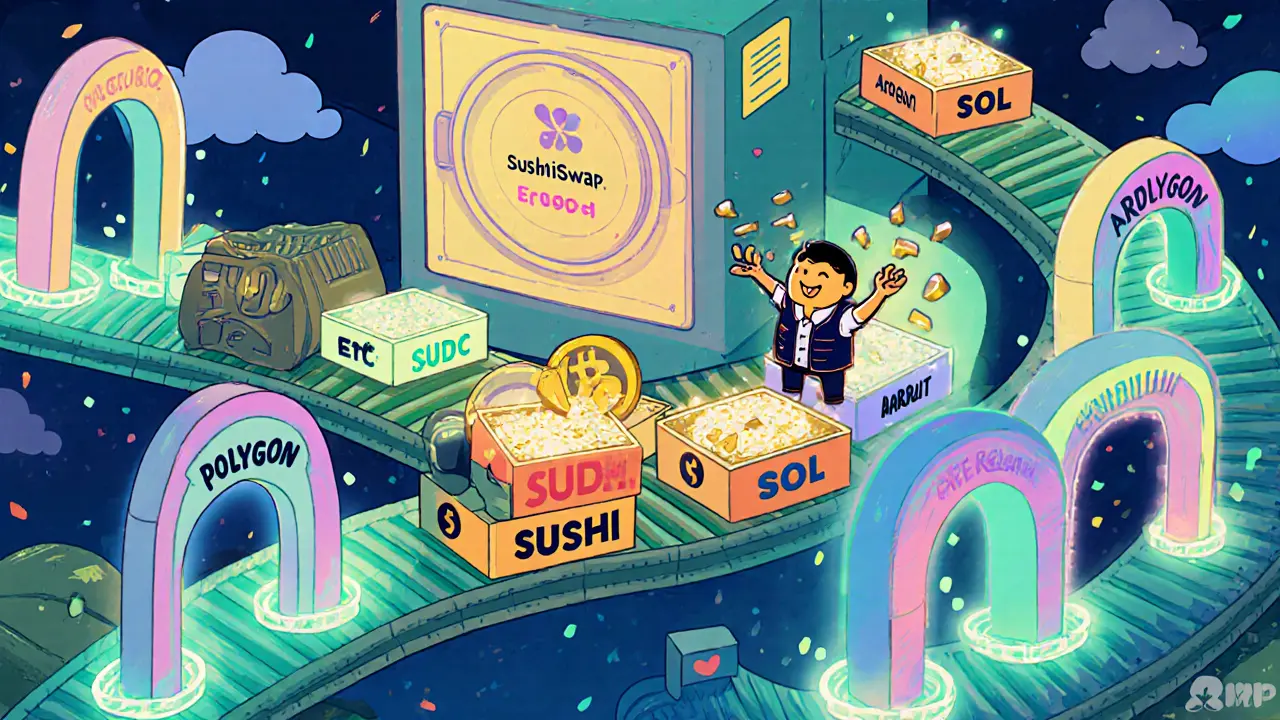
SushiSwap is a decentralized exchange (DEX) that runs on an Automated Market Maker (AMM) model. It lets users trade crypto pairs without an order book, instead relying on liquidity pools that anyone can add to. Launched in August 2020 by the pseudonymous Chef Nomi, the project quickly positioned itself as a community‑driven alternative to Uniswap. Today, SushiSwap spans more than 40 blockchains, from Ethereum and Polygon to Solana and emerging Layer‑2 solutions.
How the AMM model works
In an AMM, every trade adjusts the price curve of a pool. Liquidity providers (LPs) deposit equal values of two tokens, receiving LP shares that represent their stake. When a swap occurs, the pool’s ratio shifts, creating a price impact known as slippage. SushiSwap’s core algorithm mirrors Uniswap’s constant‑product formula (x·y = k) but adds a few twists:
- Portion of the 0.3% trading fee is rerouted to SUSHI token holders.
- Features like BentoBox and Kashi introduce tokenized vaults and isolated lending markets.
- SushiXSwap aggregates cross‑chain liquidity, allowing swaps between Ethereum, Solana, Polygon, and dozens of other networks.
SUSHI Token Basics
The native governance token, SUSHI, serves three main purposes: staking for fee rebates, voting on protocol upgrades, and liquidity mining rewards. As of October 2025, SUSHI trades around $0.74 with a circulating supply of 285 million, giving it a market cap near $160 million. Historical price highs peaked at $23.38 in March 2021, and analysts now predict a potential rise to $2.85 by year‑end 2025 if cross‑chain adoption accelerates.
Fees, Liquidity, and Trading Volume
SushiSwap maintains the industry‑standard 0.3% fee on every swap. About 0.05% of that fee is automatically sent to SUSHI stakers, while the remaining 0.25% stays in the pool to reward LPs. The platform’s 24‑hour volume sits near $27 million, placing it fifth among DEXes by raw turnover.
Liquidity, however, is about 65% lower than Uniswap’s total value locked (TVL). This gap means larger trades can experience higher slippage, especially on less popular pairs. On well‑liquified routes like ETH/USDC, slippage stays under 0.5%, but niche tokens may see 1‑2% slippage during volatile periods.
Cross‑Chain Capabilities
One of SushiSwap’s biggest selling points is its cross‑chain reach. After integrating Solana in August 2024, the platform supports bridges to more than 40 networks, enabling swaps such as ETH ↔︎ SOL or BNB ↔︎ MATIC without leaving the UI. The SushiXSwap aggregator routes orders through the lowest‑cost path, often saving users a few dollars in gas.
For traders focused on speed, Polygon and Arbitrum provide sub‑15‑second finality, while Ethereum mainnet swaps can take 15‑30 seconds depending on gas price. Users should keep an eye on gas fees-on Ethereum, a typical swap can cost $15‑$30 during peak demand.
User Experience and Onboarding
Connecting a wallet is straightforward. SushiSwap works with MetaMask, Trust Wallet, and WalletConnect. After clicking “Connect Wallet,” you approve token usage, select a pair, and hit “Swap.” The platform’s restaurant theme-terms like “BentoBox” for vaults-helps newcomers feel less intimidated. According to user surveys, 72% of beginners cite the UI as a positive factor.
Learning the basics takes about 1‑3 hours for a complete novice. More advanced features like concentrated liquidity pools may require additional 2‑4 hours of study, but the official help center (147 articles, 32 videos) covers most questions.
Security and Audits
Smart contracts have undergone multiple audits by reputable firms, and no major breaches have been reported to date. However, the security model inherits the risks of each underlying blockchain. For example, a vulnerability on a wrapped token bridge could affect cross‑chain swaps.
Best practices include:
- Enable hardware‑wallet signing for large transactions.
- Check contract addresses on the official SushiSwap site.
- Stay updated on governance proposals; 15‑25% of SUSHI typically vote on each change.
Pros and Cons
| Pros | Cons |
|---|---|
| Broad cross‑chain support (40+ networks) | Liquidity lower than top‑tier DEXes |
| 0.3% fee with SUSHI rebate | Higher gas on Ethereum swaps |
| User‑friendly themed UI | Complexity for advanced tools |
| Active community governance | Regulatory uncertainty around tokenomics |
How SushiSwap Stacks Up Against the Competition
| Feature | SushiSwap | Uniswap | PancakeSwap |
|---|---|---|---|
| Trading fee | 0.30% | 0.30% | 0.25% |
| Supported chains | 40+ (EVM + Solana) | Ethereum + L2s | BNB Chain + Arbitrum |
| 24h volume (USD) | $27 M | $180 M | $95 M |
| TVL (USD) | $7 B | $22 B | $12 B |
| Governance token | SUSHI | UNI | CAKE |
| Yield farms | Yes (5‑35% APY) | Limited | Yes (4‑30% APY) |
Is SushiSwap Right for You?
If you value cross‑chain flexibility and want to earn SUSHI rewards, SushiSwap is a solid choice. Retail traders who mainly operate on Ethereum might stick with Uniswap for deeper liquidity, while BNB‑centric users could gravitate to PancakeSwap. For anyone wanting a one‑stop DeFi hub-swapping, lending via Kashi, or using tokenized vaults-SushiSwap delivers a cohesive experience.
Final Verdict
Overall, SushiSwap blends a familiar AMM foundation with innovative cross‑chain tools. Its fee structure is competitive, the SUSHI token offers tangible incentives, and the UI lowers the entry barrier for newcomers. The main drawbacks are modest liquidity on smaller pairs and occasional high gas fees on Ethereum. For users who prioritize versatility and are comfortable managing a few extra steps for bridge transactions, SushiSwap earns a strong recommendation.
How do I start swapping on SushiSwap?
First, install a Web3 wallet like MetaMask or Trust Wallet. Go to the SushiSwap website, click “Connect Wallet,” approve the connection, select your token pair, enter the amount, and confirm the swap. The UI guides you through each step, and you’ll see the estimated slippage before confirming.
What is the benefit of holding SUSHI?
Holding SUSHI lets you stake the token to receive a portion of the platform’s trading fees (about 0.05% per swap). Stakers also gain voting power over protocol upgrades and can participate in liquidity mining programs for extra rewards.
Is SushiSwap safe to use?
The core contracts have passed multiple audits and no major exploits have been reported. Safety still depends on the underlying blockchain and the tokens you trade. Use reputable wallets, verify contract addresses, and avoid unusually high‑yield offers that could be scams.
How does SushiSwap compare to Uniswap on gas fees?
Both charge the same 0.3% swap fee, but Uniswap operates solely on Ethereum, so you’ll always pay Ethereum gas. SushiSwap can route the trade through cheaper L2s or side‑chains (Polygon, Arbitrum) via SushiXSwap, often cutting gas costs by 50‑80%.
Can I provide liquidity on SushiSwap?
Yes. Navigate to the “Pool” tab, choose a token pair, deposit equal value amounts, and you’ll receive LP tokens representing your share. You can later withdraw your assets plus fees, or stake the LP tokens in SushiSwap’s farms for extra SUSHI rewards.


