Crypto Taxation in India: What You Need to Know in 2026
Jan, 2 2026
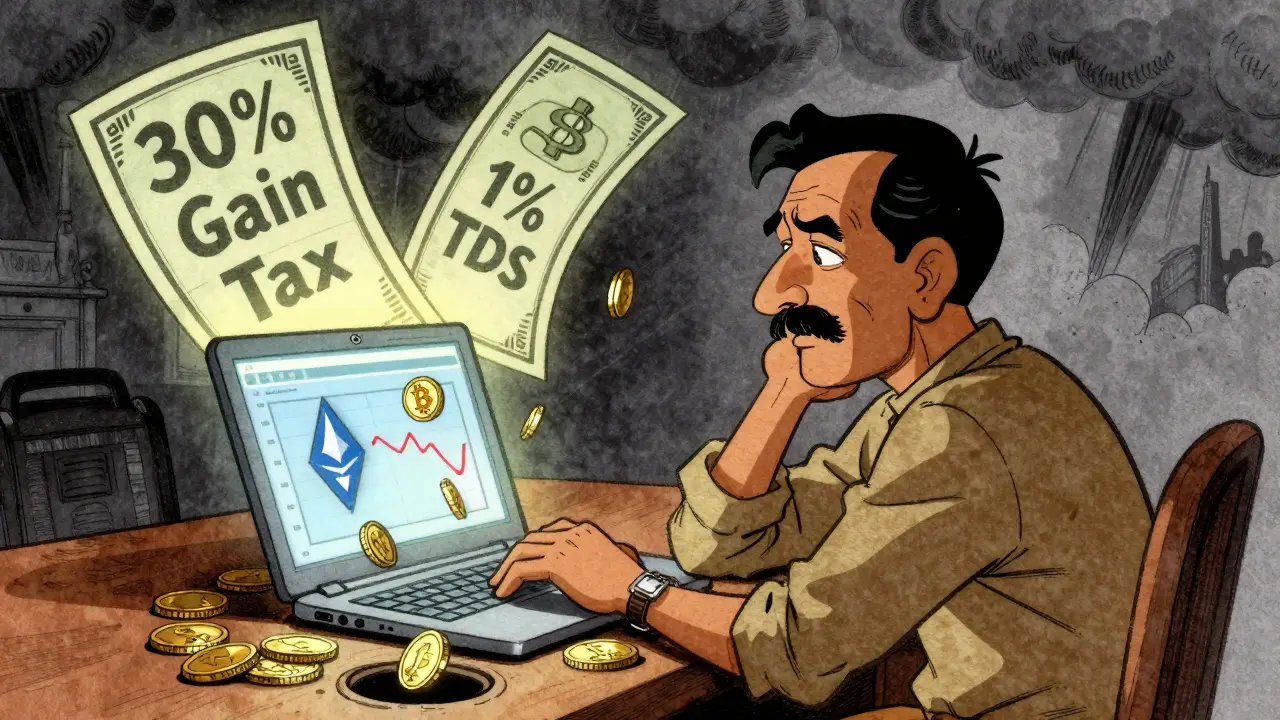
India’s crypto tax rules aren’t just complicated-they’re designed to make trading expensive. If you bought Bitcoin in 2021 and sold it in 2025, you didn’t just lose money to price swings. You also lost 30% of your profit to taxes, plus 1% of every trade taken right out before you even saw your gains. And that’s not all. Starting July 2025, every fee you paid to Binance, WazirX, or CoinSwitch got slapped with an extra 18% GST. This isn’t regulation with balance. It’s regulation with teeth.
How Crypto Taxes Work in India (2026)
India doesn’t call Bitcoin or Ethereum "cryptocurrencies." Legally, they’re Virtual Digital Assets (VDAs). That label changes everything. Under Section 2(47A) of the Income Tax Act, any profit from selling, trading, or exchanging VDAs is taxed at a flat 30%. No deductions. No indexation. No exceptions. Even if you held Bitcoin for five years, you still pay 30%. In the U.S., long-term gains get taxed at 0% to 20%. In India? Always 30%.
Here’s how the math works: If you bought 1 ETH for ₹200,000 and sold it for ₹350,000, your gain is ₹150,000. You owe ₹45,000 in tax (30%). Add the 4% health and education cess, and it jumps to ₹46,800. That’s 31.2% of your profit gone before you touch the rest.
And here’s the catch: Only the purchase price counts as a deduction. You can’t claim gas fees, wallet charges, or even the cost of using tax software. Not even if you spent ₹10,000 on a professional accountant. The government only lets you subtract what you paid to buy the asset. Everything else? On you.
The 1% TDS That’s Eating Your Profits
On top of the 30% tax, there’s a 1% Tax Deducted at Source (TDS) on every crypto trade over ₹10,000. For high-volume traders, this hits even harder. If you made ten trades of ₹50,000 each in a month, ₹5,000 got pulled out as TDS-regardless of whether you made a profit or loss.
Here’s the problem: TDS is not a final tax. It’s a prepayment. You’re supposed to get it back if your total tax liability is less than what was deducted. But in practice? Most people can’t claim it. Why? Because exchanges don’t send clean data to the Income Tax Department. Your AIS (Annual Information Statement) might show ₹1.2 lakh in sales, but your own records say ₹90,000. That mismatch means the system flags you. And when you file your return, the IT department says, "We saw ₹1.2 lakh. You paid 1% on that. Show us proof you didn’t make that much."
WazirX’s December 2024 survey found 57.2% of Indian traders struggled to claim TDS credits. Many just give up. They don’t file. Or they pay extra to tax software like KoinX just to untangle the mess.
What Counts as a Taxable Event?
It’s not just buying and selling. Every move triggers a tax event:
- Selling crypto for INR → Taxable gain
- Trading BTC for ETH → Taxable gain (even if you didn’t cash out)
- Using crypto to buy a laptop → Taxable gain
- Receiving staking rewards → Taxed as income at FMV when received
- Getting an airdrop → Taxed as income at FMV when received
- Receiving crypto as a gift → Taxed as income at FMV
Even if you didn’t sell, you still owe tax. That’s the biggest shock for new traders. You think you’re just swapping tokens. The government sees you making a profit.
And yes-NFTs are included. If you bought an NFT for ₹50,000 and sold it for ₹1.2 lakh, that ₹70,000 gain is taxed at 30%. No exceptions.
What About Mining, Staking, and DeFi?
Staking rewards? Taxed when you get them. If you earned 0.5 ETH as staking income in January 2025, and the market price was ₹280,000 per ETH, you owe tax on ₹140,000 as income. Not capital gains. Ordinary income. That means it could push you into a higher slab-up to 30% or even 35% if your total income crosses ₹15 lakh.
Mining? Same rule. The value of the coin you mine on the day you get it is your taxable income.
DeFi is the gray zone. If you provide liquidity on Uniswap and earn fees, the Indian tax department hasn’t officially said how to treat it. But experts agree: it’s likely treated as income or capital gain depending on how you structured it. No clarity. That’s the problem. You’re expected to file taxes on something the government hasn’t defined.
GST on Crypto Platforms (New in 2025)
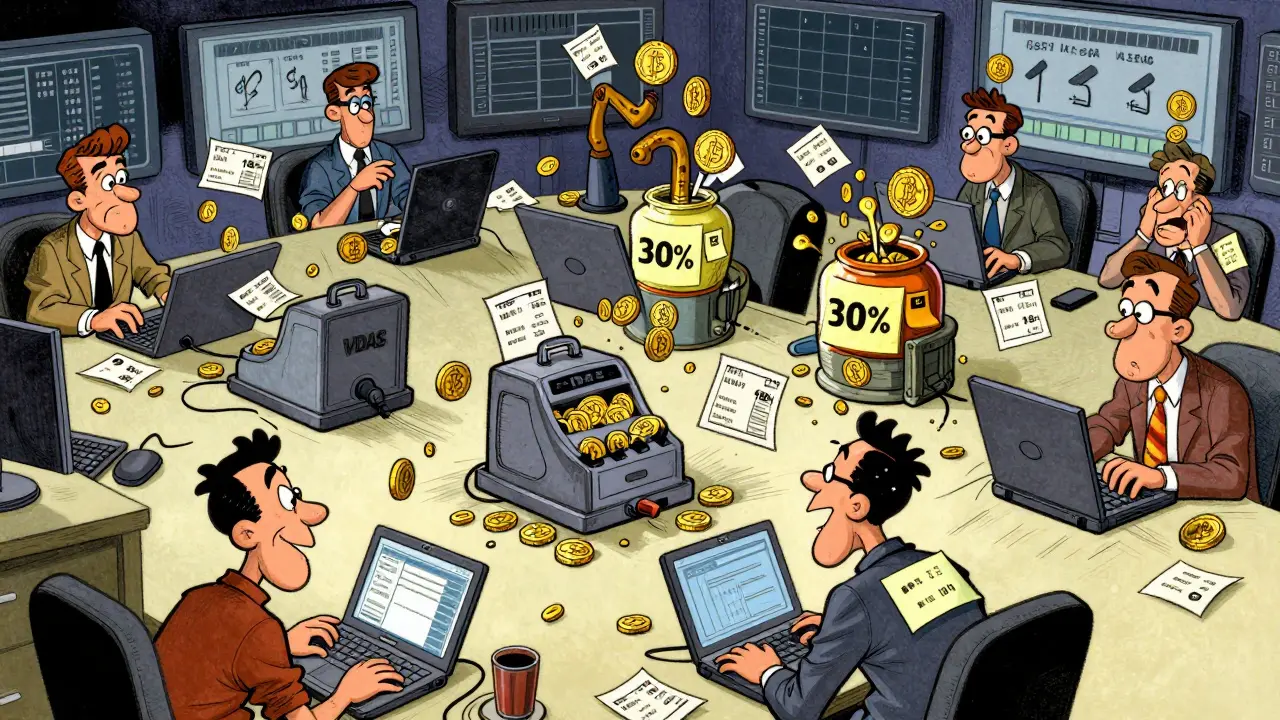
Since July 7, 2025, every fee you pay to a crypto exchange is taxed at 18% GST. That includes:
- Trading fees (spot or margin)
- Withdrawal or deposit charges
- Staking reward processing fees
- API access fees
- Any service fee charged by the platform
Exchanges like CoinDCX and ZebPay now have to register for GST, issue GST invoices, and collect the tax-even if they’re small. That’s a big shift. Before, they didn’t need GST unless they crossed ₹20 lakh in turnover. Now? All of them, big or small, must collect GST. That cost gets passed to you. A ₹10 trading fee might now cost ₹11.80. It adds up fast.
How It Compares to the Rest of the World
India’s tax system is extreme. Here’s how it stacks up:
| Country | Capital Gains Tax | TDS on Trades | Other Taxes |
|---|---|---|---|
| India | 30% flat | 1% (on trades >₹10k) | 18% GST on platform fees |
| United States | 0-37% (based on income and holding period) | No | No GST |
| Portugal | 0% (for non-professionals) | No | No |
| Singapore | 0% | No | No GST on crypto |
| Germany | 0% after 1 year | No | No |
India is one of the only countries that taxes both capital gains AND applies TDS. No other major economy does both. The result? A double hit. You pay 30% on your profit. Then you pay 1% on every trade-even if you’re breaking even. That’s why many small traders have stopped trading. According to Binance Research, retail participation dropped from 82% of all trades in 2021 to just 57% in 2024.
What Traders Are Saying
On Reddit’s r/IndianCryptoCommunity, user CryptoWarriorIN wrote: "I made ₹8 lakh in gains last year. After taxes, I walked away with ₹5.5 lakh. Then I realized I’d paid ₹8,000 in TDS that I couldn’t claim back. I’m done. I’m holding, not trading."
That’s not an outlier. A survey of 12,500 Indian traders by WazirX found 68.7% called the tax system "excessively punitive." 42.3% said they reduced trading because of it. But not everyone agrees. Institutional players like hedge funds and family offices appreciate the clarity. Before 2022, there was no rule. Now, at least you know what you owe. "I’d rather pay 30% than risk a notice," said BlockChainBankerIN on the same thread.

How to Stay Compliant
If you trade crypto in India, here’s what you need to do:
- Track every transaction-buy, sell, swap, stake, airdrop, gift. Use a tool like KoinX or CoinTracker. Manual spreadsheets will fail you.
- Record INR value at time of each transaction. Use historical prices from CoinGecko or CoinMarketCap. Don’t guess.
- Save wallet addresses. If you moved coins between wallets, document it. The tax department can trace it.
- Check your AIS on the Income Tax portal. Compare it to your own records. If there’s a mismatch, keep proof of your trades.
- File ITR-2. VDA gains go under "Capital Gains". Don’t use ITR-1.
- Claim TDS credits only if you have matching records. If the exchange deducted ₹15,000 but your gain was only ₹10,000, you might get a refund.
It takes 2-3 hours per quarter if you use software. Without it? 8-12 hours. And that’s not counting the stress.
What’s Coming in 2026?
The Joint Committee on Virtual Digital Assets is due to submit its report by March 2026. Rumors suggest they might:
- Raise the TDS threshold from ₹10,000 to ₹50,000
- Clarify DeFi and cross-border tax treatment
- Introduce a distinction between speculative and long-term holdings
Don’t expect a tax cut. The government’s stance hasn’t changed. Finance Minister Piyush Goyal said it clearly: "We don’t encourage or discourage. We only tax it."
The e-Rupee-the RBI’s digital currency-is rolling out. It’s centralized. It’s regulated. It’s backed by the government. Meanwhile, Bitcoin and Ethereum? They’re taxed like gambling winnings. That’s the message: Sovereign digital money is the future. Decentralized crypto? It’s a risky bet you pay for.
Final Reality Check
India’s crypto tax system isn’t broken. It’s working exactly as designed. It’s not meant to make crypto popular. It’s meant to make it expensive. The goal isn’t to stop people from trading. It’s to make sure the government gets its cut-no matter what.
If you’re a small trader with modest gains, you’re paying a heavy price for the freedom to trade. If you’re an investor holding long-term, you’re still paying 30% on every gain-even if inflation is 6%. There’s no reward for patience. Only a tax.
But here’s the thing: You still have to file. The government knows who you are. Exchanges report to them. AIS tracks your trades. If you skip filing, you risk a notice, a penalty, or worse. So do the work. Use the tools. Know the rules. And accept that in India, crypto isn’t a revolution. It’s a taxable activity.
Is crypto legal in India?
Yes, crypto is legal in India. The Supreme Court lifted the RBI’s banking ban in 2020. You can buy, sell, and hold crypto. But it’s heavily taxed. The government doesn’t ban it-it taxes it. Every trade, every reward, every swap is taxable.
Do I pay tax if I lose money on crypto?
You still pay tax on any gains you made during the year, even if you lost money overall. India doesn’t allow crypto losses to offset gains. If you made ₹2 lakh in profit from Bitcoin and lost ₹1.5 lakh on Ethereum, you still pay 30% on the ₹2 lakh. Losses can’t be carried forward or used to reduce your tax bill.
What happens if I don’t report my crypto gains?
The Income Tax Department gets transaction data from exchanges via AIS. If your reported gains don’t match what the exchange reported, you’ll get a notice. Penalties can be up to 200% of the tax evaded. In serious cases, it can lead to prosecution under the Income Tax Act. Don’t risk it.
Do I pay tax on crypto received as a gift?
Yes. Any crypto you receive as a gift-whether from family or strangers-is taxed as income at its fair market value on the day you received it. If you got 0.1 BTC worth ₹3 lakh as a gift, you owe tax on ₹3 lakh as income. There’s no gift tax exemption for crypto.
Can I use foreign exchanges like Binance to avoid taxes?
No. Indian tax law applies to all Indian residents, regardless of where they trade. If you’re an Indian resident, you owe tax on all crypto gains worldwide. Binance, Kraken, or Coinbase don’t matter. The government can trace your wallet addresses and link them to your PAN. You’re still liable.
Is there a way to legally reduce my crypto tax bill?
Not much. You can’t deduct expenses. You can’t offset losses. The only legal strategy is to hold longer and avoid frequent trading. But even then, you pay 30% on every gain. Some people use crypto only for long-term savings and avoid selling. Others use it for payments (like buying goods) to reduce taxable events. But there’s no loophole.
What’s the difference between VDA and cryptocurrency in India?
There’s no practical difference. "Virtual Digital Asset" is the legal term the government uses to cover Bitcoin, Ethereum, NFTs, and any similar digital asset. "Cryptocurrency" is the common term. Legally, they’re the same. All are taxed under the same rules.