What is Wrapped AyeAyeCoin (WAAC)? The First Meme Coin on Ethereum Explained

Feb, 25 2026
Wrapped AyeAyeCoin (WAAC) isn’t just another crypto coin. It’s a piece of blockchain history - the first meme coin ever deployed on Ethereum, buried for nearly a decade, then dug up and turned into something modern. If you’ve ever wondered how a coin from 2015 is still trading today, WAAC is your answer.
The Original AyeAyeCoin: A Forgotten Pioneer
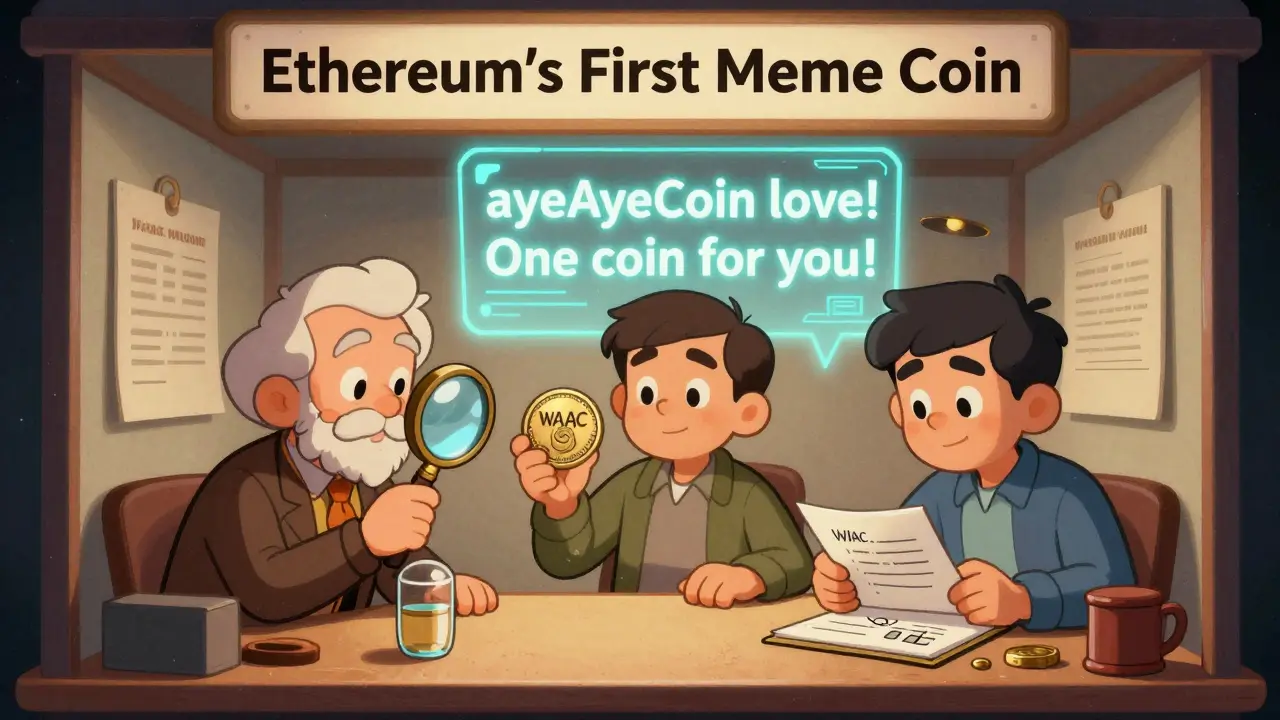
In August 2015, just three weeks after Ethereum launched, someone deployed a token called AyeAyeCoin. No whitepaper. No team. No roadmap. Just a simple contract that gave out one coin at a time to anyone willing to pay the gas fee. When you claimed it, the transaction returned a message: "ayeAyeCoin love! One coin for you!". That became its soul.
The coin was named after the aye-aye, a weird, nocturnal lemur from Madagascar - odd, yes, but fitting for a project that had no real purpose beyond being a quirky experiment. The total supply? Exactly 6 million coins. No more. No less. And here’s the twist: you couldn’t trade fractions. You had to move whole coins. That’s because it predated the ERC-20 standard. Back then, tokens didn’t have decimals. You either had one, or you didn’t.
For nine years, it sat there. No trades. No attention. Just a quiet artifact in the Ethereum blockchain. Then, in 2024, someone rediscovered it.
Why Wrapped? The Problem with Old Tokens
Modern exchanges - Uniswap, Binance, Bybit - only trade ERC-20 tokens. They need decimals. They need standardization. The original AyeAyeCoin? It couldn’t be traded on any of them. So, the person who found it built something clever: Wrapped AyeAyeCoin, or WAAC.
WAAC is a new ERC-20 token that locks up the original AyeAyeCoin in a trustless way. Every WAAC you hold is backed by one real AyeAyeCoin, stored in a smart contract. Want to get your original coin back? Just unwrap it. No middleman. No fees beyond Ethereum gas. The system is designed so the creator of WAAC has zero control over the coins. It’s like a vault with a key only you hold.
The contract address? 0x30ae41d5f9988d359c733232c6c693c0e645c77e. You can check it yourself. Every transaction is public. No one can create more WAAC. No one can freeze your coins. It’s pure, immutable, and trustless.
Market Data: Volatile, Thin, and Confusing
As of February 2026, WAAC is trading - but barely. The numbers don’t tell a story of adoption. They tell a story of niche obsession.
- Price: It varies wildly. CoinMarketCap says $0.28, CoinGecko says $0.60, Binance says $0.29. Why? Because there’s almost no trading. One big buy or sell moves the price 20% in minutes.
- Market Cap: Between $2 million and $6.8 million, depending on which site you check. That’s less than a single small-cap altcoin.
- Trading Volume: As low as $500 a day. That’s less than what some meme coins make in an hour.
- Holdings: Only 1,570 unique addresses hold WAAC. Most of them bought it in late 2024 during a short-lived hype spike.
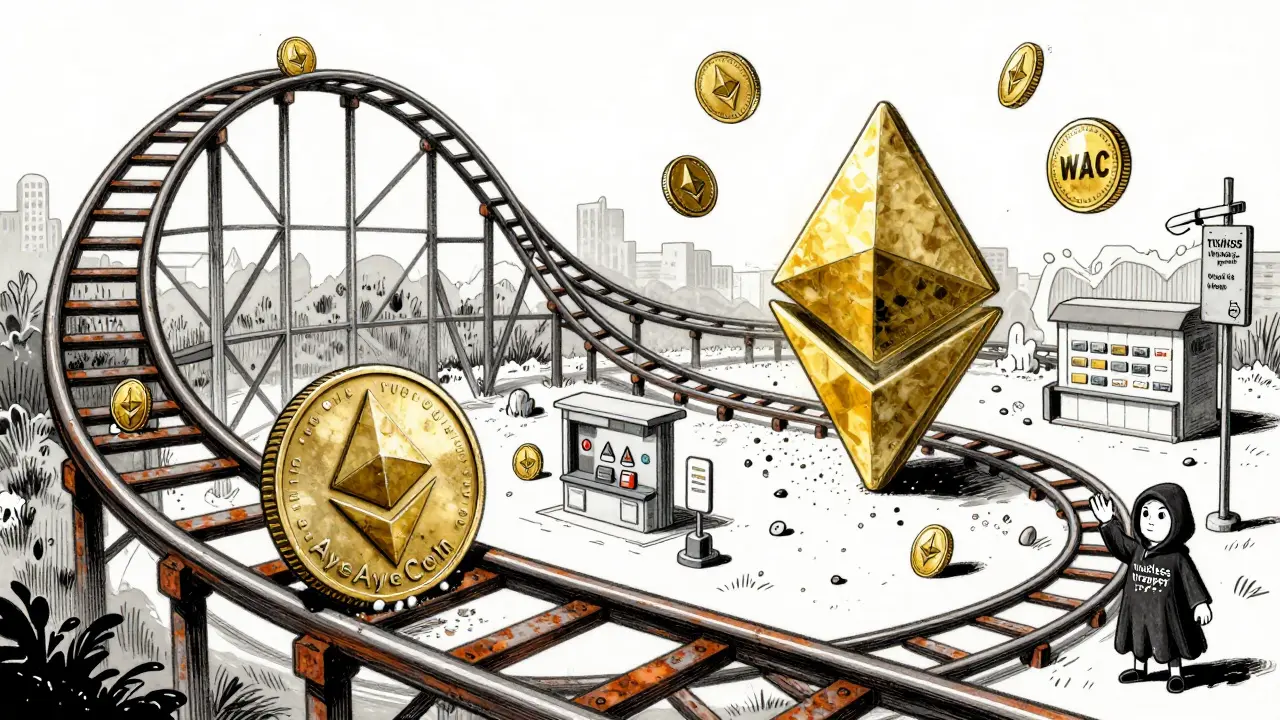
Its all-time high? $4.92 in October 2024. Today? Around $0.30. That’s an 80% drop. The coin’s price has swung from $0.14 to $4.92 in just six months. That’s not a trend. That’s gambling.
Where Can You Trade WAAC?
You won’t find WAAC on Coinbase or Kraken. It’s only on decentralized exchanges - mostly Uniswap v3 on Ethereum. The trading pair is WAAC/ETH. A few centralized platforms list it too: Binance, Bybit, MEXC, Uphold. But don’t assume liquidity means safety.
Order books are paper-thin. If you try to sell 10,000 WAAC, you’ll likely get filled at 30% below the last price. The Vol/Mkt Cap ratio is 0.024%. That means trading volume is less than 1/4000th of the total value. In normal markets, that number is over 1%. WAAC is practically frozen.
Is WAAC a Meme Coin? Or Something More?
Yes, it’s labeled a meme coin. But it’s not Dogecoin or Shiba Inu. It has no community, no influencers, no Telegram group, no marketing. There’s no team building anything. No staking. No burning. No NFTs. No utility.
Its value comes from one thing: history. It was the first meme token on Ethereum. That’s it. People collect it like vintage coins or rare Pokémon cards. The phrase "ayeAyeCoin love! One coin for you!" is its badge. If you’re into blockchain archaeology, WAAC is a relic.
Technically, it’s also a case study. The wrapper contract proves you can modernize old tokens without trust. No one had to burn the original. No one had to fork it. They just wrapped it. And that’s powerful. It’s a blueprint for how legacy tokens can survive in today’s ecosystem.
Who Should Care About WAAC?
Not investors. Not traders. Not people looking for returns.
Only three groups should pay attention:
- Blockchain historians - if you care about Ethereum’s earliest days, WAAC is a time capsule.
- Collectors - if you like owning the first of something, this is your token.
- Developers - if you’re building token bridges or wrapping protocols, WAAC’s design is a clean example of how to do it right.
Everyone else? It’s a high-risk gamble with no upside. The market is tiny. The liquidity is non-existent. And there’s zero chance of adoption beyond its current niche.
The Bigger Picture: What WAAC Teaches Us
WAAC doesn’t need to go up in price to matter. Its real value is in proving that old blockchain artifacts can be preserved - not by deleting them, but by wrapping them. It shows that decentralization isn’t just about new tech. It’s about honoring what came before.
Imagine if Bitcoin had a wrapper that let you trade it on Solana. That’s the same idea. WAAC did it for a forgotten meme coin. And it worked.
That’s why, even if WAAC’s price drops to $0.01, it’s still important. It’s not about money. It’s about memory.
Is Wrapped AyeAyeCoin (WAAC) a good investment?
No, not as an investment. WAAC has no utility, no development team, no roadmap, and almost no trading volume. Its price swings wildly because of tiny trades. It’s not a financial asset - it’s a collectible. Only buy it if you want to own a piece of Ethereum’s history, not if you expect returns.
Can I unwrap WAAC back to original AyeAyeCoin?
Yes. The wrapper contract is trustless and fully reversible. You can unwrap 1 WAAC to get exactly 1 original AyeAyeCoin at any time. The process only costs Ethereum gas fees. No one can block you. The contract code is public and immutable.
Why are prices so different across exchanges?
Because trading volume is extremely low - sometimes under $1,000 per day. With so few trades, one large buy or sell can push the price way up or down. There’s no consistent market maker, so prices don’t align. This makes WAAC unreliable for trading or arbitrage.
How many WAAC tokens are in circulation?
Exactly 6 million. The original AyeAyeCoin had a fixed supply of 6 million coins, and the wrapper maintains a 1:1 ratio. All 6 million WAAC tokens are in circulation - there are no locked or reserved coins.
Is WAAC listed on major exchanges like Coinbase?
No. WAAC is not listed on Coinbase, Kraken, or other major centralized exchanges. It’s only available on decentralized platforms like Uniswap and a few smaller centralized ones like Binance and Bybit. You’ll need a wallet like MetaMask to trade it.
What makes WAAC technically special?
WAAC is one of the first successful examples of a trustless wrapper for a pre-ERC-20 token. The original AyeAyeCoin couldn’t be traded on modern DEXs. The wrapper lets users trade it without altering the original contract. No central authority controls it. No fees beyond gas. This design is now a model for preserving legacy tokens on Ethereum.
Can WAAC be used for payments or DeFi?
No. WAAC has no integration with DeFi protocols, no staking, no yield, no liquidity pools, and no partnerships. It cannot be used for payments, lending, or any financial function. Its only use is as a collectible or speculative asset.
Is the original AyeAyeCoin still active?
The original contract still exists on the Ethereum blockchain and can be interacted with. But since the creation of WAAC, no new coins have been minted. The faucet is inactive. All trading now happens through the wrapped version. The original remains untouched - a historical artifact.
Who created Wrapped AyeAyeCoin?
The creator is anonymous. The WAAC wrapper was built by the person who rediscovered the original AyeAyeCoin in 2024. The contract was designed to be permissionless and self-sustaining. No ownership was retained. The creator has no control over the tokens or the supply.
Why hasn’t WAAC grown in popularity?
Because there’s no community, no development, and no reason to use it beyond collecting. Unlike other meme coins, WAAC doesn’t have influencers, memes, or events. Its story is historical, not viral. Without active promotion or utility, it remains a curiosity for a tiny group of blockchain enthusiasts.