DCA Frequency: Daily, Weekly, or Monthly - Which Works Best for Crypto Investors?

Mar, 19 2026
When you're investing in Bitcoin, Ethereum, or any other cryptocurrency, timing the market is a fool’s game. Prices swing wildly - up 20% in a day, down 15% the next. That’s why so many investors turn to dollar-cost averaging (DCA). Instead of trying to guess the bottom, you buy a fixed amount at regular intervals. Simple. Automatic. Effective.
But here’s the real question: should you do it daily, weekly, or monthly? There’s no one-size-fits-all answer. The best frequency isn’t the one that looks best on paper - it’s the one you can stick with for years.
What DCA Actually Does (And What It Doesn’t)
DCA doesn’t make you rich overnight. It doesn’t guarantee you’ll beat the market. What it does is remove emotion from investing. By buying the same dollar amount every time, you automatically buy more when prices are low and less when they’re high. Over time, your average cost per coin smooths out. That’s it.
Some people think daily DCA gives you the best price. Others swear by monthly. The truth? The difference in long-term returns between daily, weekly, and monthly DCA is tiny - often less than 1% over five years. What matters way more is consistency. If you skip a week because you’re “waiting for a dip,” you’re not DCAing anymore. You’re gambling.
Daily DCA: Too Much Noise, Too Little Gain
Daily DCA sounds appealing. Buy every day. Stay active. Ride every swing. But in practice, it’s a trap.
- Most brokers charge a fee per trade. Even $0.50 per transaction adds up. $150 a year on 300 trades? That’s money you could’ve kept.
- You’ll check your portfolio constantly. Every price dip feels like a crisis. Every spike feels like a missed opportunity. That’s not investing - that’s stress.
- Automated daily buys? Few platforms support it. You’ll end up manually setting it up, which defeats the purpose.
Studies show daily DCA barely outperforms monthly - and only in zero-fee environments. For most retail investors, the extra friction isn’t worth it. If you’re thinking about daily, ask yourself: are you investing, or are you day-trading in disguise?
Weekly DCA: The Sweet Spot for Some
Weekly DCA strikes a balance. You’re buying 4-5 times a month, smoothing out volatility without drowning in fees. It works best if:
- You get paid weekly
- Your broker charges $0 or under $1 per trade
- You’re disciplined and don’t obsess over daily charts
For example, if you plan to invest $400 a month, split it into $100 every Monday. That’s 52 buys a year. You’ll naturally catch both spikes and dips without overthinking. Some platforms like Coinbase, Kraken, and Binance now let you set up weekly recurring buys - no manual action needed.
But here’s the catch: if you’re the type who checks your portfolio every hour, weekly DCA can backfire. More buys = more data = more temptation to sell when prices dip. If that sounds like you, skip weekly. Go monthly.
Monthly DCA: The Default Choice for a Reason
Monthly DCA is the most popular for a reason. It’s simple, cheap, and psychologically easy.
- One transaction per month means lower fees. Even if you pay $2 per trade, that’s $24 a year - not $100+.
- Most people get paid monthly. Aligning your buy date with payday makes automation effortless.
- Less data = less noise. You’re less likely to panic-sell during a 10% drop because you’re not staring at charts every day.
Platforms like Revolut, Crypto.com, and even traditional brokers like Fidelity and Schwab support monthly recurring buys. Set it and forget it. That’s the whole point of DCA.
Research from Vanguard and Bogleheads confirms: monthly DCA performs just as well as weekly in most real-world scenarios. The minor edge weekly might have in a zero-fee environment disappears when fees, taxes, and human behavior enter the picture.
What About Lump Sums? (Yes, Even If You Got Rich Overnight)
What if you just sold your NFT collection for $50,000? Or cashed out a crypto business? Should you dump it all in now?
No. Even with a lump sum, DCA still wins. But you don’t need to stretch it over 10 months just because some study says so.
Here’s what works in practice:
- If you’re nervous - stretch it over 6 to 12 months.
- If you’re calm - 3 to 6 months is fine.
- If you’re tempted to panic - go monthly, not weekly.
The goal isn’t to “optimize” your entry. It’s to avoid selling in a panic. One investor I know took $180,000 from a crypto exit and spread it over 18 months. He didn’t get the “perfect” price - but he didn’t lose sleep either. That’s the win.

How to Pick Your Frequency
Forget theory. Look at your life.
- Check your pay schedule. If you get paid every two weeks, weekly DCA makes sense. If you’re paid monthly, stick with monthly.
- Check your broker’s fees. If each trade costs $2.50, monthly saves you $150 a year. That’s a free 0.5% return right there.
- Be honest about your behavior. Do you check your portfolio daily? Then monthly is safer. Do you ignore it for weeks? Then weekly might suit you.
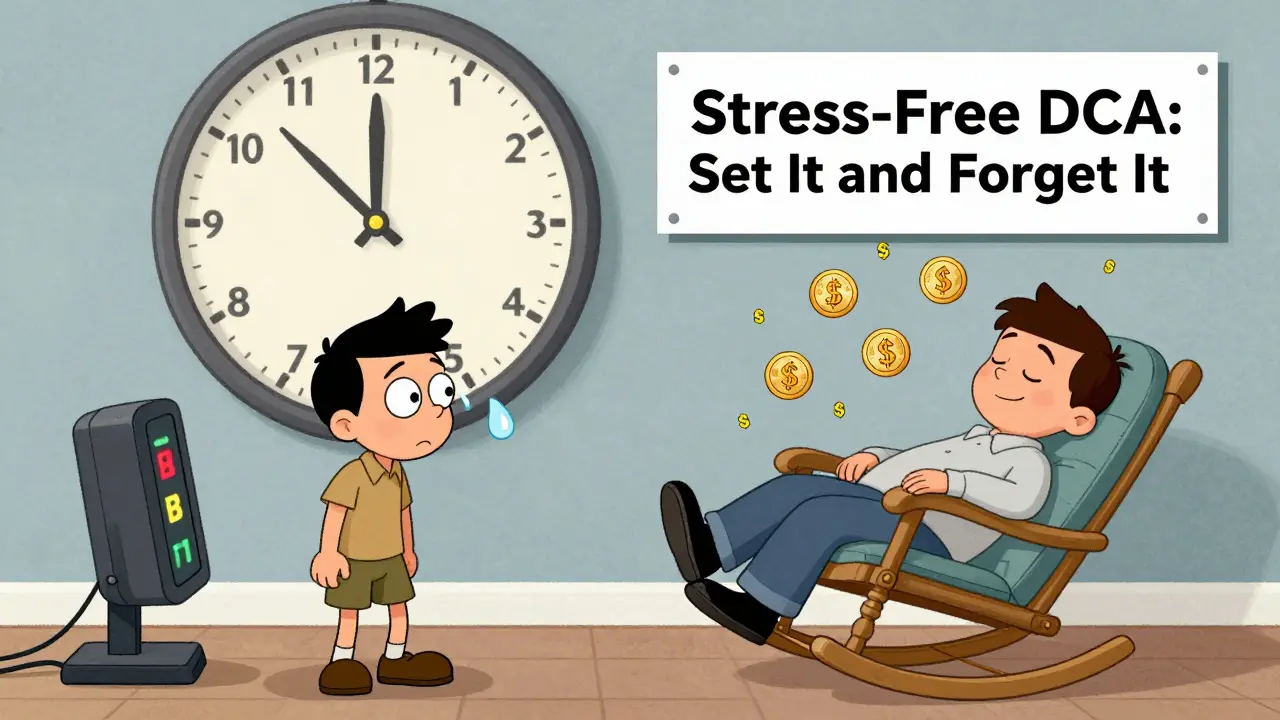
- Automate it. If you have to remember to buy, you’ll forget. Use your broker’s recurring buy feature. Set it, lock it, ignore it.
There’s no prize for buying every day. There’s no bonus for timing the bottom. The only thing that matters is showing up - regularly - over years.
Real-World Example: Two Investors, One Strategy
Meet Alex and Jamie.
Alex gets paid on the 1st and 15th of every month. They invest $200 each time - that’s $4,800 a year. They use monthly DCA. Their broker charges $1 per trade. Total fees: $24/year. They don’t check their portfolio for months. Their Bitcoin holdings grew steadily. No stress.
Jamie gets paid weekly. They invest $100 every Monday. Their broker charges $0.30 per trade. Total fees: $15.60/year. They’re disciplined. They use automation. Their portfolio is slightly smoother because they caught more price swings.
Five years later? Their returns are almost identical. Jamie’s portfolio is 0.7% higher. But Alex slept better. And Alex never missed a payment.
Who won? Both. Because they stuck to the plan.
Bottom Line: Your Frequency Should Match Your Life
DCA works because it’s simple. Not because it’s perfect.
Daily? Too much noise. Too many fees. Too easy to quit.
Weekly? Good if you’re paid weekly and your broker is cheap. Otherwise, overkill.
Monthly? The gold standard. Easy to automate. Low fees. Low stress. Works for 9 out of 10 people.
Don’t overthink it. Pick the frequency that lines up with your paycheck. Set up automation. Ignore the charts. Let time do the work.
The market doesn’t care if you buy on the 1st or the 15th. It only cares if you show up.