Factors Affecting Crypto Transaction Fees in 2025
Mar, 23 2026
Ever sent a small amount of Bitcoin and got slapped with a $15 fee? You’re not alone. In March 2025, one user on Reddit paid $15 in fees to send $50 worth of BTC during a market spike. That’s not a glitch - it’s the system working as designed. Crypto transaction fees aren’t fixed like a bank charge. They’re dynamic, unpredictable, and shaped by forces inside the blockchain itself. Understanding what drives these fees can save you hundreds a year - especially if you’re sending stablecoins, trading frequently, or running a small business that accepts crypto.
Why Crypto Fees Vary So Much
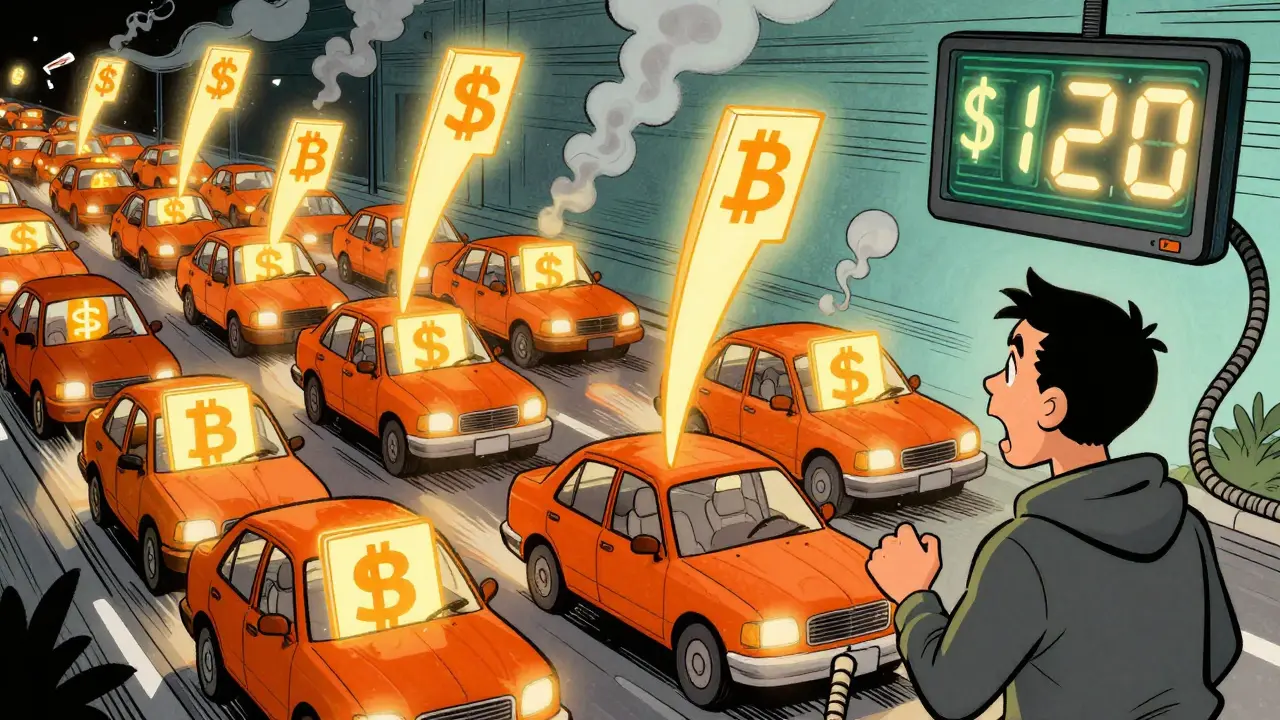
Unlike your bank, where fees are set by policy, crypto fees are decided by supply and demand on the network. Think of it like rush-hour traffic. When too many people want to send transactions at once, the network gets backed up. Miners or validators prioritize transactions that pay the most. This creates an auction. The higher your fee, the faster your transaction gets confirmed. Bitcoin, for example, measures fees in satoshi-per-byte. Each transaction has a size, measured in virtual bytes (vBytes). A simple transfer from one address to another might be 200 vBytes. But if you’re combining 15 small inputs from past transactions, that same transfer could balloon to 800 vBytes. More data = bigger fee. That’s why sending $50 from a wallet with 15 tiny UTXOs can cost more than sending $5,000 from a single large one.Network Congestion Is the Biggest Driver
According to KuCoin’s January 2025 analysis, network congestion is the #1 factor behind high fees. When Bitcoin’s mempool (the queue of unconfirmed transactions) fills up, users start bidding. During major market rallies - like the one in March 2025 - the mempool can swell to over 200,000 transactions. Fees spike from under 10 satoshi/byte to over 200 satoshi/byte. That’s a 20x increase. Ethereum’s gas system works similarly. During peak DeFi activity, gas prices jump from 10 Gwei to 100+ Gwei. If you’re swapping tokens on Uniswap or staking on Lido, you’re paying for computational work. Complex smart contracts cost more. Simple transfers? Less. But if everyone is doing it at once? Prices climb. TRM Labs’ August 2025 report confirmed that stablecoin volume hit $4 trillion between January and July 2025 - up 83% from the year before. Most of those transfers ran on Ethereum and Tron. The surge in volume directly pushed fees up on Ethereum, even though Tron’s fees stayed near $0.01.Block Size and Confirmation Speed
Bitcoin’s block size is capped at 1MB (roughly 4 million vBytes). That’s the maximum number of transactions the network can process every 10 minutes. When demand exceeds that limit, you’re forced to wait or pay more. Ethereum doesn’t have a hard block size, but it does have a gas limit per block. If the network hits that limit during high traffic, transactions pile up. Some users set their wallets to prioritize speed - paying extra to get confirmed in the next block. Others are fine waiting hours. That’s why fee estimators in wallets like MetaMask show options: “Slow,” “Average,” “Fast.” The trade-off is simple: pay more now, or wait longer. There’s no free lunch.
How Different Blockchains Handle Fees
Not all blockchains are built the same. Here’s how the major ones compare in 2025:| Network | Fee Model | Average Fee (USD) | Speed | Best For |
|---|---|---|---|---|
| Bitcoin | Byte-based (satoshi/vByte) | $1 - $20+ | 10-60 min | Large transfers, long-term value storage |
| Ethereum | Gas-based (Gwei) | $2 - $15+ | 15-120 sec | DeFi, NFTs, smart contracts |
| Tron | DPoS (fee-covered by validators) | $0.001 - $0.01 | <5 sec | Stablecoin transfers, gaming, media dApps |
| IOTA | Fee-less (no miners) | $0 | <2 sec | IoT microtransactions, machine-to-machine payments |
| Nano | Fee-less (block-lattice) | $0 | <1 sec | High-frequency, low-value payments |
| Stellar | Fixed fee (0.00001 XLM) | $0.000005 | 3-5 sec | Cross-border payments, institutional use |
Tron and IOTA dominate low-cost use cases. Tron’s Delegated Proof of Stake lets validators cover fees, so users pay almost nothing. IOTA uses a different consensus called Tangle - no miners, no validators, no fees. Every transaction confirms itself by validating two others. That’s why it’s the go-to for IoT devices sending tiny data payments.
But there’s a catch. Lower fees often mean less decentralization. Bitcoin’s fee system is designed to reward miners and secure the network. Tron’s validators are fewer in number. IOTA’s lack of fees means it doesn’t have the same economic incentive to stay secure. You’re trading security for speed.
Exchanges and Hidden Costs
Here’s where people get tripped up. Your exchange might charge a flat $1 withdrawal fee. That’s not the blockchain fee - that’s the exchange’s cut. Meanwhile, the actual Bitcoin network fee might be $3. Or $0.50. You don’t know unless you check. Trustpilot reviews from May 2025 showed 68% of negative feedback came from users surprised by hidden fees. One user withdrew ETH from Coinbase expecting $2, but got charged $12 because the network was congested and Coinbase didn’t update their estimate. Some platforms now offer fee abstraction. That means they cover your network fee so it looks “free.” But behind the scenes, they’re paying it - and building the cost into their spread or service fee. It’s a slick UX trick. Know what you’re really paying.
How to Save Money on Fees
You don’t have to overpay. Here’s how to cut your crypto fees in half:- Send during off-peak hours. Bitcoin fees are lowest Tuesday-Thursday between 02:00-08:00 UTC. Weekends? Avoid them. The March 2025 rally saw fees spike on Saturday mornings - and drop 62% on Tuesday nights.
- Use a blockchain explorer. Check Blockstream.info for Bitcoin or Etherscan for Ethereum. See the current mempool. If it’s overflowing, wait. If it’s clear, send now.
- Choose the right network. Sending USDT? Use Tron instead of Ethereum. You’ll pay $0.002 instead of $5. Sending small amounts? Nano or Stellar are nearly free.
- Consolidate inputs. If your wallet has 20 tiny UTXOs, combine them into one larger one during a low-fee window. Next time you send, it’ll be cheaper.
- Use layer-2s. For Ethereum, use Arbitrum or Polygon. Fees drop 90%. For Bitcoin, use the Lightning Network. Instant, $0.01 transfers.
Kyrrex’s February 2025 data showed users who optimized timing and network choice saved an average of 43% on fees. That’s like getting a 43% discount on every crypto transaction you make.
The Future of Crypto Fees
Stablecoin volume is growing fast. With over $300 billion in market cap and 4 trillion in annual volume, fee efficiency is now a make-or-break factor. Tron and Ethereum are winning here - not because they’re “better,” but because they’re cheaper at scale. Layer-2 solutions like Lightning Network and Arbitrum are changing the game. They move transactions off the main chain, then settle in batches. That slashes fees and speeds things up. Bitcoin’s fee problem isn’t solved - it’s bypassed. Meanwhile, IOTA and Nano are proving that fee-less blockchains aren’t just theory. They’re real. And they’re being used by factories, smart appliances, and logistics networks that need to send micro-payments every few seconds. The real winners? Users who understand the trade-offs. You can’t have low fees, high security, and instant speed all at once. But you can pick the right tool for the job.What’s Next?
If you’re sending crypto regularly, start tracking fees like you track your bank balance. Set up a simple alert: “If Bitcoin fees > $5, delay transfer.” Use a wallet that shows real-time mempool data. Switch networks when it makes sense. Don’t assume your exchange has your best interest in mind. The crypto world doesn’t charge you because it’s greedy. It charges you because the math says so. Learn the math, and you’ll never overpay again.Why are Bitcoin fees so high sometimes?
Bitcoin fees spike when too many people send transactions at once. The network can only process about 4,000 transactions per block, and blocks are mined every 10 minutes. When demand exceeds supply, users bid up fees to get their transactions confirmed faster. This happens most often during market rallies, NFT drops, or major news events. Fees can jump from $1 to $20+ in hours.
Can I avoid paying crypto transaction fees entirely?
Yes - but only on certain networks. IOTA and Nano have zero fees because they don’t use miners or validators. Tron charges less than $0.01 per transaction because validators cover the cost. Even then, you might still pay a small fee from your exchange or wallet provider. But on the blockchain itself, these networks are fee-less or nearly fee-less.
Are Ethereum fees always higher than Bitcoin?
Not always. Ethereum fees are based on computational complexity, not just data size. A simple ETH transfer might cost $2, while a complex DeFi swap could cost $15. Bitcoin fees are based on transaction size - so a simple transfer might cost $3, but a complex one with 15 inputs could cost $15. It depends on what you’re doing. For small transfers, Bitcoin is often cheaper. For smart contracts, Ethereum is unavoidable.
How do I check real-time crypto fees?
Use blockchain explorers. For Bitcoin, go to Blockstream.info or mempool.space. For Ethereum, use Etherscan.io or GasNow.org. These sites show current fee estimates, mempool size, and confirmation times. Most wallets (like MetaMask or Trust Wallet) also show fee estimators. Just don’t trust the default “Fast” option - compare it to the explorer data.
Do exchanges control crypto transaction fees?
No. Exchanges can’t control blockchain fees - those are set by the network. But they can add their own withdrawal fees. Some charge a flat $1, others charge based on network conditions. Some hide the real fee and charge you more. Always check the actual network fee using a blockchain explorer before sending. If your exchange says $3 but the explorer shows $0.50, you’re overpaying.
What’s the cheapest cryptocurrency for daily transfers?
For most people, Tron (TRX) is the cheapest for stablecoin transfers like USDT or USDC - fees are under $0.01. For non-stablecoin transfers, Nano and Stellar are nearly free. If you’re using Ethereum-based apps, consider switching to Polygon or Arbitrum - fees drop 90%. Bitcoin is only cost-effective for large, infrequent transfers.