Global Crypto Exchange Availability by Region 2025

May, 9 2025
Crypto Exchange Availability Checker
Select your region from the dropdown above to see which major exchanges are available in your area. Our tool is based on 2025 regulatory landscape and shows exchanges with 5%+ market share.
Understanding crypto exchange availability across the world is crucial for anyone who wants to trade digital assets without hitting a legal wall. In 2025 the market is booming-valued at $48.41 billion-and yet the map is anything but uniform. Below you’ll find a clear, region‑by‑region rundown, the regulatory forces shaping each market, and practical tips on picking a compliant platform.
Why Availability Varies: The Regulatory Backbone
At the heart of the split is the Regulatory framework the set of laws, licensing requirements, and enforcement bodies that govern cryptocurrency activities in a jurisdiction. Countries with clear licensing pathways (e.g., Singapore’s MAS framework) attract multiple exchanges, while places with ambiguous or hostile stances (e.g., the United States) force platforms to launch separate subsidiaries or withdraw entirely.
Key regulators that repeatedly show up in the news include the U.S. Securities and Exchange Commission (SEC), the Department of Justice (DOJ), and the Treasury’s Financial Crimes Enforcement Network (FinCEN). Europe’s MiCA package, Asia‑Pacific’s varying national approaches, and emerging standards in Africa also play decisive roles.
North America: A Patchwork of Restrictions
The United States exemplifies a high‑risk environment. After a $4 billion settlement in 2023, Binance the world’s largest centralized crypto exchange by volume committed to a phased exit, spawning Binance.US as a distinct, compliance‑focused entity. Similar splits exist for Turkey (Binance.TR) and South Korea (Binance.KR).
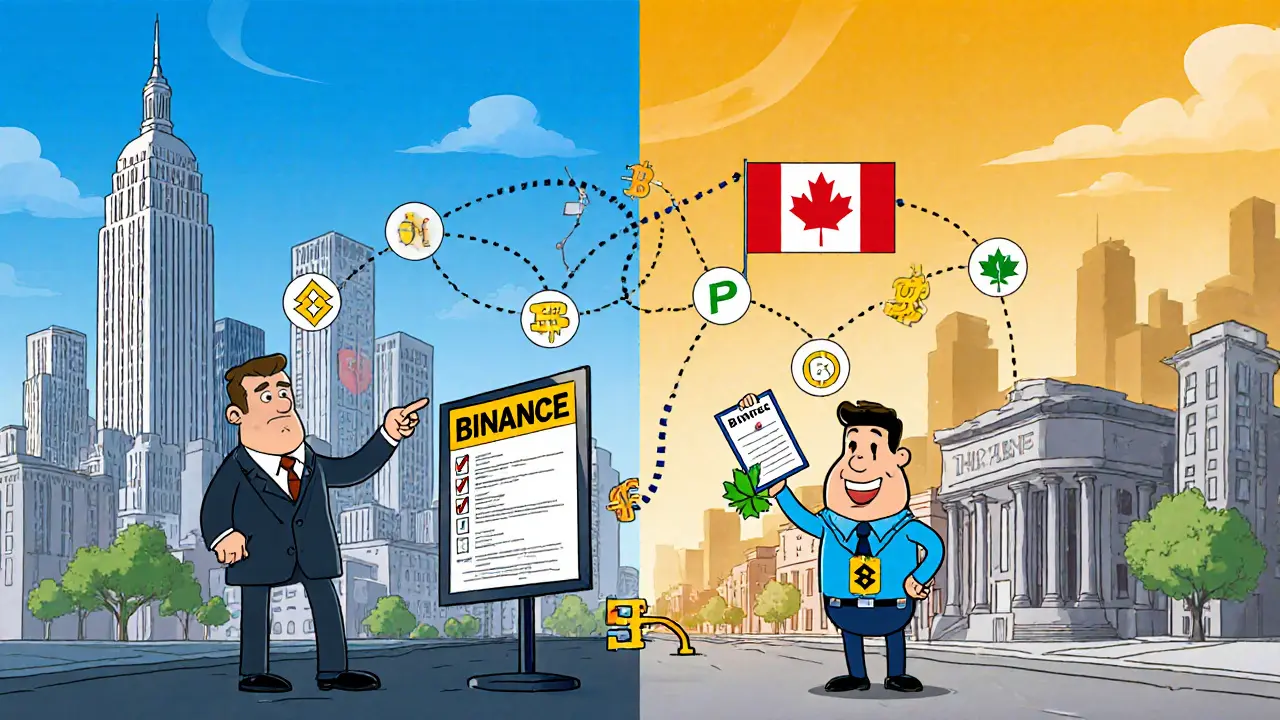
Canada, by contrast, offers a friendlier climate. The Canadian Securities Administrators (CSA) have approved a handful of platforms, including Bitget a top‑5 global exchange with a 7.2% market share, which operates under a registered money services business (MSB) licence.
Europe: Moving Toward Unified Rules
Europe is transitioning from a fragmented scene to a more coordinated one thanks to the Markets in Crypto‑Assets Regulation (MiCA). While the rule is still being fine‑tuned, many EU nations already host a healthy mix of exchanges. Gate.io the second‑largest exchange with a 9% market share has secured licenses in Malta and Estonia, giving users in Germany, France, and the Netherlands access via a single EU‑compliant platform.
Eastern Europe shows unusually high adoption. Ukraine leads the 2025 Global Crypto Adoption Index, driving demand for local services. While the country lacks a formal licensing regime, exchanges like MEXC an 8.6% market‑share exchange known for Asian market strength have launched Ukrainian‑specific onboarding flows.
Asia‑Pacific: The Hotbed of Volume
Asia remains the world’s most active crypto region. Singapore’s clear licensing, overseen by the Monetary Authority of Singapore (MAS), attracts global players. Both Binance and Gate.io operate full‑service platforms there.
South Korea, despite strict “real‑name” verification rules, hosts thriving local versions of major exchanges. Binance.KR complies with the Financial Services Commission (FSC) and offers KRW pairs.
Vietnam’s recent approval of a sandbox for crypto services has opened doors for newer entrants, while Hong Kong SAR continues its “light‑touch” stance, permitting both spot and derivatives trading.
Middle East & North Africa (MENA): Growth Amid Instability
Countries with economic volatility, such as Yemen (ranked 12th in crypto adoption) and Jordan (4th), see heightened demand for border‑less finance. However, regulatory clarity varies. The United Arab Emirates (UAE) introduced a federal crypto licence in 2023, drawing platforms like Bitget to launch dedicated UAE entities.
In contrast, Saudi Arabia still prohibits most retail crypto activities, limiting exchange availability to institutional gateway services.
Africa: Emerging Frontiers
Africa’s crypto story is driven by limited banking access. Nigeria, Kenya, and South Africa are leading adoption hubs. While Nigeria’s central bank bans direct crypto payments, it tolerates peer‑to‑peer trading, prompting exchanges like Binance to operate a “Binance Nigeria” portal with strict KYC but no fiat on‑ramps.
South Africa’s Financial Sector Conduct Authority (FSCA) issued a regulatory framework in 2022, allowing fully licensed exchanges to operate, which has attracted regional subsidiaries of Gate.io and MEXC.
Latin America: Crypto as a Hedge
Economic uncertainty in Venezuela, Argentina, and Brazil fuels crypto usage. While Venezuela (9th in adoption) faces sanctions, exchanges still offer spot trading via offshore platforms. Brazil’s central bank introduced a regulatory sandbox, and local exchange Bitget secured a licence, making it a go‑to for Brazilian traders.

Quick Reference: Regional Exchange Landscape (2025)
| Region | Top Exchanges (≥5% market share) | Regulatory Tone | Key Access Notes |
|---|---|---|---|
| North America (US) | Binance.US, Coinbase, Kraken | Restrictive - SEC, FinCEN scrutiny | Separate US entities required; strict KYC |
| North America (Canada) | Bitget, Binance, Kraken | Supportive - MSB licences | Full fiat on‑ramps available |
| Europe (EU) | Gate.io, Binance, MEXC | Transitioning - MiCA coming | Cross‑border licences accepted |
| Eastern Europe | MEXC, Gate.io | Mixed - high adoption, limited licensing | Spot trading widely available |
| Asia‑Pacific | Binance, Gate.io, Bitget | Varied - Singapore supportive, South Korea strict | Local fiat pairs offered where permitted |
| MENA | Bitget, Binance | Fragmented - UAE licensing, Saudi restrictions | Often crypto‑only, limited fiat |
| Africa | Binance, MEXC | Developing - Nigeria bans fiat, SA licenses | Peer‑to‑peer focus, limited on‑ramps |
| Latin America | Bitget, Binance | Growing - Brazil sandbox, Venezuela sanctions | Spot trading dominant, fiat limited |
How to Choose a Compliant Exchange for Your Region
- Check licensing. Look for a clear licence number from the local regulator (e.g., MAS, FCA, or local MSB). If an exchange lists multiple regional entities, verify the one that matches your country.
- Confirm fiat on‑ramps. Not all platforms support local bank transfers. For instance, Binance in Nigeria only offers crypto‑to‑crypto routes.
- Assess KYC depth. Higher‑risk jurisdictions demand extensive ID verification, which can affect privacy‑focused users.
- Review withdrawal limits. Some regions impose caps on daily crypto‑to‑bank withdrawals.
- Monitor regulatory news. A settlement like Binance’s $4 billion US deal can change availability overnight.
Future Outlook: 2026‑2032
Projections show the global crypto exchange market surging to $122.63 billion by 2032, but the growth will be uneven. Countries that codify clear licensing (e.g., Singapore, Switzerland, the UAE) will likely host a denser ecosystem of both centralized and decentralized services. Meanwhile, regions stuck in regulatory limbo may see a rise of decentralized finance (DeFi) protocols that skirt traditional licences.
Innovation trends-mobile‑first apps, AI‑driven trade analytics, biometric authentication-are already flattening entry barriers, but they will still need to sit on top of compliant foundations. Users should keep an eye on emerging “crypto‑friendly” jurisdictions like Lithuania and Malta for early‑access opportunities.
Takeaway Checklist
- Identify your country’s regulatory stance (supportive, mixed, restrictive).
- Pick a top‑ranked exchange that operates a local subsidiary.
- Verify licence details and KYC requirements before signing up.
- Confirm fiat on‑ramp options for deposits/withdrawals.
- Stay updated on news-settlements and new licences can shift availability quickly.
Can I use Binance in the United States?
No direct Binance.com service is available to U.S. residents. Binance operates a separate platform called Binance.US that complies with SEC and FinCEN rules. Access is limited to U.S. citizens and residents who pass stringent KYC.
Which exchanges are most reliable in Europe?
Gate.io, Binance, and MEXC have secured licenses in EU‑friendly jurisdictions like Malta and Estonia, making them widely accessible throughout the European Economic Area.
Do African users need a local exchange?
Not necessarily. Many global platforms (e.g., Binance, MEXC) offer crypto‑only portals that work without a local licence, but fiat on‑ramps are often limited to peer‑to‑peer transfers.
What should I watch for before signing up for a new exchange?
Check the regulator’s licence number, KYC depth, fiat deposit/withdrawal options, and recent news about enforcement actions. A quick licence‑lookup on the regulator’s website can save you headaches later.
Will decentralized exchanges replace regional restrictions?
DeFi platforms sidestep many licensing rules, but they face their own risks-smart‑contract bugs, lack of recourse, and sometimes AML scrutiny. Expect both models to coexist for the foreseeable future.


