How DPRK Hackers Use Cross-Chain Crypto Laundering to Evade Detection
Feb, 13 2026
When North Korean hackers steal billions in cryptocurrency, they don’t just vanish with the cash. They cross-chain it - hopping between blockchains, swapping tokens, and flooding networks with transactions to vanish into thin air. This isn’t science fiction. It’s happening right now, and it’s changing how the world tracks crime in digital money.
Why Cross-Chain Laundering Works
Blockchain is supposed to be transparent. Every transaction leaves a public trail. But that’s exactly why hackers started using multiple chains - to turn transparency into confusion.
Imagine stealing $100 million in Ethereum. If you try to cash out on one chain, exchanges freeze the address. So instead, the hackers send it to Tron, then to Bitcoin, then to BitTorrent Chain, then back to Ethereum - each time converting it into a different token. Each swap breaks the trail. Each chain has its own rules, its own monitoring tools, and its own blind spots. By the time analysts catch up on one chain, the money’s already moved ten steps ahead.
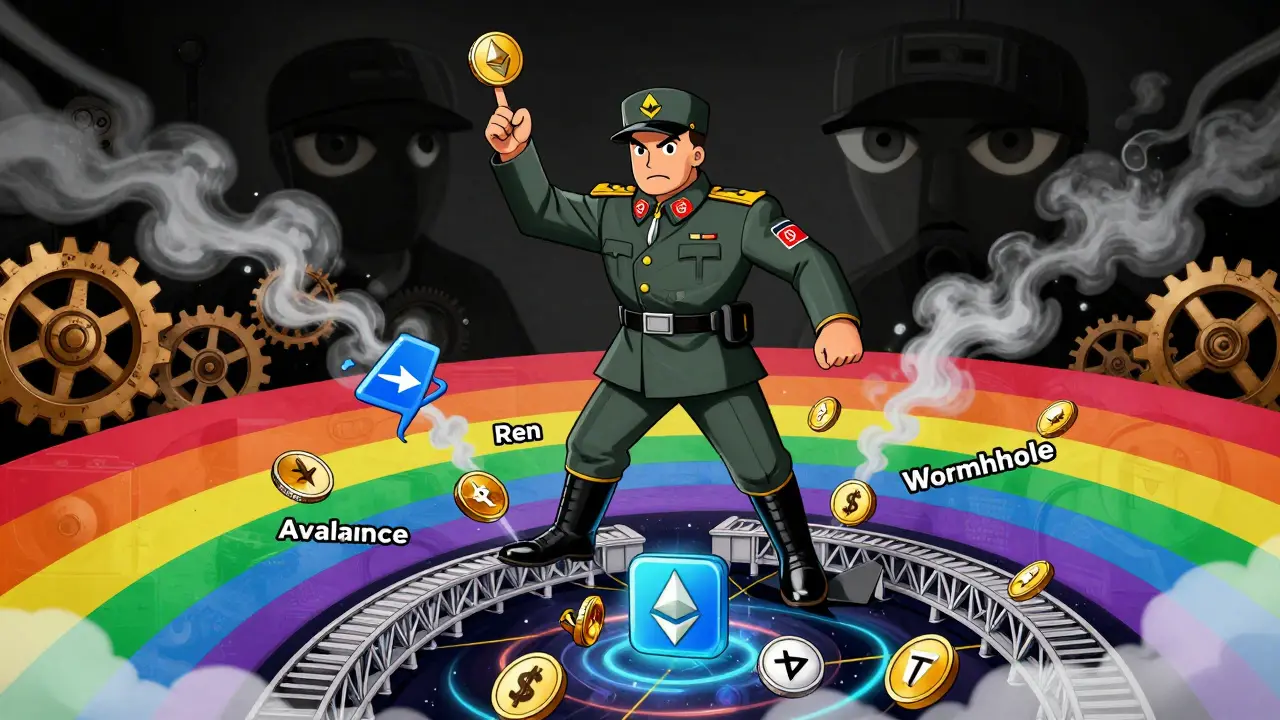
This is called "chain-hopping." And since 2023, it’s become the standard tactic for the Lazarus Group - the hacking unit tied directly to North Korea’s military intelligence agency. According to TRM Labs, over 9,500 BTC have been moved through the Avalanche Bridge alone. That’s not a glitch. It’s a strategy.
The Evolution: From Mixers to Multi-Chain Chaos
A few years ago, hackers relied on mixers - services like Tornado Cash that shuffled coins around to hide their origin. But governments cracked down. Tornado Cash was sanctioned. Mixers got shut down. So North Korea adapted.
Instead of hiding one transaction, they now create hundreds. Elliptic found that cross-chain bridge usage surged 111% in 2023, with DPRK-linked groups responsible for the majority. They don’t just use one bridge. They use Ren Bridge, Avalanche Bridge, Wormhole, and others - often in sequence. Each bridge has different oversight. Some are decentralized. Some are poorly monitored. Some don’t even log user identities.
And it’s not just about bridges. Hackers now create their own tokens - fake assets issued on obscure blockchains with no analytics coverage. They deposit stolen funds into these tokens, trade them back and forth, then convert them into Bitcoin. The trail? Gone.
TRM Labs calls this "asset-hopping." And it’s more effective than any mixer ever was.
The Bybit Heist: A New Benchmark
In February 2025, hackers stole over $1.5 billion from Bybit - the largest crypto heist in history. The attack wasn’t just big. It was perfectly executed.
Here’s how it unfolded:
- Stolen Ethereum was immediately converted into TRC-20 tokens on Tron.
- Those tokens were swapped to native Tron (TRX), then sent to the Avalanche Bridge.
- From Avalanche, funds were converted into Bitcoin.
- Simultaneously, smaller amounts were routed through BitTorrent Chain and Solana to confuse investigators.
- Over 200 separate transactions occurred within 48 hours.
This wasn’t random. It was a "flood the zone" tactic, according to Nick Carlsen of TRM Labs. The goal wasn’t to hide one transaction. It was to drown analysts in noise. By the time one chain was traced, the next was already moving. Exchanges couldn’t freeze all the addresses. Law enforcement couldn’t keep up.
And here’s the chilling part: most of the Bitcoin hasn’t been cashed out yet. It’s sitting still. Why? Because the hackers are waiting - not to spend, but to move again. They’re preparing for a massive, coordinated liquidation through over-the-counter (OTC) desks, where identities are rarely checked.

Who’s Behind It? The Lazarus Group and the 3rd Bureau
The FBI officially linked the Bybit breach to a subgroup called "TraderTraitor," part of the DPRK’s 3rd Bureau of the Reconnaissance General Bureau. This isn’t a gang of lone hackers. It’s a state-funded operation with resources, training, and strategic backing.
Since 2017, North Korea has stolen over $3 billion in crypto. In 2023, it was $660 million. In 2024, it jumped to $1.34 billion. In 2025, it’s already over $2 billion. That’s not growth. That’s escalation.
And it’s not just about money. A UN report confirmed that North Korea’s nuclear weapons program is largely funded by cybercrime. Every stolen Bitcoin, every laundered Ethereum, every converted token helps pay for missiles, warheads, and delivery systems. This isn’t a cybercrime problem. It’s a national security threat.
The New Attack Surface: You, Not the Exchange
Here’s what most people don’t realize: the biggest vulnerability isn’t the exchange. It’s you.
Since 2025, DPRK hackers have shifted from attacking platforms to attacking people. They send fake job offers to crypto investors. They impersonate customer support on Twitter. They hack social media accounts to trick users into signing malicious transactions. Once they get a private key, they drain the wallet - then send the funds across five blockchains before the victim even notices.
Elliptic says it best: "The weak point in cryptocurrency security is now human, not technological."
High-net-worth individuals, crypto executives, even small-time traders with wallets linked to social media - they’re all targets. And they’re often the ones with the least security.

How Analysts Are Fighting Back
Blockchain analytics firms aren’t sitting still. TRM Labs launched TRM Phoenix in 2022 - the first tool that automatically traces funds across chains. Chainalysis, Elliptic, and others now share threat intelligence in real time. When one firm spots a suspicious wallet, it’s flagged across the entire industry.
The FBI has published lists of known DPRK-linked Bitcoin addresses. Exchanges freeze them. But the hackers adapt. They create new wallets. They use privacy coins. They exploit chains with no compliance rules.
It’s a race. And right now, the hackers are ahead.
What This Means for the Future
The scale of DPRK’s operations is changing global finance. The Bybit heist alone was bigger than all of North Korea’s 2023 thefts combined. The money isn’t disappearing - it’s being stockpiled. Someday, it will flood markets, crashing prices, destabilizing exchanges, and triggering regulatory crackdowns.
And until governments and blockchain firms work together like one system - not isolated silos - this will keep getting worse.
Every time a new cross-chain bridge launches, it’s a potential loophole. Every time a new blockchain gains popularity, it’s a new hiding spot. And every time a hacker learns to exploit human behavior, the threat grows.
This isn’t just about crypto. It’s about who controls money in the digital age. And right now, North Korea is winning.
How do DPRK hackers move crypto across blockchains?
They use cross-chain bridges like Avalanche Bridge and Ren Bridge to swap tokens between networks. For example, stolen Ethereum is converted to Tron tokens, then sent to Bitcoin via a bridge. Each swap breaks the transaction trail. They also create fake tokens on obscure blockchains to further obscure the origin.
Why did North Korea stop using crypto mixers?
Mixers like Tornado Cash were shut down or sanctioned by governments. As enforcement increased, DPRK hackers shifted to cross-chain bridges because they’re harder to regulate, more decentralized, and allow faster movement of funds across multiple networks.
Is the Lazarus Group still active in 2026?
Yes. The Lazarus Group remains active and has escalated its operations. In 2025 alone, they stole over $2 billion in cryptocurrency, according to Elliptic. Their attacks now target both exchanges and individuals, using social engineering as much as code exploits.
How does cross-chain laundering fund North Korea’s weapons program?
A UN report confirmed that North Korea’s weapons development is heavily funded by cybercrime. Over 50% of its foreign currency earnings come from crypto theft and laundering. The stolen funds are converted into Bitcoin and held in offline wallets, then used to purchase materials and technology for missile and nuclear programs.
Can blockchain analytics firms track DPRK hackers?
They can track some activity, but it’s increasingly difficult. DPRK hackers now use obscure blockchains, create custom tokens, and flood networks with transactions to overwhelm analysts. Tools like TRM Phoenix help trace cross-chain flows, but the speed and volume of attacks often outpace detection.
What can regular crypto users do to protect themselves?
Avoid linking your crypto wallet to social media. Use hardware wallets. Never click on unsolicited links or respond to job offers promising crypto earnings. Enable multi-factor authentication everywhere. Most attacks now target people - not systems. Your behavior is your first line of defense.