How Seed Phrases Generate Private Keys: The Technical Process Explained
Jun, 2 2026
Imagine holding a single piece of paper with twelve words written on it. That scrap of paper is the master key to your entire digital fortune. It isn't just one password; it is the blueprint for thousands of unique addresses and transactions across multiple blockchains. This concept sounds like magic, but it is actually pure mathematics and cryptography. Understanding how seed phrases generate private keys is not just for developers-it is essential for anyone who wants to truly own their crypto assets.
If you have ever set up a wallet like MetaMask or Trezor, you’ve seen these words. But have you ever wondered how 'apple', 'banana', and 'cat' turn into complex hexadecimal strings that control Bitcoin or Ethereum? The answer lies in a standard called BIP-39 and a system known as Hierarchical Deterministic (HD) wallets. Let’s break down exactly what happens behind the scenes when you type those words into your device.
The Foundation: Entropy and Checksums
Before we get to the words themselves, we need to talk about randomness. In cryptography, this randomness is called entropy. When you create a new wallet, your software generates a random number-usually between 128 and 256 bits long. This number is the true source of your security. If the randomness is weak, your wallet is vulnerable. Humans are terrible at generating random numbers, which is why wallets use hardware-based random number generators instead of asking you to pick words yourself.
Once the entropy is generated, the system adds a safety net called a checksum. Think of a checksum like the check digit on a credit card number. If you mistype one digit, the bank knows immediately. Similarly, the wallet takes your random entropy, runs it through a hashing algorithm called SHA-256, and takes the first few bits of the result. For a 12-word phrase, it takes 4 bits. For a 24-word phrase, it takes 8 bits. These bits are appended to the end of your original entropy. This step ensures that if you make a small error when writing down your phrase later, the wallet can detect it.
| Entropy Bits | Checksum Bits | Total Bits | Number of Words | Security Level |
|---|---|---|---|---|
| 128 | 4 | 132 | 12 | 128-bit (Standard) |
| 256 | 8 | 264 | 24 | 256-bit (Maximum) |
From Bits to Words: The BIP-39 Wordlist
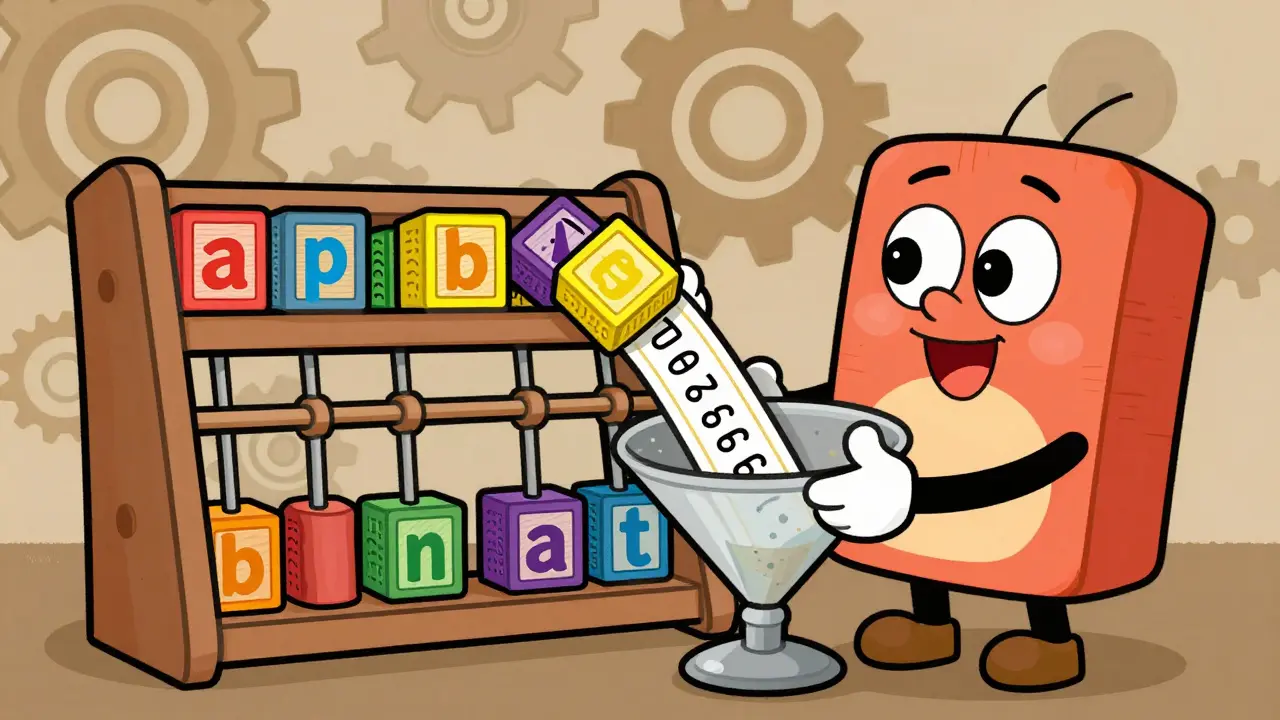
Now we have a string of binary data (ones and zeros). Computers love binary, but humans do not. Reading a 256-character hex string is prone to errors. To solve this, the Bitcoin community created BIP-39. This proposal defines a specific list of 2,048 easy-to-pronounce English words. Every word in the list has an index number from 0 to 2,047.
The process is simple math. Your combined entropy and checksum are split into chunks of 11 bits each. Why 11 bits? Because 2 to the power of 11 equals 2,048. Each 11-bit chunk corresponds to exactly one word in the BIP-39 list. For example, if your first 11 bits translate to the number 0, your first word is 'abandon'. If they translate to 1, it's 'ability'. This continues until all bits are converted into words. This is why a 12-word phrase always has 12 words-it’s a direct translation of your mathematical seed into human language.
This design offers built-in error correction. Since the first four letters of every word in the BIP-39 list are unique, you don’t even need to write the full word. Writing 'aband' instead of 'abandon' still works because no other word starts with those letters. This reduces the chance of transcription errors significantly compared to raw hexadecimal keys.
Deriving the Master Key: PBKDF2 and HMAC-SHA512
You now have your mnemonic phrase (the words). But these words aren't the private key yet. They are the input for a key derivation function. When you enter your seed phrase into a wallet, it doesn't just look up the words again. It processes them through a cryptographic function called PBKDF2 (Password-Based Key Derivation Function 2).
Here is where things get interesting. PBKDF2 uses HMAC-SHA512 to stretch your mnemonic into a 512-bit seed. It does this by repeating the hashing process thousands of times (specifically 2,048 iterations). This slowness is intentional. It makes brute-force attacks computationally expensive. If someone steals your seed phrase, they can't quickly guess a password you might have added (more on that in a moment) because the computer has to work hard to verify each attempt.
The output of this process is a 512-bit seed. This seed is the root of your entire wallet ecosystem. It is often referred to as the 'master seed.' From this single point, every private key you will ever use is derived. This is the core principle of deterministic wallets: the same input always produces the same output. If you enter the same seed phrase into any compliant wallet, you will get the exact same master seed, and thus the exact same private keys.
Hierarchical Deterministic (HD) Wallets: One Seed, Infinite Keys
This is where the real magic happens. Before HD wallets (defined by BIP-32), every time you wanted a new address, you had to generate a new random private key and back it up separately. Losing one key meant losing that portion of your funds forever. Managing hundreds of keys was a nightmare.
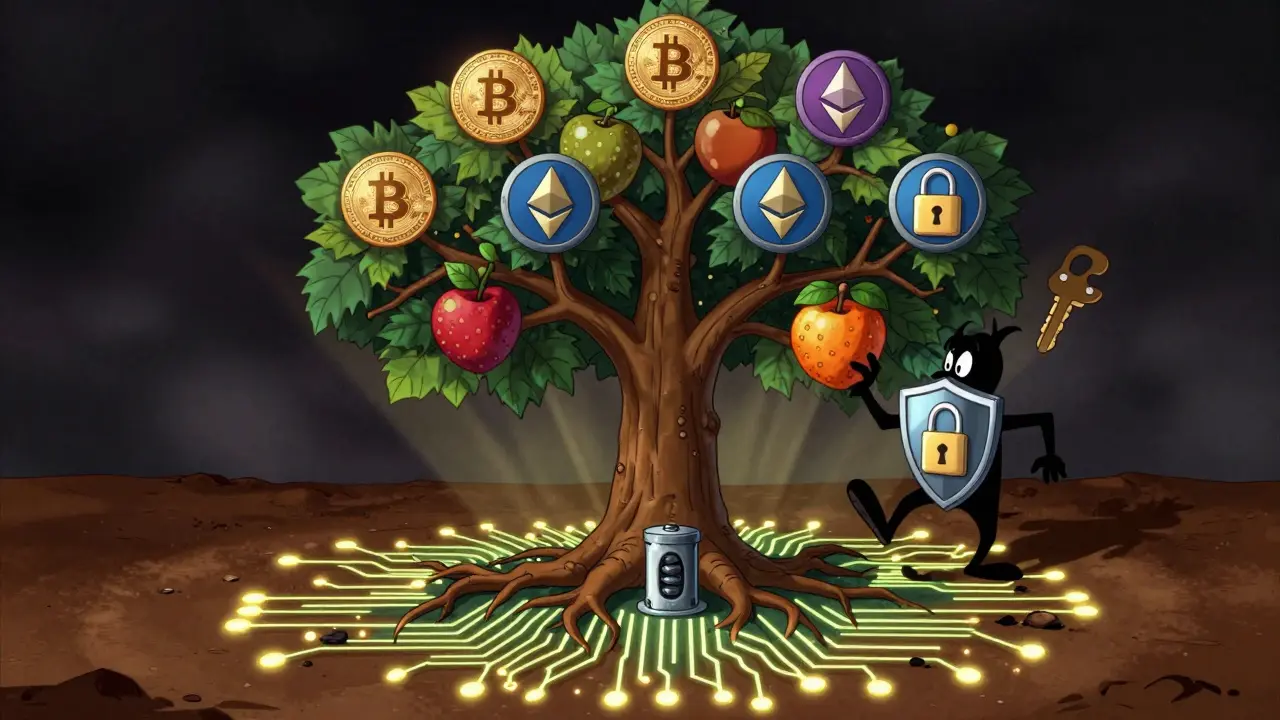
HD wallets solve this by creating a tree structure. Your 512-bit master seed is split into two parts: a master private key and a chain code. Using these two components, the wallet can derive a child private key. That child key can then derive its own children, and so on, infinitely. This creates a hierarchical tree of keys.
Each branch in this tree is identified by a path, such as m/44'/0'/0'/0/0. This path tells the wallet which cryptocurrency to use and which account/address to generate. For example, in Ethereum wallets like MetaMask, the path typically follows BIP-44 standards. The '44'' indicates a multi-currency wallet, '60'' is the coin type for Ethereum, and the subsequent numbers define the account and address index. This means your single 12-word phrase can manage Bitcoin, Ethereum, Litecoin, and dozens of other coins simultaneously, without needing separate backups for each.
Seed Phrases vs. Private Keys: What’s the Difference?
It is crucial to distinguish between a seed phrase and a private key. A private key is a single 256-bit number that controls one specific blockchain address. It is usually represented as a 64-character hexadecimal string. If you lose it, you lose access to that specific address only. You cannot derive other keys from it.
A seed phrase, on the other hand, is the parent of all your private keys. It is more powerful but also riskier. If someone gets your private key, they steal one address. If someone gets your seed phrase, they steal everything-all past, present, and future addresses derived from that seed. This is why security experts often say the seed phrase *is* the wallet. Protecting it is paramount.
Another key difference is usability. Private keys are fragile. A single character error renders them useless. Seed phrases are robust. Thanks to the checksum and the wordlist design, minor errors are often caught or corrected. However, both require careful handling. Never share either with anyone.
Security Risks and Best Practices
While the cryptography behind seed phrases is solid, human behavior is not. According to reports from security firms like Trail of Bits, the majority of crypto losses due to theft stem from poor seed phrase management, not cryptographic breaks. Here are some critical pitfalls to avoid:
- Digital Storage: Never save your seed phrase in a text file, email, cloud note, or screenshot. If your device is hacked, your funds are gone. Keep it offline.
- Human-Generated Phrases: Do not pick your own words. As mentioned earlier, humans are bad at randomness. Use the wallet's generation tool.
- Physical Damage: Paper burns. Water destroys ink. Consider metal backup solutions designed to withstand fire and corrosion.
- Social Engineering: Support staff will never ask for your seed phrase. Any website or person asking for it is trying to steal your funds.
For maximum security, consider using a passphrase. BIP-39 allows you to add an extra word or phrase after your 12 or 24 words. This acts as a second layer of encryption. Even if someone finds your physical seed phrase, they won't be able to access your funds without knowing the additional passphrase. Just remember, if you forget the passphrase, there is no recovery option. It is effectively a hidden vault door.
The Future of Seed Phrases
As technology evolves, so do the methods for managing keys. Recent developments like BIP-85 allow for the deterministic derivation of multiple seed phrases from a single master seed. This means you could have a main backup that generates separate recovery phrases for different purposes (e.g., one for daily spending, one for long-term savings) without needing to store multiple pieces of paper.
Additionally, Shamir's Secret Sharing is gaining traction. This method splits your seed phrase into multiple parts (shards). You might need 3 out of 5 shards to reconstruct the key. This eliminates the single point of failure-if one shard is lost or stolen, your funds remain safe. By 2026, many new wallets are expected to support these advanced features, making self-custody easier and more secure for everyday users.
Understanding how seed phrases generate private keys empowers you to take true control of your finances. It transforms a scary list of words into a logical, mathematical system you can trust. Remember, the strength of the system relies entirely on your ability to keep the seed secret and safe.
Can I change my seed phrase after creating a wallet?
No, you cannot change the seed phrase associated with an existing wallet's history. The seed phrase deterministically generates your private keys and addresses. If you want a new seed phrase, you must create a brand new wallet and transfer your funds to the new addresses. Always verify the new wallet works before sending large amounts.
Is a 12-word seed phrase less secure than a 24-word one?
Not significantly. A 12-word phrase provides 128 bits of security, which is considered cryptographically unbreakable with current technology. A 24-word phrase offers 256 bits of security, which is even stronger but arguably overkill for most users. The choice often depends on personal preference and the specific wallet's default settings. Both are safe if stored correctly.
What happens if I make a mistake when entering my seed phrase?
Most modern wallets will reject the phrase immediately if the checksum fails, indicating an error. If you enter a wrong word that somehow passes the checksum (rare), the wallet will generate a different set of private keys. You will see an empty wallet with zero balance. Do not panic; simply re-enter the correct words from your backup.
Do all cryptocurrencies use the same seed phrase standard?
Do all cryptocurrencies use the same seed phrase standard?
Most major cryptocurrencies, including Bitcoin, Ethereum, and Litecoin, follow the BIP-39 standard for seed phrases. However, some older or niche wallets may use proprietary formats. Always ensure your wallet supports BIP-39/BIP-44 compatibility if you plan to use it with multiple assets. Checking the wallet's documentation is recommended.
Can I use a seed phrase to recover a wallet on a different device?
Yes, this is the primary purpose of seed phrases. You can restore your wallet on any compatible device or software by entering the same seed phrase. The new device will regenerate the exact same private keys and addresses, giving you access to your funds. Ensure the new device is secure before proceeding.