How to Protect Your Seed Phrase from Physical Theft: Essential Security Steps for Crypto Owners
Jan, 10 2026
Imagine waking up to find your home broken into. Your laptop is gone. Your phone is missing. And your seed phrase-written on a sticky note in your desk drawer-vanished with them. That’s not a horror movie. It’s what happened to over 63% of crypto users who lost access to their funds in 2024, according to BitcoinTalk forum data. The thief didn’t hack your wallet. They just walked out the front door with your recovery words. And once they have those, your Bitcoin, Ethereum, or any other crypto? Gone forever. No reset button. No customer service line. No chance to get it back.
Why Your Seed Phrase Is the Most Important Thing You Own
Your seed phrase isn’t a password. It’s not a PIN. It’s the master key to your entire crypto life. It’s a sequence of 12 or 24 words-like fog squat hidden engineer morning print piano thumb cactus rain olive curate-that can rebuild your wallet from scratch. Every crypto wallet you’ve ever used, from MetaMask to Ledger, relies on this phrase. It’s generated using the BIP-39 standard, a system created in 2013 to turn complex cryptographic keys into something humans can write down and remember.But here’s the brutal truth: if someone gets your seed phrase, they own your crypto. No matter how fancy your wallet app is, no matter how strong your password is, if your 12 words are exposed, you’re already compromised. And physical theft is the #1 cause of loss-not hacking, not phishing, not malware. It’s someone breaking into your house, your office, your safe, or even your car and finding your backup.
Why Paper Backups Are a Disaster Waiting to Happen
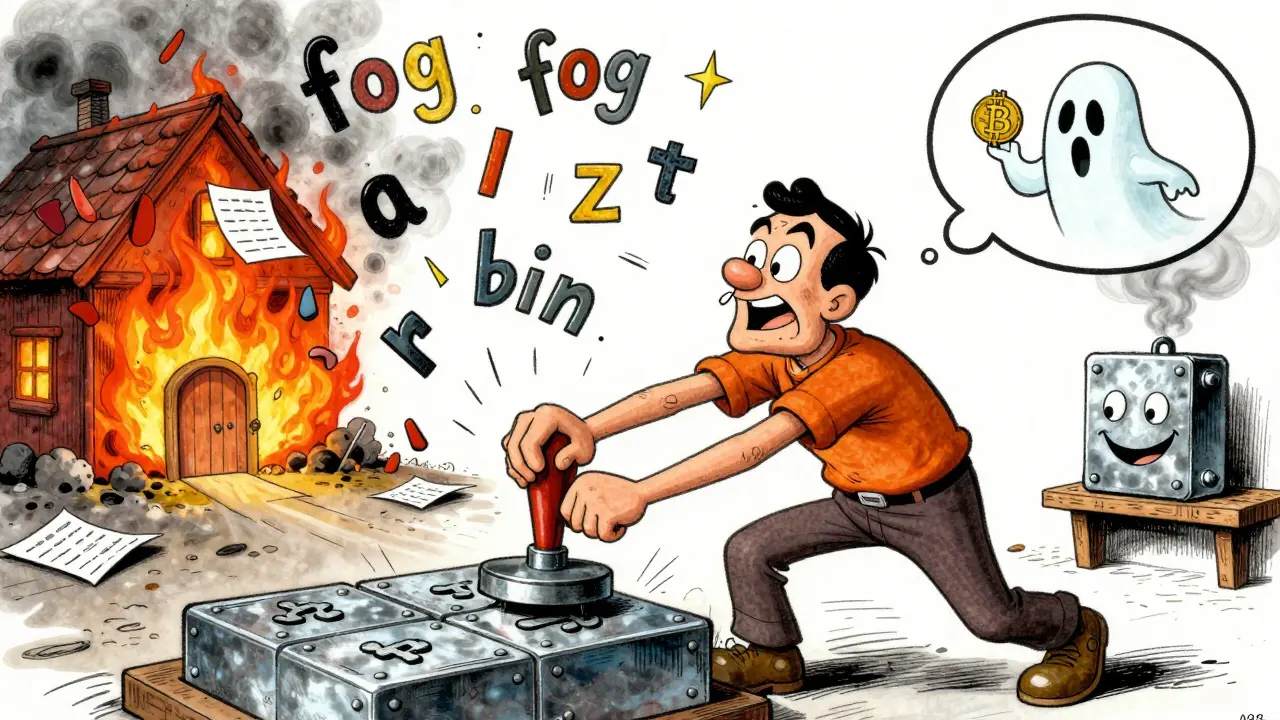
Most people start by writing their seed phrase on paper. It’s easy. It’s free. And it’s dangerously wrong.Standard printer ink fades. In just 18 months, under normal lighting and humidity, the words can become unreadable. Humidity? Smudges. Heat? Curling. A coffee spill? Done. A house fire? Paper burns at 451°F. Most home safes only survive up to 1,200°F for 30 minutes. UL’s 2024 fire testing showed that 43% of paper backups are destroyed in fires-even if the safe holds.
And what about theft? A sticky note on your desk? A scrap in your wallet? A photo saved on your phone? These aren’t backups. They’re invitations. Reddit user u/Hodl4Lyfe lost $42,000 in a house fire because their paper backup burned. Their metal backup? Survived. No one else in their building had one.
Metal Backups: The Only Physical Storage That Survives
If you’re serious about protecting your seed phrase, you need metal. Not plastic. Not paper. Not a USB drive. Metal.Products like Cryptosteel, Billfodl, and CryptoSteel are made from stainless steel or titanium. They’re designed to survive:
- Temperatures up to 2,500°F
- Submersion in water for weeks
- Being crushed or buried
- Exposure to salt, acid, or extreme weather
Each letter is stamped by hand using individual steel tiles. You assemble your 12 or 24 words one character at a time. It takes 30 to 45 minutes the first time-and 68% of users make at least one mistake on their first try, according to Vault12’s 2024 usability study. That’s why you must test it. Write it down on paper first. Verify the order. Then transfer it to metal. Then verify again. Then verify once more.
Cost? Around $130. That’s less than a month’s subscription to Netflix. And it’s the difference between losing everything and keeping your life’s savings.
Don’t Put It in a Bank Vault
A lot of people think, “I’ll just lock it in a safe deposit box.” That sounds smart. Until the bank freezes your account during an audit. Or the government seizes it. Or you die and your heirs can’t prove it’s yours.The SEC’s February 2024 guidance confirmed that 12% of crypto asset seizures in the past year came from safe deposit boxes. Banks aren’t crypto-friendly. They’re financial institutions. If they suspect illegal activity-even if you’re innocent-they can lock you out for months. One Reddit user lost $85,000 in crypto because their box was frozen during a routine audit. They never got access back.
Physical security isn’t about hiding. It’s about controlling. And banks don’t give you control. They give you a key to a room they own.
Shamir’s Secret Sharing: Split Your Seed, Not Your Risk
What if you could split your seed phrase into 5 pieces, and only need 3 of them to rebuild your wallet? That’s Shamir’s Secret Sharing (SSS). It’s not sci-fi. It’s built into Trezor and Ledger wallets now.Instead of storing one copy of your seed phrase, you create 5 shares. You give one to a trusted friend. One to your sibling. One you keep at work. One you bury in your backyard (in a waterproof metal case). One you keep in your wallet. To recover your funds, you need any 3. No single point of failure. No single thief can steal everything.
But here’s the catch: only 28% of users implement it correctly, according to ACM’s April 2024 study. If you mess up the math, you lose access forever. You need to use a trusted tool-like Trezor’s built-in SSS generator-and follow the steps exactly. Don’t guess. Don’t improvise. Use the software. Test it on a wallet with $10 in it first.
Passphrase Protection: The Secret Layer Most People Ignore
Your seed phrase is your master key. But what if you had a second key? That’s a passphrase-a hidden 13th or 25th word (or more) you add on top of your seed phrase. It’s optional. It’s not stored anywhere. You have to remember it.Here’s how it works: your seed phrase + your passphrase = a completely different wallet. Same seed. Different funds. So if someone steals your metal backup, they still can’t access your main wallet unless they know your passphrase.
Trezor’s firmware 2.5.1 (August 2024) shows that a 20-character passphrase adds 10^30 extra possibilities to brute-force attacks. That’s more combinations than stars in the observable universe. And it’s free. No extra hardware. No extra cost.
Reddit user u/CryptoSaver88 used this exact trick. When their Ledger was stolen, the thief got the seed phrase-but couldn’t access the main wallet because the passphrase was never written down. The thief walked away with nothing. The user kept $220,000.
But here’s the risk: if you forget your passphrase? Gone. Forever. No recovery. That’s why 17% of wallet failures in 2024 were due to forgotten passphrases, according to Bitcoin Wiki. Write it down? No. Memorize it. Or store it separately-like in a password manager, not on the same device as your seed phrase.
Where to Store Your Backups: Geography Matters
Don’t keep all your backups in one city. Not even in one house.Harvard’s Center for Internet and Society recommends storing copies at least 50 miles apart. Why? Natural disasters. Fires. Floods. Earthquakes. If you live in Wellington, New Zealand, and you store all your backups in your apartment, a major quake could wipe them all out. Japan’s earthquake culture explains why 89% of Japanese crypto users use metal backups in multiple locations. The US? Only 32% do.
Best practice:
- One copy: metal backup in your home (hidden, not obvious)
- One copy: metal backup at a friend’s house (someone you trust, not a family member)
- One copy: metal backup in a safety deposit box (if you must, but never as your only copy)
- One copy: encrypted digital backup on a separate offline device (not your phone or laptop)
And never, ever take a photo of it. Never email it. Never upload it. Cloud storage? 92% of wallet breaches in 2023-2024 came from cloud-stored seed phrases, according to Bitcoin Core’s security advisory.
Annual Checkups: Your Backup Isn’t Set and Forget
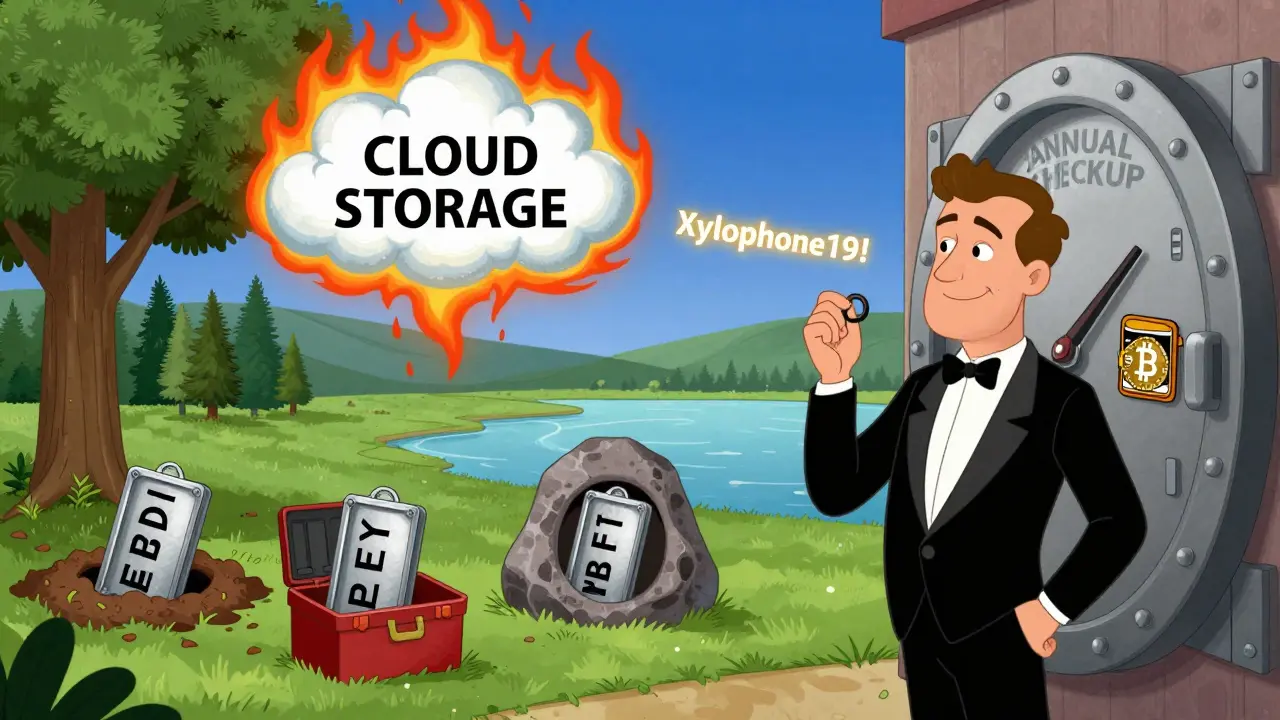
You don’t check your smoke alarm once and forget it. Your seed phrase backup needs the same attention.Every year, do this:
- Retrieve one backup copy
- Restore it to a new wallet (use a test wallet with $10, not your main one)
- Verify all your funds are there
- Check for corrosion, fading, or damage
- Update any damaged copies
Wallet providers like Ledger, Trezor, and Klever all say the same thing: test your backup. 100% of them require it. And yet, only 40% of users do it. Don’t be one of them.
What Not to Do
Here’s a quick list of deadly mistakes:- Don’t store your seed phrase on your phone, laptop, or cloud drive
- Don’t write it on paper without metal backup
- Don’t keep all copies in one location
- Don’t use a bank safe deposit box as your primary storage
- Don’t share your seed phrase with anyone-even your partner or parent
- Don’t assume your hardware wallet is safe if you haven’t backed up the seed phrase separately
Final Reality Check
You don’t need to be a tech expert to protect your seed phrase. You just need to be careful. And consistent. The tools exist. The knowledge is public. The cost is low. The risk is extreme.Hardware wallets cost $79-$199. Metal backups cost $130. Shamir’s Secret Sharing is free. Passphrases are free. Annual checks take 20 minutes.
Compare that to losing $10,000. $100,000. $1 million.
Your seed phrase is your crypto life. Treat it like your passport. Your birth certificate. Your last will. Because it’s all of those things, rolled into one. And if you lose it? There’s no second chance.
Can I store my seed phrase on a USB drive?
No. USB drives are vulnerable to malware, corruption, and physical damage. Even if you keep it offline, if your computer gets infected, the file can be copied without you knowing. Seed phrases should only be stored as physical, human-readable backups-on metal or engraved material. Digital copies, even encrypted ones, increase risk.
What happens if I lose one part of my Shamir’s Secret Sharing shares?
If you lose one share but still have the required number (e.g., you have 3 out of 5 shares), you can still recover your wallet. But if you lose more than the threshold (e.g., you only have 2 out of 5 when you need 3), you cannot recover your funds. Always keep at least one extra share in a secure, separate location.
Is a hardware wallet enough to protect my seed phrase?
No. A hardware wallet protects your private keys from online attacks, but if someone steals the device and knows your PIN, they can access your funds. The seed phrase is the real key. Always write it down on metal and store it separately from the device. Never let your hardware wallet be your only backup.
Can I use a password manager to store my seed phrase?
Only if you use it for your passphrase, not your seed phrase. Storing your seed phrase in a password manager connects it to your digital life-and that’s a risk. If your password manager is hacked, your crypto is gone. Seed phrases should be stored offline, physically. Password managers are fine for complex passphrases, but never for the core 12 or 24 words.
How do I verify my seed phrase backup actually works?
Restore it to a new wallet using a trusted app like Electrum, Ledger Live, or Trezor Suite. Send $10 worth of crypto to the new wallet. Then, use your backup to recover it. If the $10 appears, your backup works. If not, you made a mistake. Do this test every year, and always before storing your backup long-term.