MDEX Crypto Exchange Review: Is It Worth Your Time in 2026?
Sep, 22 2026
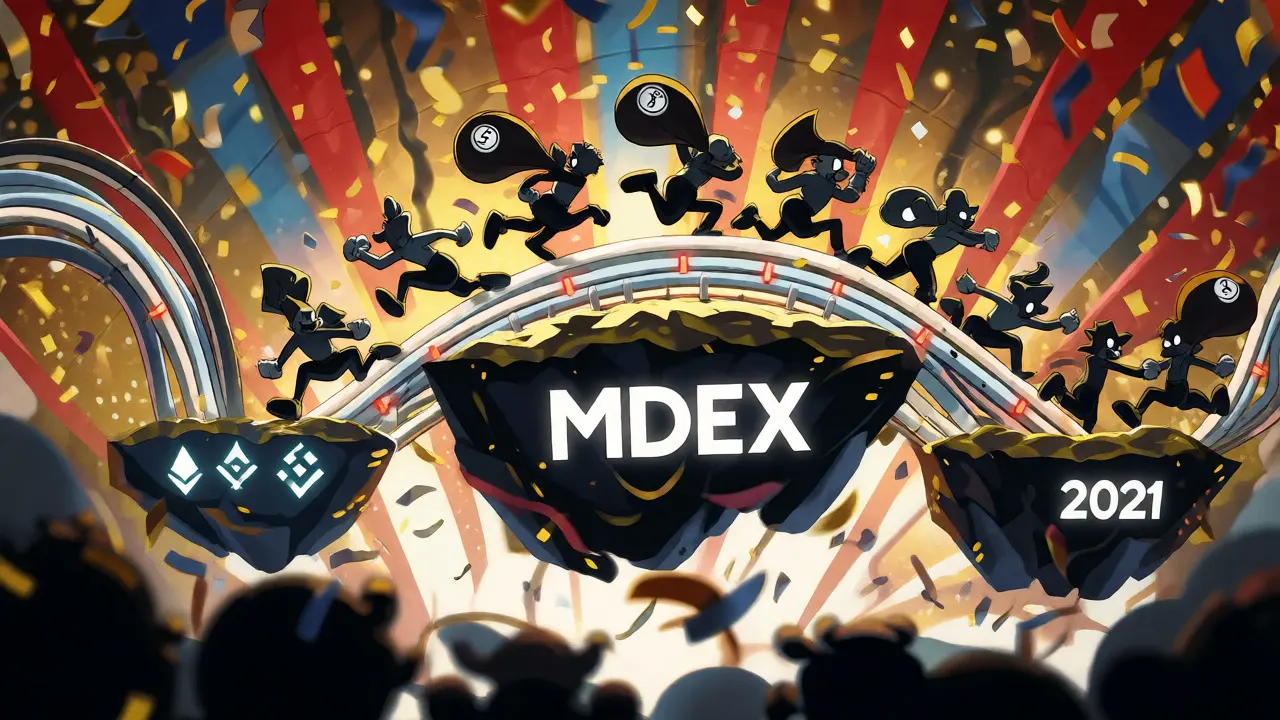
Imagine checking your portfolio and seeing a MDEX decentralized exchange (DEX) protocol that facilitates cross-chain transactions across Binance Smart Chain, Huobi Ecological Chain, and Ethereum. You remember the hype from 2021, when TVL hit billions. But today? The numbers tell a different story. If you are looking for an active, high-volume trading platform, MDEX might not be it. However, if you are digging into DeFi history or holding legacy assets, understanding its current state is crucial.
This review cuts through the noise. We will look at what MDEX actually offers now, why its volume has collapsed, and whether the "dual mining" promise still holds water. Spoiler alert: the landscape has changed drastically since its peak.
What Exactly Is MDEX?
MDEX is a multi-chain automated market maker (AMM) protocol. Unlike centralized exchanges like Binance or Coinbase, MDEX operates via smart contracts on three specific blockchains: Binance Smart Chain (BSC), Huobi Ecological Chain (HECO), and Ethereum. It launched in January 2021 as part of the Huobi ecosystem, aiming to solve liquidity fragmentation by allowing users to trade assets across these chains seamlessly.
The core idea was clever. Instead of forcing users to bridge assets manually every time they wanted to swap tokens on a different chain, MDEX introduced the MDEX Bridge a cross-chain interoperability tool connecting HECO, ETH, and BSC networks. This allowed for unified liquidity pools. For a brief moment, this made MDEX a top-tier competitor against giants like Uniswap and PancakeSwap.
The Dual Mining Mechanism: Promise vs. Reality
Why did people flock to MDEX initially? The answer lies in its incentive structure, known as "Dual Mining." This system rewarded two groups simultaneously:
- Liquidity Providers (LPs): Users who deposited assets into pools earned rewards.
- Transaction Miners: Users who traded frequently received additional incentives.
The economic model allocated 66% of daily transaction fees toward purchasing Huobi Token (HT) and burning MDX tokens. Specifically, 70% went to buying HT and 30% to burning MDX. The logic was sound: buy pressure on HT supports the broader Huobi ecosystem, while burning MDX reduces supply, theoretically increasing its value. In early 2021, this worked. Total Value Locked (TVL) soared to approximately $3.4 billion. Traders loved the low fees compared to Ethereum mainnet.
But here is the catch. High inflationary rewards often lead to sell pressure. As more LPs joined to farm yields, the circulating supply of MDX increased rapidly. When the bull market cooled, so did the demand for yield farming. Without constant new capital inflows, the token price struggled to maintain stability.
Current Market Status: A Stark Contrast
If you check CoinCodex data for September 2026, the picture is sobering. MDEX currently ranks around 240th among all cryptocurrency exchanges. Its daily trading volume hovers near $11,480. That is a fraction of what it handled during its glory days. Compare this to industry leaders like Uniswap or PancakeSwap, which process hundreds of millions daily, and the gap becomes obvious.
| Metric | 2021 Peak (Approx.) | September 2026 Status |
|---|---|---|
| Total Value Locked (TVL) | $3.4 Billion | Negligible / Not Prominently Listed |
| Daily Trading Volume | Hundreds of Millions USD | ~$11,480 USD |
| Exchange Ranking | Top 10 DEX | ~240th Overall |
| MDX Token Price | ~$10.00 (ATH) | ~$0.001 - $0.01 Range* |
*Note: Token prices fluctuate; verify with live charts before trading.
The decline isn't just about volume. It reflects a broader shift in DeFi user behavior. Traders moved toward platforms with better user interfaces, deeper liquidity, and stronger security audits. MDEX failed to retain its community effectively. BitCourier’s analysis notes that raising a dedicated community remains a daunting task for MDEX, especially when competitors offer superior developer experiences.

Security Concerns and Scam Warnings
This is where things get tricky. While the original MDEX protocol was legitimate, the brand name has been targeted by scammers. Some reviews explicitly label certain MDEX-related websites as scams using fake domains to steal cryptocurrency. Always double-check the URL. The official protocol interacts via standard wallets like MetaMask, TokenPocket, and Math Wallet.
Be wary of any site promising guaranteed returns or asking you to connect your wallet to claim unexpected airdrops. These are common tactics used by phishing sites mimicking popular DeFi protocols. Since MDEX’s activity has slowed, fewer eyes are watching for these impersonators, making vigilance essential.
User Experience and Interface
For those who still use MDEX, the interface is functional but dated. Connecting a wallet is straightforward-standard DeFi procedure. Swapping tokens works smoothly if liquidity exists for your pair. However, slippage can be high due to lower volume. If you try to trade a large amount of an obscure token, you might move the price significantly against yourself.
The platform supports over 100 trading pairs, mostly focused on BEP-20 tokens on BSC and HRC-20 tokens on HECO. If you are looking for exotic altcoins, you might find them here. But for major caps like BTC or ETH, centralized exchanges or larger DEXs offer better execution quality.
Should You Use MDEX in 2026?
Let’s be direct. For most traders, MDEX is no longer a primary choice. Here is who might still consider it:
- Legacy Holders: If you already hold MDX or assets locked in MDEX pools from previous years, managing those positions might require using the platform.
- HECO Chain Users: If you are specifically working within the Huobi Ecological Chain ecosystem, MDEX remains one of the few viable DEX options there.
- Speculators: If you believe in a massive revival of the Huobi ecosystem, buying MDX at rock-bottom prices could be a high-risk, high-reward bet.
For everyone else, alternatives like PancakeSwap on BSC or Uniswap on Ethereum provide better liquidity, more robust communities, and frequent updates. The opportunity cost of dealing with lower liquidity and potential slippage usually outweighs any minor fee savings.
Final Verdict
MDEX was a pioneer in cross-chain DeFi, proving that multi-chain interoperability was possible. Its dual mining model created excitement and initial growth. However, it failed to sustain momentum in a fiercely competitive market. Today, it serves more as a niche utility for HECO chain users rather than a mainstream trading hub.
If you are starting fresh in DeFi, look elsewhere. If you are cleaning up old portfolios, keep an eye on security warnings and treat MDEX with caution. The technology is solid, but the market has moved on.
Is MDEX safe to use?
The original MDEX protocol is generally considered safe as it uses audited smart contracts. However, beware of scam websites using similar names. Always verify the URL and ensure you are interacting with the official contract addresses on the blockchain explorer.
Does MDEX support Bitcoin?
Yes, but typically as wrapped versions like WBTC on Ethereum or BTCB on Binance Smart Chain. You cannot deposit native Bitcoin directly onto the BSC or HECO chains without bridging first.
What wallets work with MDEX?
MDEX supports standard Web3 wallets including MetaMask, TokenPocket, Huobi Wallet, Math Wallet, ONTO, and Bitkeep. Ensure your wallet is configured for the correct network (BSC, HECO, or Ethereum).
Why is MDEX trading volume so low?
Low volume results from intense competition from larger DEXs like Uniswap and PancakeSwap, a decline in HECO chain popularity, and reduced interest in yield farming strategies that originally drove traffic to MDEX.
Can I still earn rewards on MDEX?
You can, but rewards are significantly lower than during the 2021 boom. Liquidity providers may still earn fees and occasional MDX emissions, but annual percentage rates (APRs) are modest compared to newer incentivized protocols.