Opnx Crypto Exchange Review: Why It Failed and What Happened to OX Token
May, 21 2026
You might be searching for Opnx crypto exchange reviews because you hold OX tokens, or perhaps you stumbled upon the name while researching controversial figures in the crypto space. Here is the hard truth right away: OPNX is dead. The platform permanently shut down on February 14, 2024. If you are looking to deposit funds, trade assets, or open an account, you cannot do it anymore. The doors are closed, the servers are offline, and the experiment has ended.
This isn't just another failed startup story. OPNX was built by Su Zhu and Kyle Davies, the co-founders of Three Arrows Capital (3AC), the hedge fund that collapsed in 2022 after losing billions of dollars. Their attempt to create a marketplace for trading bankruptcy claims from other failed crypto companies-like FTX and Celsius-was ambitious, technically complex, and ultimately unsustainable. This review breaks down what OPNX actually did, why it failed so quickly, and what this means for anyone holding its native tokens today.
What Was OPNX? Understanding the Bankruptcy Claims Market
To understand why OPNX existed, you have to look at the chaos following the collapse of major crypto firms in late 2022. When platforms like FTX, Celsius, and BlockFi went bankrupt, creditors were left waiting. In traditional bankruptcy law, these "claims"-your right to a portion of the recovered assets-are illiquid. You can’t easily sell them. You have to wait years for a judge to decide how much money comes back, if any.
OPNX was a specialized cryptocurrency exchange designed to tokenize and trade bankruptcy claims as financial derivatives. The idea was simple on paper: allow creditors to sell their claims immediately at a market price rather than waiting for a lengthy legal process. If you owed $10,000 from FTX, you could theoretically sell that claim on OPNX for maybe $2,000 cash today, letting someone else gamble on whether they’d get more later.
This created a secondary market for debt. It was a niche product targeting a very specific pain point: liquidity for distressed assets. However, executing this required sophisticated legal frameworks, robust valuation models for uncertain recoveries, and significant trust-all things OPNX struggled to provide.
The Founders: A Trust Deficit That Never Went Away
In the world of finance, reputation is everything. For OPNX, reputation was its biggest liability. The platform was founded by Su Zhu and Kyle Davies. These names are synonymous with failure in the crypto industry due to the implosion of Three Arrows Capital (3AC). 3AC borrowed heavily against volatile assets and collapsed when Bitcoin prices dropped, leaving partners and creditors with massive losses.
Industry experts viewed OPNX with extreme skepticism from day one. How could two individuals who lost billions in client funds suddenly build a trusted platform for handling other people’s legal claims? Financial analysts noted that the target audience for OPNX-creditors of failed exchanges-were already burned by bad actors. Asking them to trust Su Zhu and Kyle Davies again was a steep hill to climb.
Furthermore, Mark Lamb served as the CEO of OPNX. He was previously associated with CoinFLEX, another platform that faced severe legal challenges in Hong Kong. Creditors alleged that the transition from CoinFLEX to OPNX was unauthorized and chaotic. This added another layer of legal risk and confusion, deterring institutional players and serious retail investors alike.
Performance Data: Why the Numbers Don’t Lie
If you want to know if a crypto exchange is viable, look at the volume. Volume indicates liquidity, interest, and utility. OPNX’s numbers were abysmal.
| Exchange | Daily Avg. Volume (Est.) | Status | Primary Use Case |
|---|---|---|---|
| Binance | $10B+ | Active | Spot/Futures Trading |
| Coinbase | $1B+ | Active | Spot Trading |
| OPNX | $624k (Total Peak) | Defunct | Bankruptcy Claims |
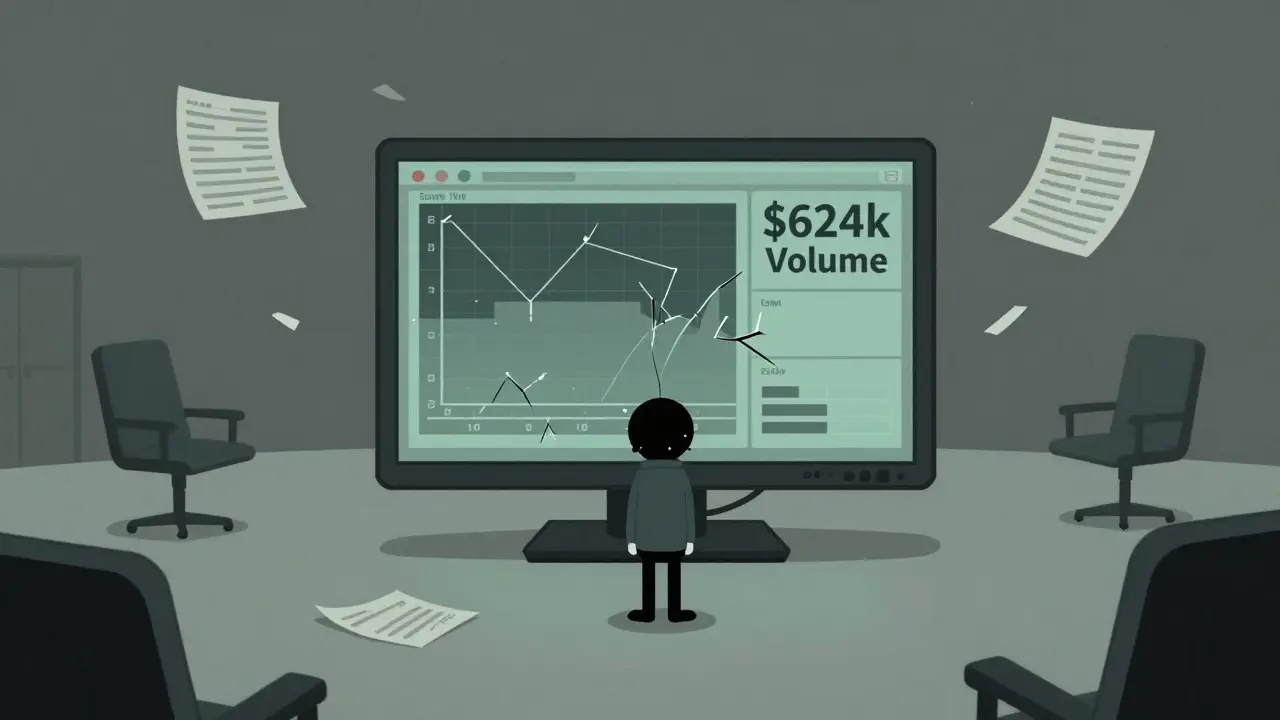
According to data tracked by CoinGecko, OPNX’s trading volume peaked at just $624,093 throughout its entire operational life. To put that in perspective, Binance processes billions daily. On its launch day, OPNX executed less than two dollars worth of trades. This lack of liquidity was a death spiral. Without buyers, sellers couldn’t exit. Without sellers, buyers had nothing to buy. The market simply didn’t exist in the way the founders hoped.
User Experience and Technical Limitations
Even if you ignored the reputation issues, using OPNX was difficult. The platform lacked the polished user interface and intuitive design found on mainstream exchanges. Trading bankruptcy claims isn’t like buying Bitcoin; it requires understanding complex legal outcomes, recovery probabilities, and derivative pricing.
Users reported a steep learning curve. There were minimal educational resources to help newcomers understand how to value a claim from a defunct company. The verification process was also cumbersome, requiring extensive documentation to prove ownership of claims. Unlike standard KYC (Know Your Customer) checks, this involved proving your standing in foreign bankruptcy proceedings-a nightmare for most retail users.
Additionally, OPNX did not offer mobile applications. In 2023 and 2024, expecting users to trade exclusively via desktop browsers was a major barrier to entry. Customer support was limited, leaving many users confused about the status of their accounts and tokens as the platform wound down.
The Shutdown and the OX.Fun Pivot
On February 7, 2024, OPNX halted all trading. Withdrawals remained open until the final closure on February 14, 2024. The official reason cited by Su Zhu was that FTX announced full customer repayments, which he claimed eliminated the need for a claims trading market. While partially true, this ignored the existence of other ongoing bankruptcies. Most observers believed the shutdown was due to the platform’s inability to generate revenue or attract users.
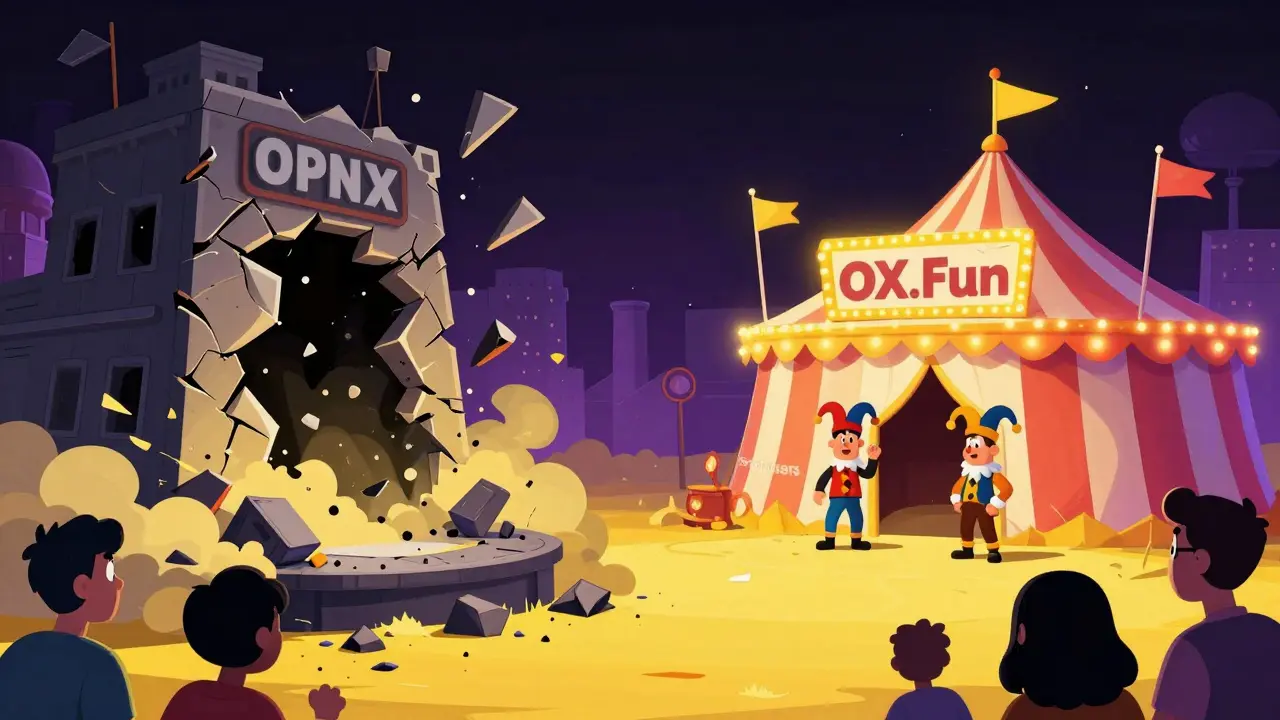
Following the closure, the founders pivoted to promoting a new entity called OX.Fun. This platform focused on derivatives trading centered around the OX token. OX.Fun saw higher volumes initially, reaching nearly $39 million in January 2024, but settled into modest levels. Crucially, Su Zhu and Davies listed themselves only as "advisers" to OX.Fun, distancing themselves legally from direct operations. This shift raised red flags for regulators and investors concerned about accountability.
What Happens to OX Tokens Now?
If you hold OX tokens, you likely have questions about their value. Since OPNX is closed, the original utility of the token-governance and fees on the claims exchange-is gone. The OX token continues to trade on various decentralized and centralized exchanges, including Uniswap, Gate.io, BingX, Bitget, MEXC, and Poloniex.
However, without a functioning primary platform, the token’s long-term viability is questionable. Its value now depends entirely on speculation and the success of the unrelated OX.Fun derivatives platform. Investors should exercise extreme caution. The token lacks fundamental backing from a active ecosystem, making it highly volatile and risky.
Lessons from the OPNX Failure
The rise and fall of OPNX offers critical lessons for the crypto industry:
- Niche markets need liquidity: Even a brilliant idea fails if no one wants to trade it. Bankruptcy claims are too complex and illiquid for a broad audience.
- Reputation matters: Past failures haunt future ventures. Trust is hard to rebuild once broken.
- Regulatory clarity is essential: Operating in gray areas of securities law and bankruptcy regulation creates existential risks.
- User experience drives adoption: Complex products require simple interfaces. OPNX failed to bridge this gap.
For users, the takeaway is clear: research thoroughly before engaging with new platforms, especially those led by controversial figures. Look for transparent leadership, strong regulatory compliance, and proven track records. Do not chase novelty over stability.
Is OPNX still operational in 2026?
No, OPNX permanently shut down on February 14, 2024. All trading ceased, and the platform is no longer accessible for new registrations or transactions.
Who founded OPNX?
OPNX was founded by Su Zhu and Kyle Davies, the former co-founders of the collapsed hedge fund Three Arrows Capital (3AC). Mark Lamb served as CEO.
What happened to my OX tokens after OPNX closed?
OX tokens continue to trade on various exchanges like Uniswap and Gate.io. However, their original utility on the OPNX platform is void. Their value is now speculative and tied to the separate OX.Fun derivatives project.
Why did OPNX fail?
OPNX failed due to extremely low trading volume, lack of user trust in its controversial founders, complex user experience, and insufficient demand for trading bankruptcy claims.
Is OX.Fun the same as OPNX?
No, OX.Fun is a separate derivatives exchange launched after OPNX’s closure. While the same founders act as advisers, it is a distinct entity focusing on futures trading rather than bankruptcy claims.
Can I still withdraw funds from OPNX?
Withdrawals were allowed until February 14, 2024. After this date, the platform was fully decommissioned, and no further withdrawals are possible through the OPNX interface.