Bitrus Crypto Exchange Review: Is It Safe or a Scam?
May, 14 2026
Imagine finding a new cryptocurrency exchange that promises high returns, special benefits, and early access. The website looks sleek. The name sounds familiar-maybe like Bitrue or Bittrex? You enter your details into the waitlist, hoping to get in on the ground floor. But then you pause. There are no reviews. No user testimonials. No clear explanation of how it works. Just a signup form.
This is exactly where Bitrus stands as of mid-2026. If you have stumbled upon this platform and are wondering whether it is legitimate, safe, or worth your time, you are not alone. The lack of information is actually the most important piece of data you have right now. In the world of digital assets, silence often speaks louder than marketing hype.
What Is Bitrus?
Bitrus is a cryptocurrency exchange platform currently in its pre-launch phase. Unlike established exchanges such as Coinbase or Kraken, which have been processing trades for years, Bitrus has not yet opened its doors to the general public for active trading. Instead, the official website at bitrus.com primarily functions as a landing page inviting users to join a waitlist for "early access and special benefits."
The project claims to offer over-the-counter (OTC) trading capabilities, a feature typically reserved for institutional investors or high-net-worth individuals who need to move large amounts of capital without affecting market prices. However, these claims remain unverified because there is no live trading engine to test. As of May 2026, there is no evidence that Bitrus has processed a single real-world trade.
The Red Flags: What’s Missing?
When evaluating any financial platform, transparency is non-negotiable. For a crypto exchange, certain elements must be present before you even think about depositing funds. Bitrus fails to provide almost all of them. Let’s break down what is conspicuously absent:
- No Team Information: The founders, developers, and leadership team are anonymous. In reputable projects, you can usually find LinkedIn profiles or public interviews with the key players. Here, there is nothing.
- No Regulatory Licenses: Legitimate exchanges operate under strict regulatory frameworks. They hold licenses from bodies like the Financial Conduct Authority (FCA) in the UK, the SEC in the US, or local equivalents in Asia and Europe. Bitrus discloses no jurisdiction, no license number, and no compliance framework.
- No Security Audits: How are your funds stored? Are they in cold storage? Has a third-party security firm audited their code? Established platforms publish these reports regularly. Bitrus has none.
- No User Reviews: A quick search on Trustpilot, Reddit, or YouTube yields zero results for Bitrus. This is highly unusual for a project that claims to be building a community. Even beta testers usually leave some trace online.
The absence of these critical components suggests that Bitrus is either in a very early stage of development or, more concerningly, lacks the infrastructure to operate safely.
Bitrus vs. Bitrue: Don’t Get Confused
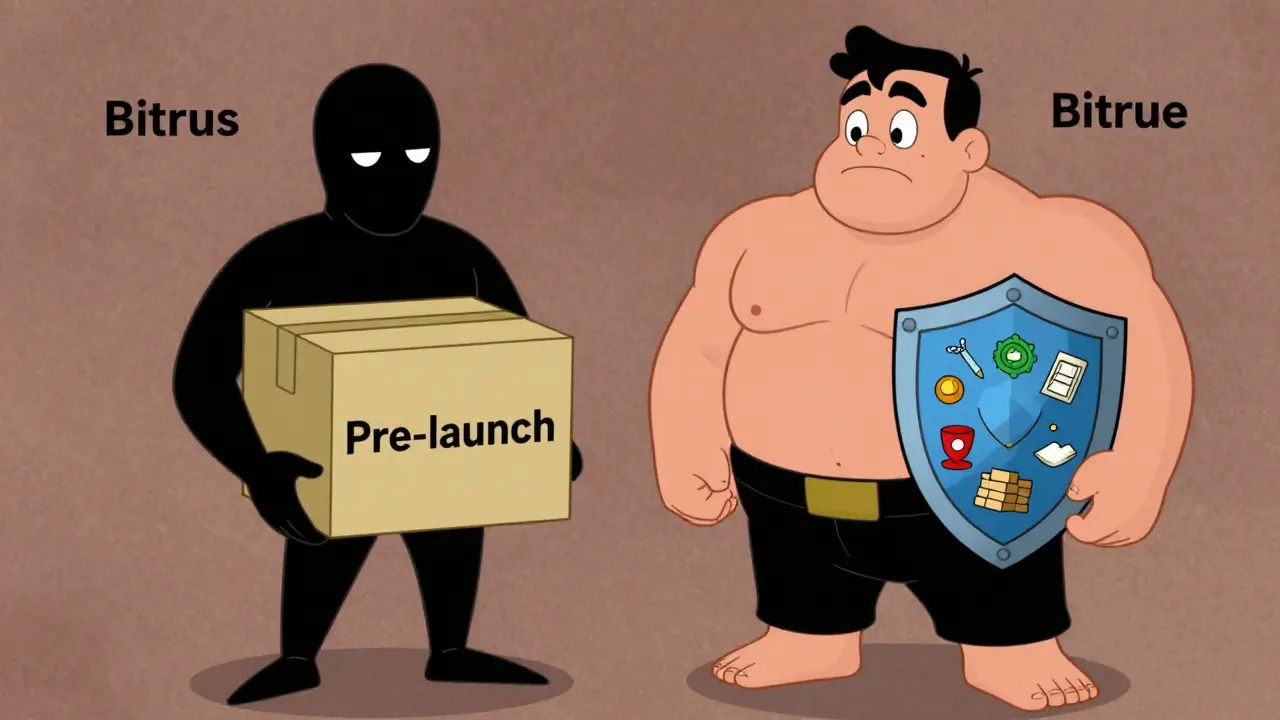
One of the biggest risks with Bitrus is name confusion. Many users mistake it for Bitrue, an established cryptocurrency exchange launched in 2018. These are two completely different entities.
| Feature | Bitrus | Bitrue |
|---|---|---|
| Status | Pre-launch / Waitlist only | Live and operational |
| Launch Year | Undisclosed (likely 2025/2026) | 2018 |
| Supported Coins | None disclosed | Over 150 cryptocurrencies |
| Security Certifications | None public | McAfee solutions, NSFOCUS certification |
| User Base | Unknown | Millions of users globally |
| Mobile App | Not available | Available (3.7 stars on Google Play) |
Bitrue offers staking, lending, leverage trading, and has a proven track record. Bitrus offers... a waitlist. Do not assume they are related. They are not.
The BTRS Token: Utility or Hype?
Bitrus has a native token called BTRS. The utility and supply details of this token are largely undocumented. Some references on ICO tracking sites mention BTRS as part of the platform’s tokenomics, but there is no whitepaper or technical documentation explaining its purpose.
In legitimate ecosystems, tokens serve specific functions: paying fees, governance voting, or staking for rewards. Without a clear use case, BTRS appears to be speculative. Be cautious if anyone tries to sell you BTRS tokens privately. Without a regulated listing or transparent distribution plan, these tokens could lose value rapidly or become worthless if the platform never launches.
Why Transparency Matters in Crypto
You might wonder why I am being so harsh. After all, many big companies started small. That is true. But finance is different from software. When you buy shares in a startup, you accept risk. When you deposit money into an exchange, you expect security.
Consider the recent collapse of FTX in 2022. Users lost billions because the company lacked transparency and proper segregation of funds. Or look at Bittrex Global, which entered liquidation in early 2025. While Bittrex was a legitimate entity, its failure highlighted the risks of centralization and poor management.
Bitrus does not even have the luxury of a past track record. It has no history to analyze. This makes it impossible to assess reliability. In the crypto industry, trust is built through verification, not promises. Until Bitrus publishes its audit reports, regulatory licenses, and team identities, it remains an unverified entity.
Should You Join the Waitlist?
If you are curious, joining a waitlist costs nothing but your email address. However, treat this with extreme caution. Do not provide personal identification documents (KYC) until the platform is fully verified and legally compliant. Scammers often use waitlists to harvest personal data for identity theft.
Ask yourself: Why do I want to use Bitrus? If the answer is "because it’s new," that is not a strong enough reason. New does not mean better. It often means untested. If the answer is "because I heard about a discount," remember that discounts on risky platforms can lead to total loss of principal.
Safer Alternatives for Trading
If you are looking to trade cryptocurrencies, stick to platforms with proven records. Here are three options that prioritize security and compliance:
- Coinbase: Publicly traded on NASDAQ, heavily regulated in the US and Europe, and known for user-friendly interfaces.
- Kraken: One of the oldest exchanges, with a strong reputation for security and customer support.
- Binance: The largest exchange by volume, offering a wide range of assets and features, though it faces regulatory scrutiny in some regions.
These platforms may not offer "special early access benefits," but they offer something more valuable: peace of mind.
Is Bitrus a scam?
It is too early to definitively label Bitrus a scam, but it exhibits several characteristics common to fraudulent or high-risk projects. The lack of team information, regulatory licenses, and security audits raises significant concerns. Until these issues are resolved, it should be treated as highly speculative and potentially unsafe.
What is the BTRS token?
BTRS is the native token associated with the Bitrus platform. However, there is no publicly available whitepaper or detailed documentation explaining its utility, supply, or distribution. Investors should exercise extreme caution as the token’s value is entirely speculative without a functional ecosystem.
Can I trade on Bitrus right now?
No. As of May 2026, Bitrus is in a pre-launch phase and only accepts waitlist signups. There is no live trading interface, and no deposits can be made for trading purposes. Any claim otherwise is likely false.
Is Bitrus the same as Bitrue?
No, they are completely separate entities. Bitrue is an established exchange launched in 2018 with millions of users. Bitrus is a new, unverified project with no operational history. Do not confuse the two.
Why is there no information about Bitrus?
The lack of information is a major red flag. Legitimate financial platforms disclose their team, regulatory status, and security measures to build trust. Bitrus’s silence suggests it is either still in early development or lacks the necessary credentials to operate transparently.
Should I share my ID with Bitrus?
Absolutely not. Do not submit any personal identification documents until the platform has published verifiable regulatory licenses and security certifications. Sharing your ID with an unverified entity puts you at risk of identity theft and fraud.