Privacy Coin Technology: Ring Signatures vs. zk-SNARKs
Sep, 3 2026
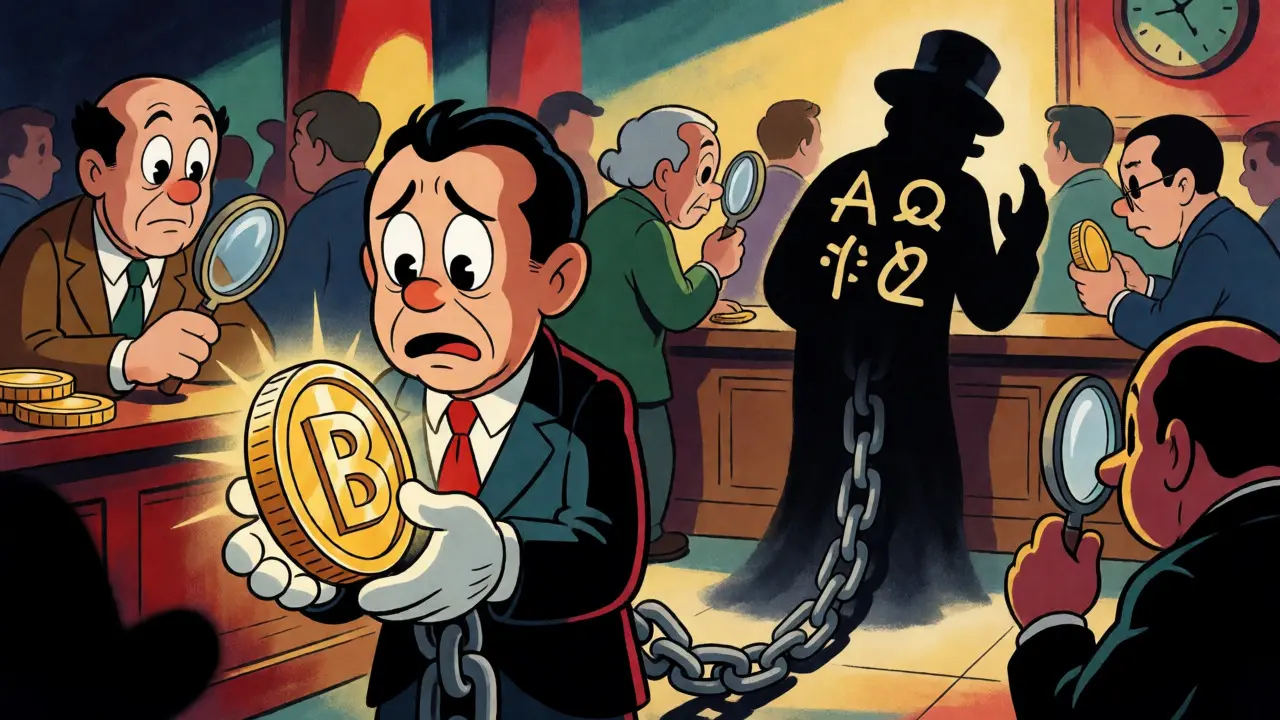
Imagine walking into a bank to make a deposit. In the traditional world, you hand over cash, and the teller doesn't know where that money came from or who held it before. Now imagine doing that same transaction on Bitcoin. Every single coin is tagged with its entire history, tracing back to the moment it was mined. If your funds ever touched a shady exchange or a sanctioned entity, that stain follows them forever. This lack of privacy is the core problem Privacy Coin Technology aims to solve. It’s not just about hiding your wealth; it’s about fungibility-ensuring one unit of currency is interchangeable with another without a baggage-laden past.
Two cryptographic giants dominate this space: Ring Signatures, championed by Monero, and zk-SNARKs, popularized by Zcash. While both promise anonymity, they achieve it through wildly different mathematical paths. One mixes your signature into a crowd; the other proves you’re right without showing your work. Understanding the difference isn’t just academic-it determines whether your transactions are cheap and fast or heavy and complex.
The Core Problem: The Blockchain Transparency Paradox
Public blockchains are ledgers. Everyone sees everything. This transparency is great for trust but terrible for privacy. When you send Bitcoin, the network verifies three things: you own the inputs, you’re sending the correct amount, and the recipient can spend it. But it reveals exactly who sent what to whom, and how much.
Privacy coins introduce obfuscation techniques to break this link between identity and transaction data. They don’t hide the fact that a transaction happened; they hide the details of *who* did it and *how much* moved. This creates a paradox: how do you prove a transaction is valid (no double-spending, sufficient funds) if the network can’t see the balances or identities? That’s where advanced cryptography steps in.
Ring Signatures: Hiding in the Crowd
Think of a Ring Signature like a group photo where everyone is wearing the same mask. You sign a transaction, but your digital signature is mixed with several other random past outputs from the blockchain. These decoys are called "mixins." To an outside observer, any member of the ring could be the actual signer. There is no way to mathematically distinguish the real sender from the decoys.
Monero uses this technique extensively. When you send XMR, your wallet picks a set number of decoy outputs (currently 16) to mix with yours. The network knows someone in this group signed the transaction, but it doesn’t know which one. This provides strong sender anonymity.
- Sender Anonymity: Your identity is hidden among other users.
- No Trusted Setup: Unlike some zero-knowledge systems, ring signatures don’t require a special initial ceremony to generate parameters. Anyone can join at any time.
- Default Privacy: On Monero, every transaction is private by default. You don’t have to opt-in.
However, this method has costs. Because you’re attaching multiple decoy signatures to every transaction, the data size balloons. A standard Monero transaction is roughly 15-20 times larger than a Bitcoin one. This leads to slower block propagation and higher fees during network congestion. Also, while it hides the sender, it requires additional tech like Stealth Addresses to hide the receiver and RingCT to hide the amount.

zk-SNARKs: Proving Without Revealing
If ring signatures hide you in a crowd, zk-SNARKs (Zero-Knowledge Succinct Non-Interactive Argument of Knowledge) let you prove you know a secret without revealing the secret itself. Imagine proving you’re over 21 without showing your ID card or date of birth. You just show a proof that says "Yes, I am over 21," and the verifier accepts it as true without seeing your age.
In crypto terms, a zk-SNARK allows a user to generate a tiny piece of data (a proof) that confirms a transaction is valid. The proof shows that the sender owns the funds and hasn’t spent them twice, but it doesn’t reveal the sender’s address, the recipient’s address, or the amount. The verification is incredibly fast-often taking less than 10 milliseconds-even though generating the proof takes seconds.
Zcash was the first major project to implement this at scale. Its shielded transactions use zk-SNARKs to encrypt all transaction details. The blockchain only stores the proof and a commitment to the new balance, keeping the rest opaque.
| Feature | Ring Signatures (Monero) | zk-SNARKs (Zcash) |
|---|---|---|
| Privacy Mechanism | Mixes real signature with decoys | Mathematical proof of validity |
| Transaction Size | Large (increases with ring size) | Succinct (fixed small size ~100-400 bytes) |
| Verification Speed | Standard (linear complexity) | Very Fast (constant time) |
| Proof Generation | Instant | Slower (seconds to minutes) |
| Trusted Setup | Not required | Historically required (Halo 2 removes this) |
| Primary Weakness | Blockchain bloat, metadata leakage | Complex implementation, trusted setup risk |
The Trade-Offs: Performance vs. Security
You might think zk-SNARKs win because they’re smaller and faster to verify. And for pure efficiency, they do. A Zcash shielded transaction adds minimal weight to the blockchain compared to Monero’s bloated rings. But there’s a catch: generation time.
Creating a zk-SNARK proof is computationally expensive. On a standard laptop, generating a Zcash shielded transaction proof can take 30-60 seconds. On a mobile device, it might take longer or drain battery significantly. Ring signatures, conversely, are instant to create because they’re just aggregating existing data. You pay for speed in creation with bulkier storage later.
Then there’s the "Trusted Setup" issue. Early zk-SNARK implementations required a multi-party computation ceremony where participants generated cryptographic keys. If even one participant kept their secret safe, the system was secure. If all colluded, they could forge proofs. This scared off purists. However, newer technologies like Halo 2 used in Zcash’s NU5 upgrade eliminate this need, making zk-SNARKs more decentralized-friendly.

Regulatory Pressure and Real-World Adoption
Privacy doesn’t sit well with regulators. Governments want to track money laundering and tax evasion. This has led to delistings of privacy coins from major exchanges in countries like Japan and South Korea. The EU’s MiCA regulations also pose challenges, demanding identity verification for service providers.
This pressure forces innovation. Projects like Panther Protocol are trying to bridge the gap by using zk-SNARKs for "selective disclosure." Users can keep their transactions private generally but prove compliance to auditors when needed. This hybrid approach might be the key to surviving regulation.
Adoption metrics reflect this tension. Monero remains the most widely used privacy coin because its privacy is mandatory and easy to use. You don’t need to choose between transparent and shielded addresses; everything is shielded. Zcash offers flexibility-you can choose to be private or public-but many users accidentally send to transparent addresses, losing privacy. Data shows that only a fraction of Zcash transactions are actually shielded, whereas nearly all Monero transactions are private.
Which Should You Choose?
Your choice depends on your threat model and usage habits.
- Choose Ring Signatures (Monero) if: You want absolute simplicity and default privacy. You don’t care about transaction size or slightly higher fees, and you want to ensure every transaction is private without thinking about it. It’s best for everyday spending where you don’t want to leak metadata.
- Choose zk-SNARKs (Zcash) if: You value scalability and smaller blockchain footprint. You are comfortable managing two types of addresses (transparent and shielded) and want the option to reveal information for auditing purposes. It’s better for institutional use cases where selective transparency is needed.
Neither technology is perfect. Ring signatures suffer from chain analysis attacks if the decoy selection algorithm is flawed. zk-SNARKs face criticism over potential bugs in circuit logic. Both are under constant scrutiny by cryptographers. As we move toward 2026, expect these technologies to converge. We’re already seeing projects combining ring signatures with zero-knowledge proofs to get the best of both worlds: the robust anonymity of rings and the succinctness of SNARKs.
Are privacy coins completely anonymous?
No cryptocurrency is 100% anonymous. Privacy coins obscure on-chain data, but they can still be deanonymized through IP address leaks, poor operational security (like reusing addresses), or correlation attacks when moving funds to/from centralized exchanges. They offer strong pseudonymity, not absolute anonymity.
Why are Monero transactions so large?
Monero uses ring signatures, which require including multiple "decoy" outputs alongside the real input to hide the sender. Each decoy adds data to the transaction. With a ring size of 16, the transaction includes 16 potential inputs, making it significantly heavier than a Bitcoin transaction that only lists the exact inputs used.
What is a trusted setup in zk-SNARKs?
A trusted setup is a one-time ceremony where participants generate cryptographic parameters. If any single participant destroys their portion of the secret randomness, the system remains secure. If all participants collude, they could theoretically forge proofs. Newer protocols like Halo 2 remove this requirement entirely.
Can governments ban privacy coins?
Governments cannot easily ban the underlying technology or the network itself, as it runs on decentralized nodes globally. However, they can ban exchanges from listing them or restrict businesses from accepting them. This reduces usability and liquidity but doesn't stop peer-to-peer transactions.
Is zk-SNARK faster than Ring Signatures?
It depends on the phase. Verifying a zk-SNARK proof is extremely fast (milliseconds). However, *generating* the proof takes seconds. Creating a ring signature is instant, but verifying it takes longer and consumes more bandwidth due to the larger data size. For the end-user, Monero feels faster to send; for the network, Zcash is lighter to store.