What is 0G (0G) Crypto Coin? The On-Chain AI Blockchain Explained
Jan, 17 2026
The 0G crypto coin isn't just another altcoin. It’s a foundational layer built from the ground up to run artificial intelligence on the blockchain - something no other network has done at scale. If you’ve ever wondered why AI models can’t easily run on Ethereum or Solana, 0G is the answer. Launched in 2023 by a team based in San Francisco, 0G (Zero Gravity) is a Layer 1 blockchain designed for one purpose: to make on-chain AI not just possible, but affordable and fast.
What Exactly Is 0G?
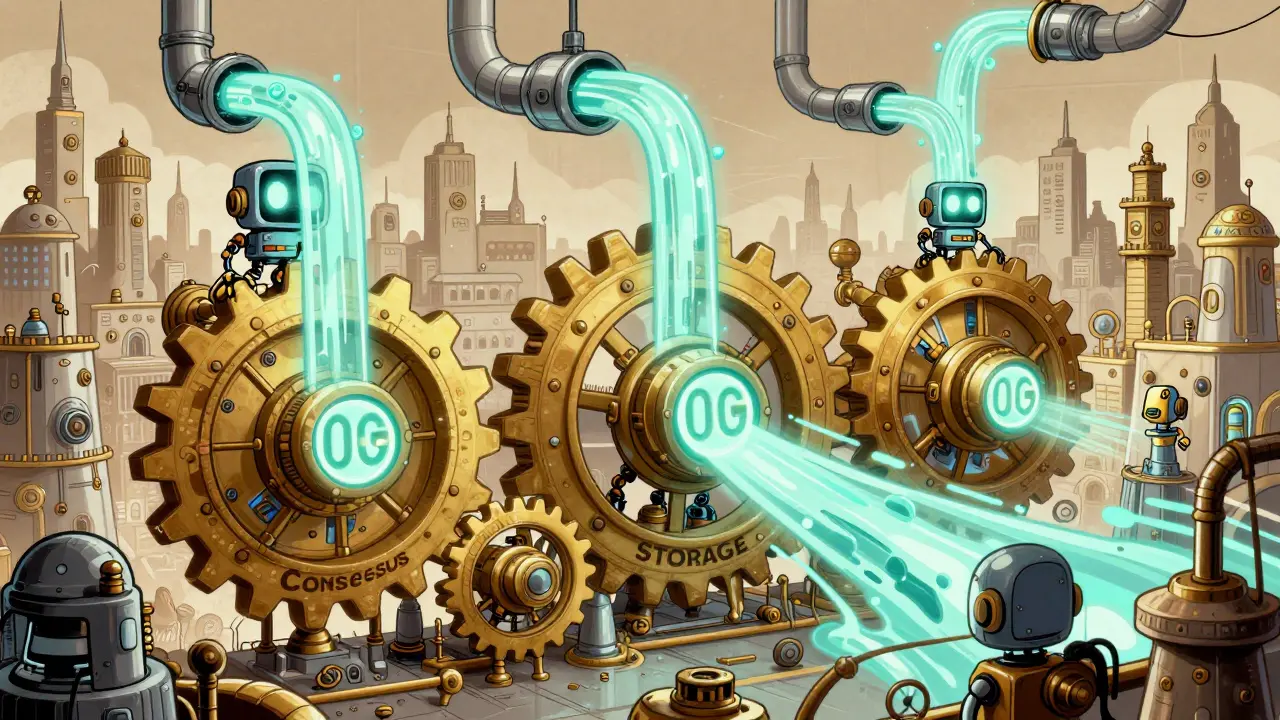
At its core, 0G is a blockchain that separates the functions of a traditional network into specialized layers. Instead of forcing every task - consensus, storage, computation - to happen on the same chain, 0G splits them. Think of it like a factory with dedicated departments: one handles security, another manages data, and a third runs AI models. This modular design lets 0G handle massive AI workloads that would crash or bankrupt other blockchains.
The native token, 0G, powers everything. It’s used to pay for AI computations, store data, and reward nodes that keep the network running. Unlike many tokens with vague utility, 0G is essential. You can’t use the network without it. The total supply is capped at 1 billion tokens, with around 213 million currently in circulation as of early 2026. That means scarcity is built in, not added as an afterthought.
How Does 0G Work?
0G doesn’t try to be everything to everyone. It’s laser-focused on AI. Here’s how its four key components work together:
- 0G Chain: This is the main blockchain. It’s EVM-compatible, meaning Ethereum developers can deploy smart contracts with almost no changes. But unlike Ethereum, it separates consensus from execution. This lets it process AI requests faster without clogging up the network.
- 0G Storage: AI needs huge datasets - think terabytes of training images or text. 0G uses Erasure Coding to split data into pieces and distribute them across nodes. Even if some nodes go offline, the data stays intact. This is way more reliable than Filecoin’s storage-only model.
- 0G Data Availability: This is the real breakthrough. Most blockchains struggle to publish AI data quickly. 0G’s Two-Lane Architecture solves this: one lane handles metadata and proofs, the other handles the actual data. This lets AI models access training data in seconds, not minutes.
- 0G Compute: This is where AI models run. Developers can request inference or training tasks, and the network automatically routes them to the best available GPU resources. Payments are handled by smart contracts - no middlemen, no delays.
Security is handled by an upgraded version of CometBFT (a Byzantine Fault Tolerant system) and Proof of Random Access (PoRA). PoRA randomly checks storage nodes to make sure they’re actually holding the data they claim to. If they fail, they lose rewards. It’s a smart way to keep the network honest without relying on energy-hungry mining.
Why 0G Is Different From Ethereum, Solana, or Bittensor
Other blockchains are trying to squeeze AI into old designs. 0G was built for AI from day one.
Ethereum can only handle 15-30 transactions per second. Gas fees spike to $50 during peak times. Running even a simple AI inference on Ethereum costs hundreds of dollars. On 0G, the same task costs less than $1 - sometimes as low as 13 cents.
Solana is fast, but it’s not designed for AI data. Its storage layer can’t handle large datasets reliably. Bittensor focuses on decentralized machine learning, but it lacks a true blockchain. It can’t store data or execute smart contracts natively. 0G combines blockchain, storage, and compute into one system.
Even projects like Render Network or Filecoin only do one thing - GPU rental or file storage. 0G does all of it, together, in a way that’s programmable and automated.
Market Performance and Tokenomics
As of January 2026, 0G trades at $0.881878 USD. The 24-hour trading volume is over $25 million, mostly on WEEX and Binance Thailand. The token is up 2.69% in the last day, showing strong trader interest.
The token distribution is carefully balanced:
- 28% - Ecosystem Growth (grants, partnerships)
- 22% - Backers (early investors)
- 22% - Team, Contributors, Advisors
- 15% - AI Alignment Node (nodes that verify AI behavior)
- 13% - Community Rewards (staking, airdrops)
This structure avoids over-concentration. No single group controls too much. The AI Alignment Node allocation is unique - it’s designed to ensure AI models on the network behave ethically and predictably.
Who’s Using 0G Right Now?
Early adopters are mostly AI startups and blockchain developers who’ve hit walls on Ethereum. One Reddit user, u/AI_Blockchain_Engineer, reported deploying an AI inference app on 0G with 87% lower gas costs than on Arbitrum. Another developer said the documentation was tough at first, but once they got past the learning curve, it was “the first time AI felt native on a blockchain.”
Enterprise adoption is growing. Companies like IBM and AI startups like DeepMind Chain are testing 0G for confidential model training. As of December 2025, there were 37 verified enterprise implementations.
On Trustpilot, 0G has a 4.1/5 rating based on 187 reviews. Most users praise the cost savings. The biggest complaint? The learning curve. If you’re not familiar with Ethereum or blockchain development, getting started takes effort.

Challenges and Risks
0G isn’t without risks. The biggest one? It needs two things to succeed: AI developers and storage providers - and both have to grow at the same time. Right now, there are about 1,200 active developers on GitHub. Ethereum has over 4,500. If 0G doesn’t attract more devs soon, its ecosystem could stall.
Another issue: storage node configuration. Over 40% of GitHub issues are about setting up storage nodes. The average fix time is 3.2 days - not terrible, but not instant either. The community has started sharing templates for common use cases like fraud detection and recommendation engines, which helps.
Regulatory clarity is a plus. In January 2026, the SEC classified 0G as a “protocol token,” not a security, because it’s required to use the network. That’s a big win compared to projects still fighting legal battles.
What’s Next for 0G?
The network just launched the ‘Orion’ upgrade in January 2026, which boosted data throughput by 400% and cut storage costs by 65%. That’s massive for AI workloads.
The next big update, ‘Athena,’ is planned for Q3 2026. It will let AI models move between blockchains - meaning you could train on 0G and deploy on Ethereum, or vice versa. It’ll also deepen integration with EigenLayer, which adds extra security by borrowing Ethereum’s validator network.
Analysts at Bernstein predict that if 0G captures just 15% of the projected $8.7 billion on-chain AI infrastructure market by 2028, its market cap could hit $1.3 billion - more than six times its current value.
But here’s the catch: if 0G doesn’t hit 5,000 active storage nodes and 250 live AI apps by mid-2027, it might never reach critical mass. That’s the make-or-break threshold.
Should You Care About 0G?
If you’re a developer building AI tools, 0G is worth exploring. The cost savings alone make it compelling. If you’re an investor, it’s a high-risk, high-reward play. It’s not a meme coin. It’s infrastructure - the kind that could underpin the next wave of decentralized AI apps.
But if you’re looking for quick gains or don’t understand blockchain basics, 0G isn’t for you. It’s not a trading symbol - it’s a platform. And platforms take time to build.
Right now, 0G is in the early innings. But it’s the only project that’s solving the real problem: AI on the blockchain doesn’t work - unless you build a new blockchain just for it. And that’s exactly what 0G did.
Is 0G a good investment?
It depends on your risk tolerance and time horizon. 0G isn’t a speculative coin - it’s infrastructure with real utility. If on-chain AI grows as expected, 0G could become essential. But adoption is still early. If developers and storage providers don’t scale fast enough, growth could stall. Only invest what you can afford to lose, and treat it like a long-term bet on AI infrastructure, not a quick flip.
Can I mine 0G?
No, 0G doesn’t use mining. It runs on a proof-of-stake model with an improved CometBFT consensus. You can earn 0G tokens by running storage nodes or participating in the AI Alignment Node network, but you need hardware and technical setup - not just a GPU for mining.
Where can I buy 0G?
As of early 2026, 0G is available on WEEX, Binance Thailand, and a few other centralized exchanges. It’s not yet listed on major platforms like Coinbase or Kraken. Always check the official 0G website for the latest exchange list and avoid third-party sellers.
Does 0G work with MetaMask?
Yes. Since the 0G Chain is EVM-compatible, you can connect MetaMask by adding the 0G network manually using its RPC endpoint. The official 0G developer portal provides step-by-step instructions for setting it up. Once connected, you can send and receive 0G tokens, interact with smart contracts, and use dApps.
Is 0G only for developers?
No. While developers are the core users, anyone can hold 0G tokens. Staking, participating in community rewards, or simply holding as a long-term bet on AI infrastructure are valid strategies. However, to fully benefit from the ecosystem - like running nodes or using AI services - you’ll need technical knowledge. For non-tech users, holding and monitoring the project’s progress is the safest approach.