Bitcoin Block Structure: The Complete Technical Breakdown
Jun, 17 2026
Imagine a digital ledger where every page is locked in steel, chained to the one before it, and verified by thousands of independent auditors simultaneously. That is essentially what a Bitcoin block is. It isn't just a container for transactions; it is the fundamental unit of trust in the entire cryptocurrency ecosystem. If you are looking to understand how Bitcoin actually works under the hood, you have to start here. Without this structure, there is no blockchain, no security, and no decentralization.
This guide breaks down the anatomy of a Bitcoin block. We will look at the specific bytes that make up the header, how transactions are packed inside, and why the cryptographic links between blocks make tampering practically impossible. Whether you are a developer building on top of Bitcoin or just someone who wants to know why your transaction takes time to confirm, understanding this structure gives you clarity on how the network stays secure.
The Anatomy of a Bitcoin Block Header
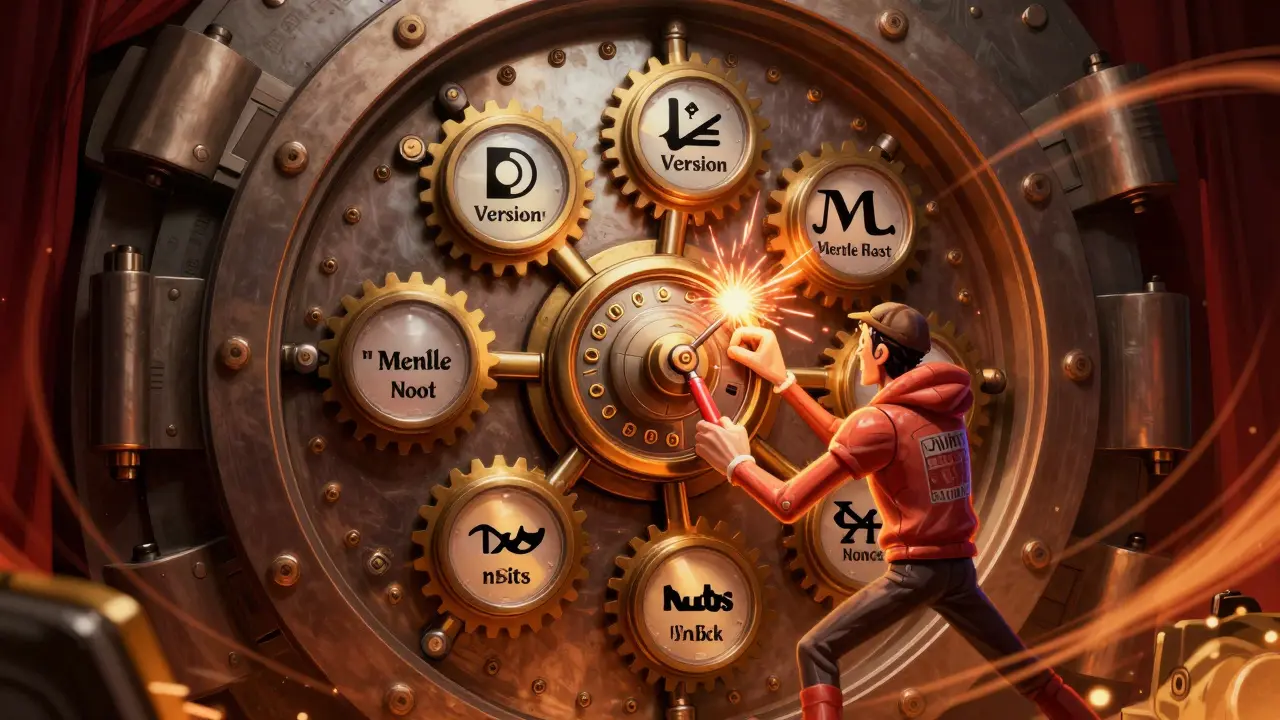
Every Bitcoin block starts with a fixed-size header. This header is exactly 80 bytes long. It doesn't contain the actual money transfers; instead, it contains the data needed to verify the block's validity and link it to the rest of the chain. Think of it as the cover of a book that tells you when it was written, who wrote the previous chapter, and a unique fingerprint of all the content inside.
The header consists of six distinct fields. Each field has a precise size and purpose defined by the Bitcoin protocol since its inception in 2009.
- Version (4 bytes): This number indicates which set of validation rules the miner followed. It allows the network to upgrade protocols without breaking older software. For example, version numbers changed when SegWit and Taproot were activated.
- Previous Block Hash (32 bytes): This is the heart of the blockchain. It is a SHA-256 hash of the previous block's header. By including this, each block cryptographically points back to its parent, creating an unbroken chain going back to the Genesis Block.
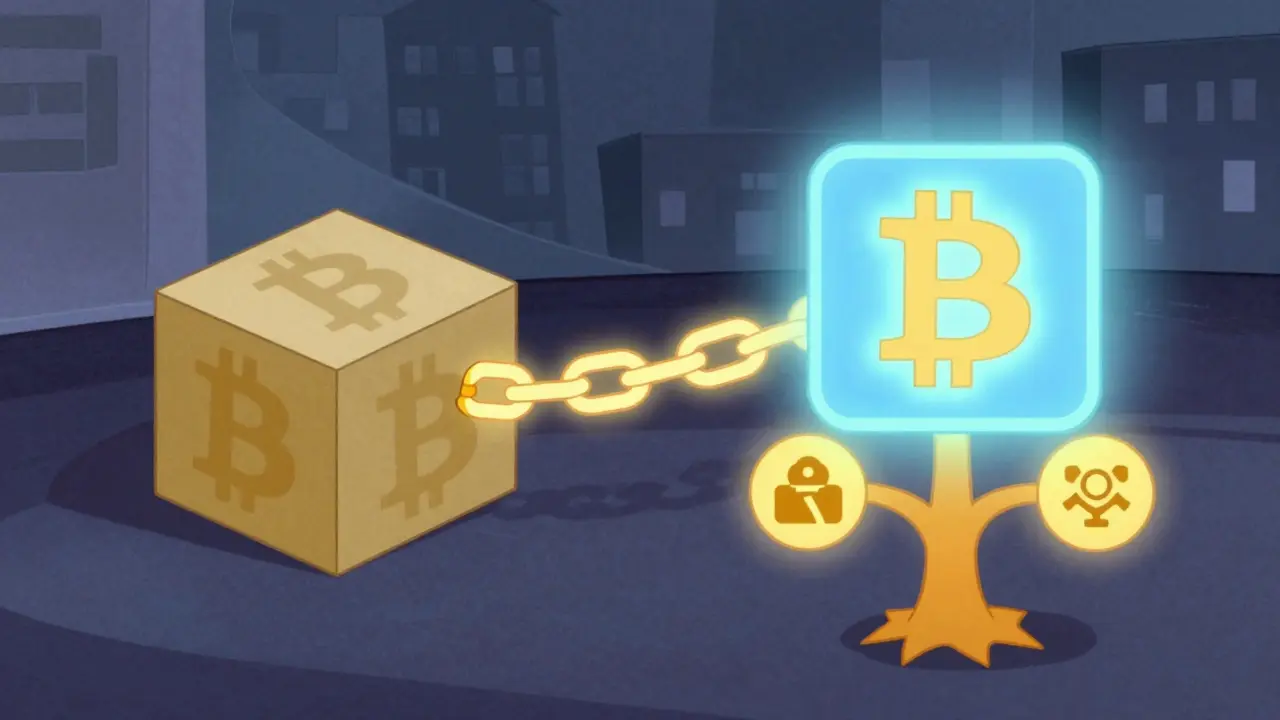
- Merkle Root (32 bytes): This single hash represents all the transactions in the block. It is derived from a Merkle Tree, a binary tree structure that allows efficient verification of whether a specific transaction is included in the block without downloading the whole thing.
- Timestamp (4 bytes): This records the approximate time the miner started working on the block. It must be greater than the median time of the previous 11 blocks and cannot be more than two hours in the future, preventing miners from manipulating time-based rules.
- nBits (4 bytes): This is a compact representation of the target difficulty. It defines how small the block hash must be for the block to be accepted by the network. As more computing power joins the network, this target gets smaller, making mining harder.
- Nonce (4 bytes): This is the variable number miners change repeatedly. They tweak this value millions of times per second until the resulting hash of the entire header falls below the nBits target. This process is known as Proof-of-Work.
These six fields are serialized together and hashed. The result must meet the difficulty target. If it does, the block is valid. If not, the miner changes the nonce and tries again. This simple mechanism secures the entire network.
The Transaction Section and UTXOs
After the 80-byte header comes the body of the block: the transactions. Unlike traditional banking ledgers that track balances per account, Bitcoin uses a system called Unspent Transaction Outputs, or UTXOs. You don't have a "balance" stored on the blockchain. Instead, you have a collection of coins (UTXOs) that you own and can spend.
A Bitcoin block begins its transaction section with a count field using variable-length encoding. This tells the node how many transactions follow. Then, each transaction is listed in sequence.
Each transaction has inputs and outputs. Inputs reference previous UTXOs, proving you have the right to spend those coins. Outputs create new UTXOs, assigning value to new addresses or returning change to the sender. The sum of inputs must always exceed the sum of outputs; the difference is the mining fee, which rewards the miner for including your transaction.
| Component | Description | Purpose |
|---|---|---|
| Input | Reference to a previous UTXO | Proves ownership and authorizes spending |
| Output | New value assigned to a script/address | Creates new spendable coins (UTXOs) |
| Witness Data | Cryptographic signatures (SegWit) | Validates input spending conditions |
| Locktime | Time or block height constraint | Prevents transaction from being valid too early |
The order of transactions matters for the Merkle Root calculation. Miners often prioritize transactions with higher fees, placing them earlier in the block. However, any valid ordering is acceptable as long as the final Merkle Root matches the header.
How Mining Links Blocks Together
Mining is not just about finding blocks; it is about securing history. When a miner finds a valid nonce, they broadcast the block to the network. Other nodes verify three main things: the proof-of-work, the validity of every transaction, and the consistency of the block structure.
If the block passes verification, nodes add it to their local copy of the blockchain. Because the new block contains the hash of the previous block, changing any data in an old block would change its hash. This would break the link to the next block, requiring the attacker to redo the proof-of-work for that block and all subsequent blocks. Given the computational power of the Bitcoin network, this is economically and practically infeasible.
This is why Bitcoin is immutable. The cost to rewrite history exceeds the value of any potential gain. The block structure enforces this security through cryptographic chaining and decentralized consensus.
Evolution: SegWit and Taproot Impact
The basic block structure hasn't changed much since 2009, but upgrades have enhanced how data is handled within it. Two major soft forks-Segregated Witness (SegWit) and Taproot-have significantly impacted block capacity and privacy.
SegWit (2017) moved signature data (witnesses) out of the main transaction structure and into a separate witness area. This solved a bug called transaction malleability and effectively increased block capacity. While the base block limit remains 1 megabyte, SegWit allows additional data to be included at a discount, increasing throughput without changing the core block size rule.
Taproot (2021) introduced new scripting capabilities and improved privacy. It allows complex multi-signature transactions to look like simple single-signature ones on the blockchain. This reduces the amount of data revealed in the block, saving space and enhancing user anonymity. Both upgrades maintained backward compatibility, ensuring older nodes could still validate blocks even if they didn't understand the new features.
Real-World Implications for Users
Why does this matter to you? If you send Bitcoin, your transaction enters the mempool-a waiting room for unconfirmed transactions. Miners pick transactions from the mempool to fill their candidate blocks. The speed of your confirmation depends on the fee you pay relative to others in the queue.
Understanding block structure helps you interpret blockchain explorers. When you see a block height, timestamp, and hash, you are seeing the real-world manifestation of these technical components. You can verify that a transaction is included by checking its presence in the Merkle Tree of a confirmed block.
For developers, knowing the exact byte layout is crucial for building wallets, nodes, and analysis tools. For investors, it explains why Bitcoin scales differently than other cryptocurrencies. The 1MB base limit and 10-minute block time are design choices that prioritize security and decentralization over raw speed.
Common Misconceptions About Blocks
Many people think blocks are created exactly every 10 minutes. In reality, 10 minutes is the average. Some blocks come quickly; others take longer. The difficulty adjustment algorithm retargets every 2016 blocks (roughly two weeks) to keep the average close to 10 minutes despite changes in total network hash rate.
Another myth is that blocks store personal identities. They do not. Bitcoin addresses are pseudonymous strings of characters. While transactions are public, linking an address to a real person requires external information. The block structure itself provides no identity data.
Finally, some believe that once a block is mined, it is permanent. While extremely unlikely, reorganizations can happen if a longer chain is found. This is why services often wait for several confirmations (blocks added after yours) before considering a transaction final. Each additional block exponentially increases the security of your transaction.
What is the maximum size of a Bitcoin block?
The base block size limit is 1 megabyte (MB). However, with Segregated Witness (SegWit), blocks can include additional witness data, effectively allowing up to 4 MB of weight units. This means larger blocks can be processed without violating the original 1MB rule for non-witness data.
Why is the nonce important in a Bitcoin block?
The nonce is the variable number miners change to solve the proof-of-work puzzle. By adjusting the nonce, miners generate different hashes for the block header until they find one that meets the current difficulty target. This process secures the network and prevents spam.
How does the Merkle Root ensure transaction integrity?
The Merkle Root is a single hash derived from all transactions in the block using a Merkle Tree structure. If any transaction is altered, the Merkle Root changes, invalidating the block header. This allows users to verify transaction inclusion efficiently without downloading the entire block.
Can a Bitcoin block be empty?
No, every Bitcoin block must contain at least one transaction: the coinbase transaction. This special transaction awards newly minted bitcoins and mining fees to the miner. It is the first transaction in every block and creates the initial UTXOs for that block.
What happens if two miners find a block at the same time?
This causes a temporary fork in the blockchain. Nodes may accept either block initially. However, the next block mined will extend one of the chains. The longest valid chain becomes the accepted history, and the orphaned block is discarded. Its transactions return to the mempool for inclusion in future blocks.