NFT Art Ownership Rights Explained: Do You Own the Image or Just the Token?
Jul, 20 2026
Quick Summary
- Owning an NFT is not the same as owning the copyright. In most cases, you own a unique token on the blockchain, but the artist retains the rights to the underlying image.
- Read the Terms of Service (ToS). Your rights depend entirely on what the project creators wrote in their legal agreements. Some grant full commercial use; others grant nothing beyond personal display.
- The 'Bored Ape' effect changed the market. Projects that grant broad commercial rights often see higher floor prices and stronger communities because holders can monetize their assets.
- Silence usually means limited rights. If a project doesn't explicitly state your rights, you likely only have an implied license to view the image for personal use, not to sell merchandise featuring it.
- AI-generated art adds legal gray areas. With AI tools creating more NFTs, questions about human authorship and copyrightability are becoming critical for buyers and sellers alike.
The Great Misunderstanding: Token vs. Copyright
You bought that cool digital monkey. It’s sitting in your wallet. You feel like the owner. But here is the hard truth: NFT art ownership is a complex legal relationship where owning the token rarely equals owning the intellectual property rights to the artwork. Unless the contract says otherwise, you probably don’t own the image itself.
This distinction trips up almost everyone new to crypto art. We are used to physical world logic. If I buy a painting from a gallery, I hang it on my wall. I own the canvas. I own the paint. Sure, the artist still holds the copyright (meaning they can print posters of it), but I have physical possession and certain display rights.
In the digital realm, this logic breaks down. When you purchase an Non-Fungible Token (NFT) is a unique cryptographic identifier stored on a blockchain that proves ownership of a specific digital asset. Think of it less like buying a painting and more like buying a signed receipt. The receipt is valuable because it’s unique and verifiable, but the receipt isn’t the car.
Legal experts at firms like Arnold Porter have made this crystal clear. Their standard language states that when you accept ownership of the NFT, you acquire all right, title, and interest in the token. Crucially, they add that you do not gain any right, title, or interest in the artwork, images, music, or other content represented by that token. The artist keeps the copyright. You keep the proof of purchase.
Why This Distinction Matters So Much
So, why does it matter if you own the copyright or just the token? Because copyright is where the money lives.
If you own the copyright, you can:
- Print the image on T-shirts and sell them.
- Create derivative works (like animations or comics) based on the character.
- Licensed the image to brands for advertising.
- Sue someone else who uses the image without permission.
If you only own the NFT token, you typically can only:
- Display the image on your social media profile.
- Sell the NFT itself to another collector.
- Show it off in a virtual gallery.
Let’s look at a real-world example. Jack Dorsey sold his first-ever tweet as an NFT for $2.9 million. The buyer got a very expensive digital certificate. But did they own the text of the tweet? No. Did they own the ability to print that tweet on mugs and sell them globally? No. The platform, Valuables, explicitly stated that the purchase was an "autographed certificate" and that the copyright remained with Twitter (now X) and Dorsey. The buyer paid millions for bragging rights and historical significance, not for commercial IP.
This separation creates a weird dynamic. The value of the NFT comes from its scarcity (there is only one token), but the utility of the image depends on the license. Without the license, the image is just a JPEG anyone can right-click and save.
The Spectrum of NFT Licenses
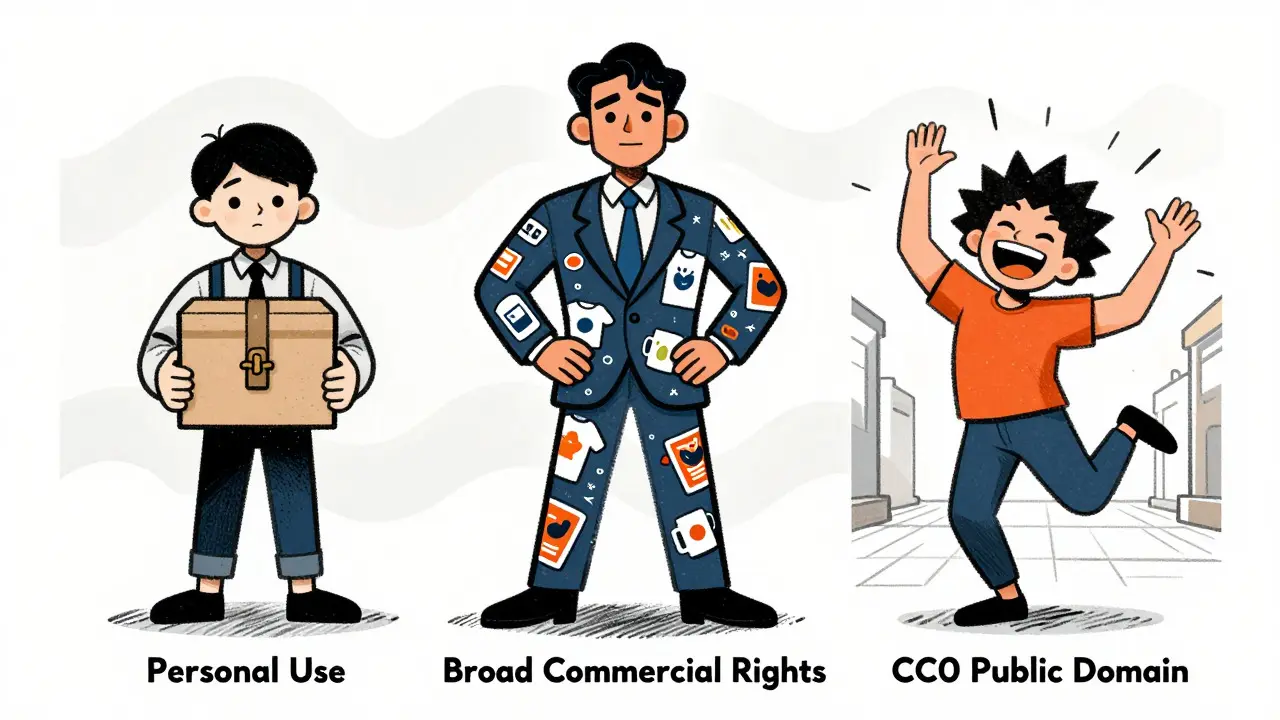
Not all NFTs are created equal. Over the last few years, a spectrum of licensing models has emerged. As a buyer, you need to know which bucket your drop falls into.
| License Type | What You Can Do | What You Can't Do | Typical Use Case |
|---|---|---|---|
| No Rights / Silence | View the image personally. | Commercial use, printing, derivatives. | Traditional fine art drops, high-end collectibles. |
| Personal Use Only | Profile pictures, personal prints (non-sale). | Selling merch, corporate branding. | Community-focused projects, fan clubs. |
| Broad Commercial Rights | Merge, modify, sell merch, sublicense. | Claiming you created the original art. | PFPs (Profile Pictures) like BAYC, community building. |
| CC0 (Public Domain) | Anything. Waives all creator rights. | Nothing (technically), but brand protection may apply. | CryptoPunks, early experimental projects. |
No Rights/Silence: Many older projects or traditional artists entering the space stay silent. If the Terms of Service (ToS) don’t mention IP, courts generally assume you get an "implied license" for personal display. That’s it. Print a shirt? You’re infringing copyright.
Broad Commercial Rights: This model exploded after the success of Bored Ape Yacht Club (BAYC) is a popular NFT collection that granted holders extensive commercial rights to their ape images, setting a new industry standard. By allowing holders to make money from their apes, Yuga Labs turned collectors into entrepreneurs. This boosted the floor price significantly. Data from DappRadar showed that collections with explicit commercial rights averaged 37% higher floor prices than those without. Why? Because the asset has utility beyond speculation.
CC0 (Creative Commons Zero): This is the wild west. The creator waives all their rights. The image enters the public domain. CryptoPunks is one of the earliest and most famous NFT projects that initially released its characters under a CC0 license, though later clarified trademark protections. However, be careful. Even with CC0, creators might retain trademark rights. You can print a CryptoPunk on a shirt, but if you try to start a clothing line called "CryptoPunks Apparel," Yuga Labs can sue you for trademark infringement. Confusing? Yes. Common? Absolutely.
How to Check Your Rights Before Buying
Don’t guess. Checking your rights takes five minutes and can save you from a lawsuit or a worthless investment. Here is your checklist:
- Find the Terms of Service (ToS). Every legitimate project has a website. Look for a link at the bottom labeled "Terms," "License," or "IP Rights." Read it. Seriously.
- Look for Keywords. Search for words like "commercial use," "derivative works," "copyright transfer," or "exclusive license." If you see "personal, non-commercial use only," you’re out of luck for merch.
- Check the Smart Contract. Advanced users can look at the code on Etherscan or Solscan. While the code rarely contains the full legal text, it sometimes references a URI (Uniform Resource Identifier) that points to metadata containing license info.
- Ask the Community. Join the Discord. Ask, "Do holders have commercial rights?" If the mods hesitate or say "check the ToS," proceed with caution. Transparency is key.
- Consult a Lawyer for High Stakes. If you’re spending $100k+ on an NFT and plan to build a business around it, hire an IP lawyer. It’s cheaper than a cease-and-desist letter.
A survey by CoinGecko found that only 32% of NFT marketplaces prominently display IP rights information at the point of purchase. OpenSea, Rarible, and Blur are platforms, not lawyers. They facilitate the trade; they don’t define the rights. The burden is on you.
The AI Complication
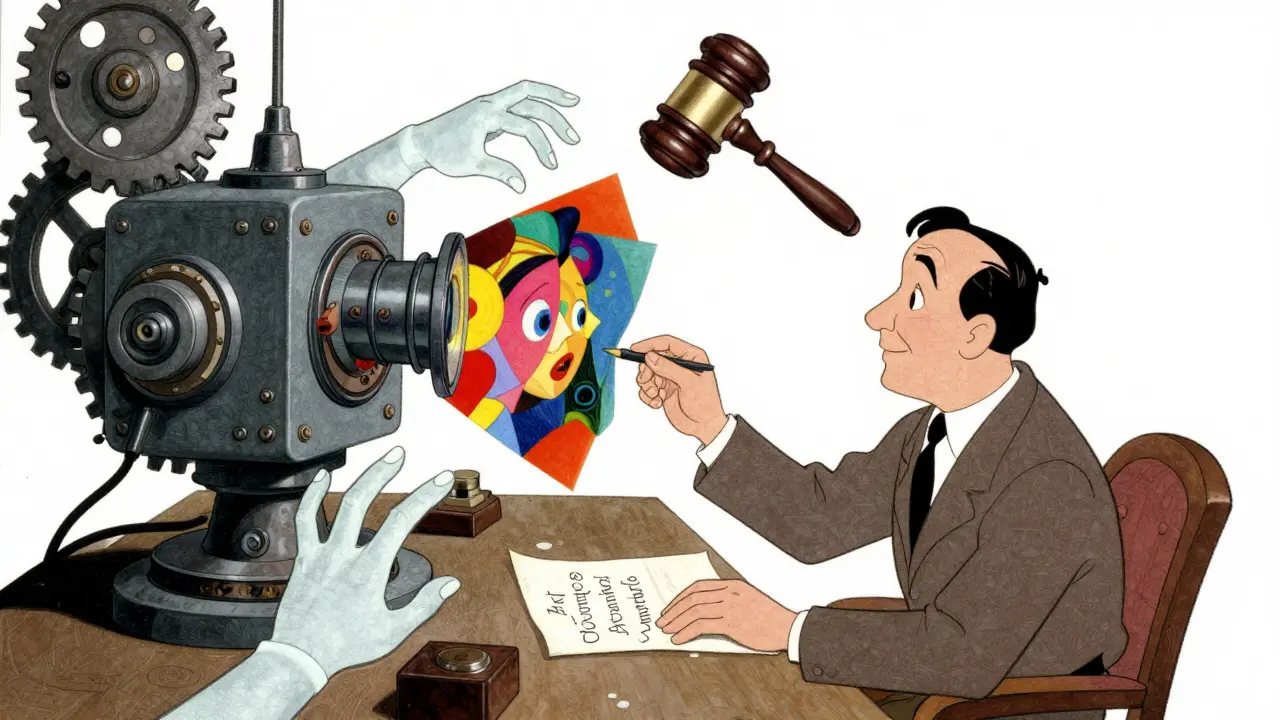
Here is where things get messy in 2026. Generative AI tools like Midjourney and DALL-E have flooded the NFT space. According to NonFungible.com, AI-generated art accounted for nearly 18% of all NFT sales in mid-2023, and that number has only grown.
The problem? Copyright law requires human authorship. The U.S. Copyright Office has stated that works generated entirely by AI without sufficient human input are not copyrightable. So, if an artist prompts an AI to create an image, mints it as an NFT, and sells it with a "full copyright transfer" license... who owns what?
If the work isn’t copyrightable in the first place, the artist can’t transfer rights they don’t have. This creates a massive legal gray area. Buyers thinking they’re securing exclusive rights to an AI-generated character might find themselves with nothing but a pretty picture and no legal leverage against copycats.
For now, treat AI-generated NFTs with extra skepticism regarding IP claims. Verify if the artist added significant human modification or curation. Pure prompt-to-image NFTs carry higher legal risk for commercial exploitation.
What Comes Next for NFT Law?
The landscape is shifting. In 2023, the World Intellectual Property Organization (WIPO) established a dedicated NFT working group. Courts are starting to hear cases. The first major U.S. case involving NFT copyright disputes is moving through the preliminary stages. Expect clearer precedents soon.
We are also seeing more standardization. Major brands entering the space now explicitly define IP rights in 73% of cases, up from 41% in 2021. The days of vague, silent licenses are fading for professional projects. Independent artists, however, still lag behind, with only 28% providing clear terms.
As the market matures, expect to see "smart contracts" that automatically enforce licensing terms. Imagine a system where every time you sell a T-shirt with your NFT character, a micro-royalty is automatically sent back to the original artist via blockchain. This technology exists in theory and is being piloted in practice. It could bridge the gap between token ownership and IP revenue sharing.
Until then, remember: the token is the receipt. The license is the key. Always read the fine print.
Does buying an NFT give me the copyright to the image?
Generally, no. Buying an NFT transfers ownership of the token on the blockchain, not the intellectual property (IP) rights to the underlying artwork. Unless the project's Terms of Service explicitly state that copyright is transferred to the buyer, the artist retains the copyright. You typically receive a license to display the image for personal use.
Can I sell merchandise featuring my NFT?
Only if the project grants you commercial rights. Projects like Bored Ape Yacht Club allow holders to create and sell merchandise. Other projects may restrict usage to personal, non-commercial purposes. Always check the specific license agreement of the collection before launching a product line.
What happens if an NFT project goes silent on rights?
If the Terms of Service are silent or vague, legal precedent suggests you have an "implied license" to display the work for personal use. This usually excludes commercial activities like printing shirts or using the image in ads. To avoid infringement risks, assume you have no commercial rights unless explicitly granted.
Are AI-generated NFTs copyrightable?
It depends on the level of human involvement. The U.S. Copyright Office has ruled that purely AI-generated content without significant human authorship is not eligible for copyright protection. If an NFT is created solely by an AI tool, the buyer may not be acquiring any enforceable copyright, even if the seller claims to transfer it.
What is a CC0 license in NFTs?
CC0 stands for Creative Commons Zero. It means the creator waives all their copyright and related rights, placing the work in the public domain. Holders can generally use the image for any purpose, including commercial ones. However, creators may still retain trademark rights to protect the brand name associated with the collection.