How Digital Signatures Verify Blockchain Transactions: A Simple Guide
Oct, 19 2026
Imagine sending money to a friend across the world. You don't know them well, you've never met, and there's no bank acting as a middleman to check if you actually own that money. So, how does the network know it’s really you? It doesn’t look at your face or ask for a password. It checks a mathematical proof called a digital signature. This tiny string of characters is the invisible lock and key that secures every single transaction on networks like Bitcoin and Ethereum. Without it, the entire concept of trustless finance would collapse.
You might think this sounds complicated, but the core idea is surprisingly straightforward. Think of it like signing a check. When you sign a check, you prove you’re the account holder without revealing your account number to the cashier. In blockchain, digital signatures do something similar but far more secure. They prove that a specific person authorized a transaction using their unique private key, without ever exposing that key to the public internet. Let’s break down exactly how this magic works, step by step.
The Two Keys That Rule Your Wallet
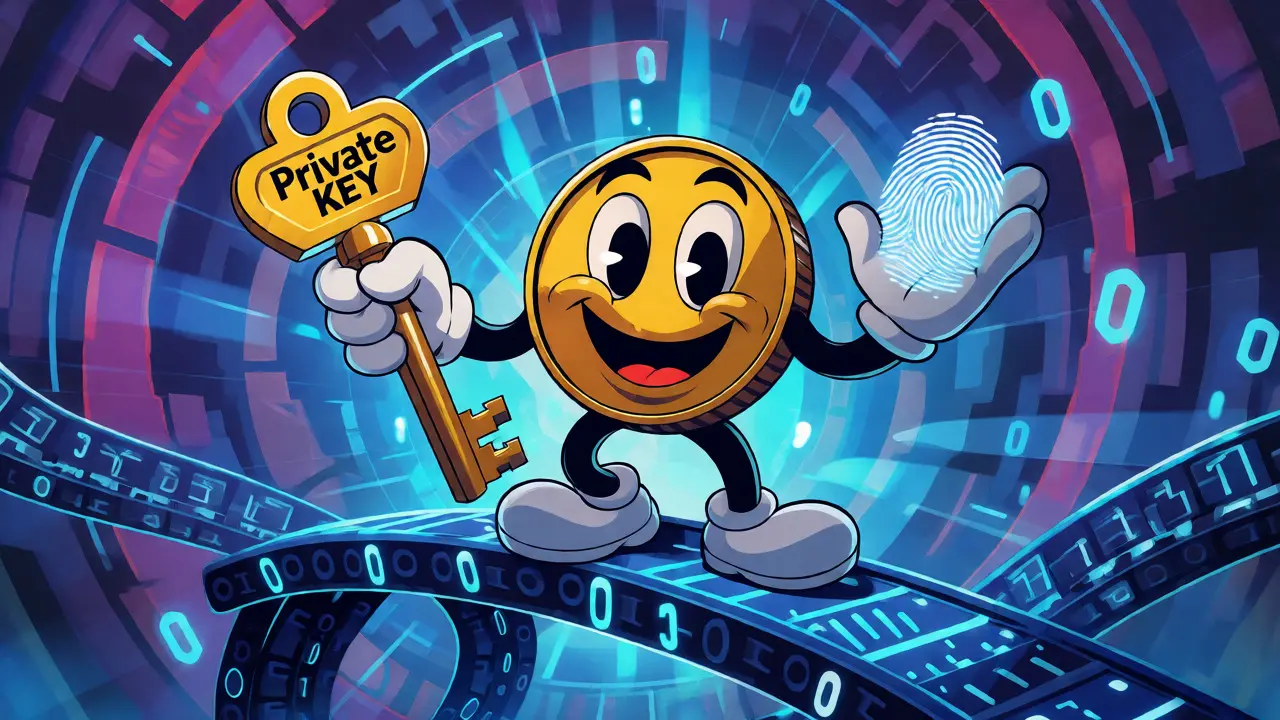
To understand digital signatures, you first need to grasp the concept of asymmetric cryptography. Unlike traditional encryption where one key locks and unlocks data, blockchain uses a pair of keys that are mathematically linked but distinct. One is your private key. This is your secret. It’s like the PIN code to your safe deposit box. If someone else gets hold of it, they can move your funds. The other is your public key, which acts like your bank account number. You share this freely with anyone who wants to send you money.
Here is the critical rule: You use your private key to create a signature, but you use your public key to verify it. No one can derive your private key from your public key. This one-way street is what makes the system secure. When you initiate a transfer, your wallet software combines your private key with the details of the transaction-like the amount and the recipient’s address-to generate a unique signature. This signature is then attached to the transaction and broadcast to the network.
Step-by-Step: From Click to Confirmation
So, what actually happens when you hit "send"? The process follows a strict sequence that ensures integrity and authenticity. First, your wallet creates a hash of the transaction data. A hash is essentially a digital fingerprint-a fixed-length string of characters generated from any input data. Even changing a single decimal point in the amount changes the hash completely.
- Data Hashing: The transaction details (sender, receiver, amount) are run through a hashing algorithm, usually SHA-256 in Bitcoin, to create a unique digest.
- Signing: Your wallet takes this hash and combines it with your private key using a specific algorithm, most commonly ECDSA (Elliptic Curve Digital Signature Algorithm). This produces the digital signature.
- Broadcasting: The transaction data, the hash, and the signature are sent out to the peer-to-peer network.
- Verification: Nodes (computers running the blockchain software) receive the package. They use your public key to verify that the signature matches the hash.
If the signature verifies correctly, the node knows two things for sure: the transaction came from the owner of the private key, and the data hasn’t been tampered with during transit. If a hacker tried to change the amount from 1 BTC to 10 BTC after you signed it, the hash would change, the signature would no longer match, and every node would reject the transaction instantly.
Why ECDSA Is the Standard
You might wonder why we use ECDSA instead of older methods like RSA. It comes down to efficiency. Blockchain networks are massive distributed systems processing thousands of transactions per second. They need security that is strong but also fast and compact. ECDSA provides high security with much smaller key sizes compared to RSA. For example, a 256-bit ECDSA key offers roughly the same security strength as a 3072-bit RSA key. Smaller keys mean smaller block sizes, faster transmission times, and lower storage requirements for every node in the network.
| Feature | ECDSA (Bitcoin/Ethereum) | RSA (Traditional) | EdDSA (Modern Alternatives) |
|---|---|---|---|
| Key Size for ~128-bit Security | 256 bits | 3072 bits | 256 bits |
| Speed | Fast | Slower | Very Fast |
| Blockchain Adoption | High (Standard) | Low | Growing (Solana, Cardano) |
| Security Risk | Randomness dependent | Deterministic | Deterministic/Safe |
While ECDSA is dominant, newer chains like Solana use EdDSA because it offers even better performance and resistance to certain types of attacks related to random number generation. However, the fundamental principle remains the same: proving ownership without revealing secrets.

The Role of Consensus and Integrity
Digital signatures don’t work in isolation; they rely on the network’s consensus mechanism. When you send a transaction, it doesn’t go to a central server. It floods into the mempool, a waiting room for unconfirmed transactions. Miners or validators pick up these transactions and include them in a new block. But before they do, they must verify the signature.
This verification is deterministic. Every node runs the exact same math. If Node A says the signature is valid, Node B will always say it’s valid too, provided they have the same public key and transaction data. This eliminates the need for trust. You don’t need to trust the miner; you just need to trust the math. If a malicious actor tries to double-spend-using the same coins twice-the second transaction will fail because the ledger state has already updated to reflect the first spend, or the signature won’t match the available balance context depending on the chain’s implementation.
Moreover, the immutability of the blockchain reinforces this. Once a block containing your verified transaction is added to the chain, changing it would require re-doing all the proof-of-work (or equivalent) for that block and every subsequent block. This makes reversing a verified transaction practically impossible.
Common Pitfalls and Security Risks
Even though the math is solid, human error remains the biggest vulnerability. Since the private key generates the signature, losing it means losing access forever. There is no "forgot password" link in DeFi. Conversely, if you expose your private key, anyone can sign transactions on your behalf. They don’t need to guess your password; they just need the key.
Another risk involves the randomness in ECDSA. The algorithm requires a random number (nonce) for each signature. If this nonce is reused or predictable, attackers can reverse-engineer your private key from two different signatures. This happened in the past with some PlayStation 3 games and early Bitcoin wallets. Modern wallets handle this securely, but it’s a reminder that implementation matters as much as theory.

The Future: Quantum Computing and Beyond
We live in Wellington, New Zealand, where tech trends often arrive with a slight delay, but the global shift toward quantum-resistant cryptography is coming fast. Current elliptic curve algorithms like ECDSA are vulnerable to Shor’s algorithm, which could theoretically break them using powerful quantum computers. While today’s quantum machines aren’t ready to crack Bitcoin yet, experts predict this could become a reality within 10-15 years.
Blockchain developers are already preparing. Projects are testing post-quantum signature schemes like CRYSTALS-Dilithium and FALCON. These new methods use lattice-based cryptography, which quantum computers struggle to solve efficiently. Transitioning existing networks will be tricky, requiring hard forks or soft forks, but the goal is clear: keep the trustless model alive even as computing power evolves.
Frequently Asked Questions
Can I change my digital signature after sending?
No. Once a transaction is signed and broadcast, the signature is locked to the specific data hashed at that moment. Changing the amount or recipient invalidates the signature immediately upon verification by network nodes.
Is my private key exposed when I make a transaction?
No. The private key stays on your device (or hardware wallet). Only the resulting digital signature and your public key are shared on the network. Math prevents deriving the private key from the public key or signature.
What happens if I lose my private key?
You lose control of your assets permanently. Since only the private key can generate valid signatures, no one else-including the blockchain creators-can help you recover access or move the funds.
Do all blockchains use the same signature method?
Most major ones like Bitcoin and Ethereum use ECDSA. However, newer chains like Solana and Cardano use EdDSA for better performance. Some experimental chains explore multi-signature or threshold signatures for enhanced privacy.
Can hackers fake a digital signature?
It is computationally infeasible to forge a valid ECDSA signature without the private key. Brute-forcing a 256-bit key would take billions of years with current technology, making forgery practically impossible.
Next Steps for Secure Signing
If you’re managing crypto assets, focus on securing the source of your signatures. Use hardware wallets like Ledger or Trezor, which keep your private keys offline and isolated from malware. Always double-check the destination address and amount before confirming the signature on your device. Remember, the digital signature is your final vote of confidence-once cast, it’s irreversible.