How Merkle Trees Secure and Scale Cryptocurrency Networks

Jul, 31 2026
Imagine trying to verify that a specific page exists in a massive, constantly growing encyclopedia without downloading the entire book. You’d be stuck waiting for gigabytes of data just to check one fact. This is exactly the problem early distributed networks faced before Merkle trees became the backbone of cryptocurrency systems like Bitcoin. Without this structure, checking if your transaction was included in a block would require every user to download every single transaction in that block. It’s slow, expensive, and impossible for mobile devices.
Merkle trees solve this by creating a compact digital fingerprint of all transactions in a block. They allow anyone to prove a transaction is valid using only a tiny fraction of the data. This isn't just a technical detail; it is the reason light wallets work on your phone and why blockchain networks can scale without collapsing under their own weight.
The Anatomy of a Merkle Tree
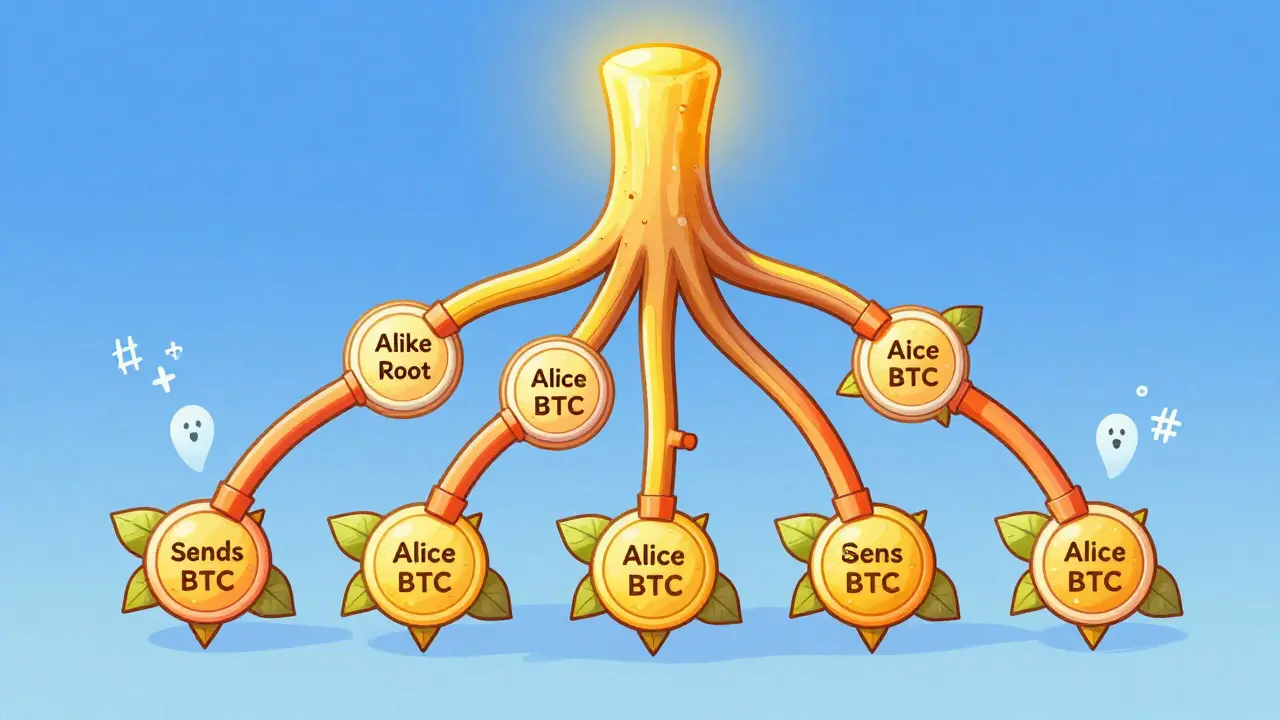
To understand why Merkle trees are so powerful, you need to see how they are built. Think of a tree upside down. The roots are at the top, and the branches spread out below. In a Merkle tree, the "leaves" at the bottom are individual transactions. Each transaction is hashed-a mathematical process that turns any amount of data into a fixed-size string of characters.
Here is how the process works step-by-step:
- Hashing Leaves: Every individual transaction (e.g., Alice sends 1 BTC to Bob) is hashed individually. These are the leaf nodes.
- Pairing Hashes: The system takes two adjacent hashes and combines them, then hashes the result together. For example, Hash(A + B) becomes a new parent node.
- Repeating Upwards: This pairing and hashing continues up the tree. If there is an odd number of hashes, the last one is duplicated to ensure pairs exist.
- The Merkle Root: Eventually, all these combined hashes converge into a single hash at the very top. This is the Merkle root.
This Merkle root is then stored in the block header of the blockchain. It acts as a summary for every single transaction in that block. Because cryptographic hashes are deterministic, even a microscopic change in one transaction changes the final root completely. This creates a chain of trust from the bottom up.
Efficient Verification with SPV
The most immediate benefit of Merkle trees is enabling Simple Payment Verification (SPV), also known as light client verification. Full nodes-computers that store the entire blockchain history-have plenty of storage and bandwidth. But your smartphone does not. It cannot download terabytes of blockchain data.
With SPV, a light client doesn't need the whole block. To verify that your transaction is in a block, the network only needs to send you the Merkle proof. This proof consists of:
- The hash of your specific transaction.
- The hashes of its sibling nodes along the path to the root.
- The Merkle root itself (which is already in the block header).
You re-calculate the hash path locally. If the result matches the Merkle root in the block header, your transaction is confirmed. You verified it without downloading the other thousands of transactions in that block. This reduces data transfer from megabytes to mere kilobytes. For a user in Wellington checking their balance on a mobile app, this means instant confirmation instead of hours of syncing.
Data Compression and Storage Efficiency
Blockchain networks grow larger every day. Bitcoin's blockchain exceeds hundreds of gigabytes. If every node had to store raw transaction data redundantly, decentralization would suffer because fewer people could afford the hardware to run a node.
Merkle trees provide significant data compression. Instead of storing the full content of every transaction repeatedly across different verification processes, nodes primarily rely on the hash pointers. The Merkle root is a fixed size-256 bits for SHA-256 used in Bitcoin-regardless of whether the block contains 10 transactions or 10,000.
This efficiency extends to synchronization. When a new node joins the network, it can request block headers first. By comparing Merkle roots, it can quickly identify which blocks it has and which it needs. It doesn't have to download the entire dataset blindly. This lowers the barrier to entry for running a node, keeping the network decentralized and resilient against centralization by large mining pools or corporations.
Tamper Detection and Data Integrity
Security in cryptocurrency relies on the assumption that data hasn't been altered. Merkle trees make tampering nearly impossible to hide. Because each hash depends on the ones below it, changing a single bit in a transaction changes its hash. That changed hash alters the parent hash, which alters the next level up, until the Merkle root itself changes.
If a malicious actor tries to modify a transaction in a past block-for example, changing the recipient address-the Merkle root of that block will no longer match the root recorded in subsequent blocks. Since each block header contains the hash of the previous block's header, the entire chain after the tampered block becomes invalid. Miners and nodes instantly detect this discrepancy. The network rejects the altered block because the cryptographic signature no longer aligns with the consensus state.
This property ensures that once a transaction is buried deep enough in the blockchain, altering it requires redoing the proof-of-work for that block and all following blocks. Combined with the Merkle tree's structural integrity, this makes historical records immutable.
Collision Resistance and Cryptographic Strength
Merkle trees rely on cryptographic hash functions like SHA-256. A critical feature of these functions is collision resistance. This means it is computationally infeasible to find two different inputs that produce the same hash output.
In the context of a Merkle tree, this guarantees uniqueness. No two different sets of transactions can produce the same Merkle root. If someone tried to swap a valid transaction with a fraudulent one that happened to generate the same intermediate hash, they would need to break the underlying cryptography. With current computing power, including quantum-resistant considerations for future upgrades, breaking SHA-256 collision resistance is effectively impossible. This gives users absolute confidence that the data represented by the root is exactly what was agreed upon by the network.
| Feature | Linear List / Flat Database | Merkle Tree |
|---|---|---|
| Verification Speed | Slow (requires scanning entire list) | Fast (logarithmic time complexity) |
| Data Required for Proof | Full dataset | Only sibling hashes (Merkle branch) |
| Tamper Evidence | Hard to detect without checksums | Immediate detection via root mismatch |
| Storage Overhead | High (redundant data) | Low (compact hash representation) |
| Scalability | Poor for distributed networks | Excellent for light clients |

Supporting Advanced Blockchain Features
Beyond basic transaction verification, Merkle trees enable advanced features that modern cryptocurrencies rely on. One key application is Merkle Proofs for State Channels. State channels allow users to transact off-chain and settle results on-chain later. To do this securely, both parties must agree on the latest state. A Merkle proof allows one party to present evidence of the agreed-upon state without revealing all previous interactions, ensuring privacy and efficiency.
Another critical use is in Bitcoin Core pruning. Pruned nodes delete old block data to save space but keep the block headers. Thanks to Merkle trees, pruned nodes can still verify if a specific transaction ever occurred in the past by requesting the relevant Merkle branch from a full node. This balances storage constraints with security verification.
Furthermore, Merkle trees facilitate efficient synchronization between different blockchain implementations. Whether you are using a wallet based on Electrum, Sparrow, or a hardware device like Ledger, the underlying verification logic remains consistent because it relies on the universal mathematical properties of the Merkle root.
Practical Implications for Users and Developers
For everyday users, the benefits of Merkle trees are invisible but vital. When you send crypto from a mobile wallet, you aren't running a full node. You are relying on SPV. The speed and reliability of that transaction check depend entirely on the Merkle tree structure. Without it, mobile wallets would be impractical due to battery drain and storage limits.
For developers building decentralized applications (dApps), understanding Merkle trees is crucial for optimizing gas costs and data retrieval. Storing large datasets on-chain is expensive. By storing only the Merkle root on-chain and keeping the actual data off-chain (in IPFS or Arweave), developers can allow users to verify the authenticity of off-chain data cheaply. This pattern, known as commitment schemes, is foundational for Layer 2 scaling solutions like Optimistic Rollups and ZK-Rollups.
In essence, Merkle trees transform blockchain from a bloated ledger into a streamlined, verifiable database. They bridge the gap between the need for total transparency and the reality of limited computational resources.
What happens if a transaction is removed from a Merkle tree?
If a transaction is removed, the hash of its leaf node disappears. This forces the recalculation of all parent hashes up to the root. Consequently, the Merkle root changes entirely. Any node verifying the block will see a mismatch between the new root and the expected root, signaling that the block's contents have been altered.
Can Merkle trees handle an odd number of transactions?
Yes. If a layer in the tree has an odd number of hashes, the last hash is duplicated to create a pair. For example, if there are three transactions A, B, and C, the tree pairs A and B, and then pairs C with C. This ensures the tree always converges to a single root.
Why don't we just use a simple checksum for the whole block?
A simple checksum verifies the integrity of the entire block but doesn't help you prove that a *specific* transaction is inside it without downloading everything. Merkle trees allow for partial verification (SPV). You can prove membership of one item without seeing the rest, which is essential for light clients.
Are Merkle trees used outside of cryptocurrency?
Yes. Merkle trees are used in file-sharing protocols like BitTorrent to verify file chunks, in Git for version control to track changes efficiently, and in various database systems to detect corruption. Their ability to provide efficient integrity checks makes them versatile across computer science.
How does a Merkle tree improve blockchain scalability?
By reducing the amount of data needed for verification, Merkle trees allow more participants to validate the network without heavy hardware. This supports decentralization. Additionally, they enable Layer 2 solutions where thousands of transactions are batched into a single Merkle root submitted to the main chain, drastically increasing throughput.