How to Set Stop-Loss for Bitcoin: A Practical Guide

Oct, 8 2026
Imagine waking up to find your Bitcoin position has dropped 15% overnight while you were asleep. You didn't check the charts at 3 AM in Wellington because you thought you had a safety net. But maybe you didn't set one, or worse, you set it too tight and got shaken out before the price recovered. This is the nightmare scenario for most crypto traders. The solution isn't just "watching the market"-it's understanding exactly how to configure a stop-loss order that actually works in Bitcoin's chaotic environment.
This guide cuts through the noise. We aren't here to tell you what Bitcoin will do next week. We're here to show you how to protect your capital when it goes sideways-or straight down. Whether you are using Binance, Coinbase, or a decentralized exchange, the principles of risk management remain the same. Let's get your positions protected.
Why Standard Stop-Losses Fail in Crypto
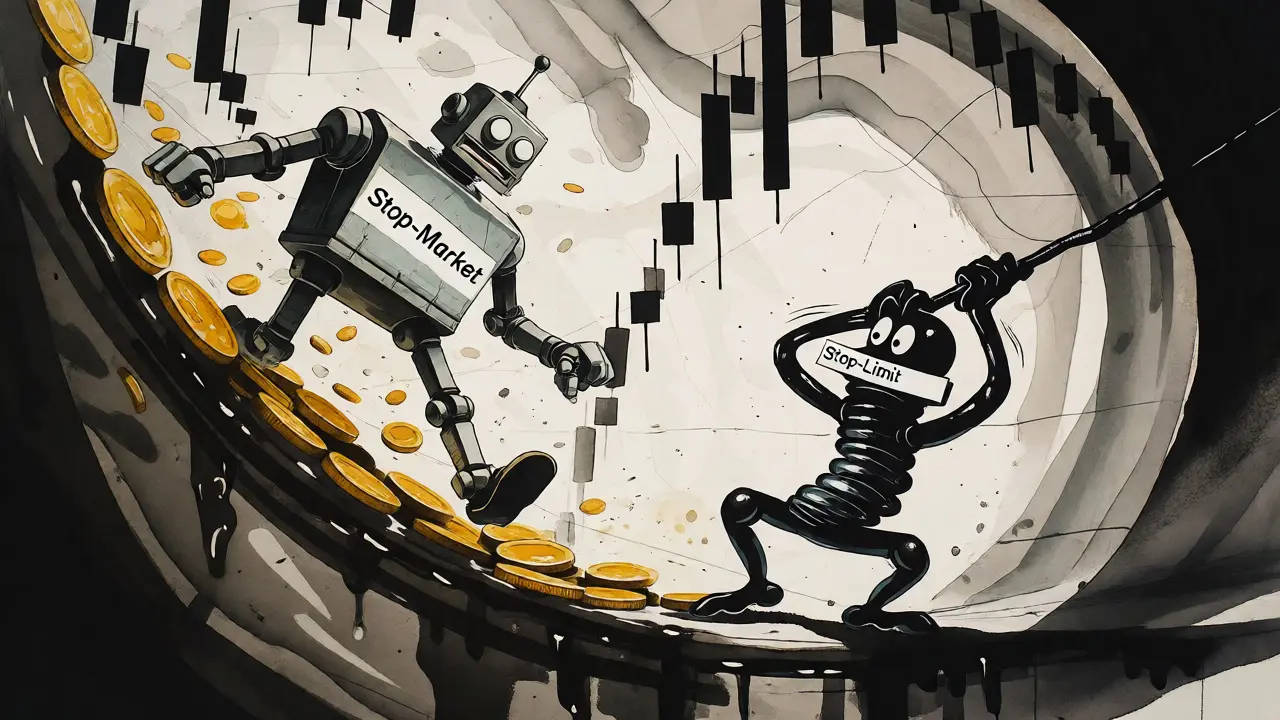
In traditional stock markets, a stop-loss usually triggers a market sell order at the next available price. It’s straightforward. In Bitcoin, it’s messy. Why? Because Bitcoin trades 24/7 with extreme volatility. A "market" stop-loss converts to a market order once the trigger price is hit. If the price crashes rapidly, you might get filled significantly lower than your stop price. This is called slippage.
For example, if you set a stop-loss at $60,000 but a flash crash drops the price to $59,500 instantly, your order executes at $59,500 or even lower. You lose more than you planned. To combat this, many traders use a stop-limit order. This sets two prices: a "stop" price (trigger) and a "limit" price (the worst price you’ll accept). If the market gaps below your limit, the order doesn’t fill. You stay in the trade, but you risk holding a bag if the price keeps falling. Choosing between these two depends on whether you prioritize guaranteed exit (market) or guaranteed price (limit).
Determining Your Risk Per Trade
Before you pick a number for your stop-loss, you need to know how much money you can afford to lose. Professional traders rarely risk more than 1-2% of their total account balance on a single trade. If you have $10,000 in your portfolio, your maximum loss per trade should be $100 to $200.
This calculation dictates where your stop-loss goes, not the other way around. Here is the formula:
- Account Balance: $10,000
- Risk Tolerance: 1% ($100)
- Entry Price: $60,000
- Stop-Loss Distance: 5% below entry ($3,000 drop)
- Position Size: $100 risk / $3,000 distance = 0.033 BTC
If you don't adjust your position size based on the stop-loss distance, you’re gambling, not trading. A wider stop-loss requires a smaller position size to keep the dollar risk constant. Ignoring this leads to blown accounts during high-volatility events like ETF approvals or Fed rate announcements.
Strategic Placement: Technical Levels vs. Arbitrary Percentages
Newbies often set stops at arbitrary numbers, like "I'll put it 5% down." This is dangerous because Bitcoin ignores round percentages. Instead, look at the chart. Where are the buyers likely to step in? These are support levels.
A smart stop-loss sits just below a key support level. If Bitcoin has bounced off $58,000 three times recently, setting your stop at $58,000 is risky because market makers often push the price slightly below obvious levels to trigger stops before reversing. Place your stop at $57,800 instead. This gives the price room to breathe without invalidating your thesis.
| Strategy | Best For | Pros | Cons |
|---|---|---|---|
| Fixed Percentage | Beginners, low-frequency trading | Easy to calculate, consistent | Ignores market structure, prone to noise |
| Support Level | Swing traders, trend followers | Logical placement, avoids noise | Requires technical analysis skills |
| ATR-Based | Volatility-adjusted trading | Adapts to market speed | Complex setup, needs indicator knowledge |
Another robust method uses the Average True Range (ATR) indicator. The ATR measures volatility. If the daily ATR is $2,000, setting a stop-loss only $500 away is suicide-you’ll get stopped out by normal noise. A common rule is to set the stop 1.5x to 2x the ATR below your entry. This ensures your stop is outside the range of random market fluctuations.
The Power of Trailing Stops
Once you’re in profit, your job changes from protecting capital to locking in gains. A static stop-loss leaves money on the table if Bitcoin rallies hard. Enter the trailing stop.
A trailing stop moves automatically as the price moves in your favor. If you buy at $60,000 and set a 5% trailing stop, the stop starts at $57,000. If Bitcoin hits $65,000, the stop rises to $61,750. You’ve locked in profit. If the price then drops to $61,750, you sell. You captured the upside but protected against a reversal.
Be careful with the percentage. Too tight (e.g., 1%) and you’ll get shaken out during minor pullbacks. Too wide (e.g., 10%) and you give back too much profit. For Bitcoin, a 3-5% trailing stop is often a sweet spot for swing trades, while day traders might use tighter trails based on minute-chart volatility.

Common Mistakes That Kill Trades
Even experienced traders fall into traps. The biggest one is moving the stop-loss further away after entering a trade. You bought at $60,000, set a stop at $58,000, and the price drops to $58,500. Panic sets in. You move the stop to $56,000, hoping it bounces. Often, it keeps dropping. Never widen a stop-loss unless your original technical analysis was wrong. Usually, you should only tighten it (move it closer to current price) as profits accumulate.
Another error is placing stops at exact round numbers like $60,000 or $50,000. These are psychological levels where huge clusters of orders sit. When the price hits $60,000, liquidity dries up momentarily as everyone tries to sell or buy simultaneously, causing spikes. Placing your stop slightly below these levels ($59,950) helps avoid being triggered by temporary wicks.
Implementation Across Exchanges
Not all platforms handle stop-losses the same way. On centralized exchanges like Kraken or Bitstamp, stop-losses are server-side. They execute even if your internet dies or your computer turns off. This is crucial for Bitcoin’s 24/7 nature.
However, some DeFi protocols rely on client-side execution or oracle-based triggers, which can lag. Always verify if your stop is active on the exchange’s servers. Also, check fees. Some exchanges charge a maker/taker fee for stop-market orders, while others treat them differently. Ensure you understand the cost basis before assuming a small stop-loss is "free."
What happens if Bitcoin gaps down past my stop-loss?
If you used a standard stop-market order, it will execute at the next available price, which could be significantly lower than your stop price. This is slippage. If you used a stop-limit order, the order may not fill at all if the gap skips over your limit price, leaving you exposed to further losses until the price recovers or you manually intervene.
Is a stop-loss guaranteed to execute at my specified price?
No. A stop-loss guarantees execution, not price. In fast-moving markets, especially during news events or liquidation cascades, the actual execution price can differ from your trigger price. Only limit orders guarantee a specific price, but they do not guarantee execution.
How far should I set my stop-loss for Bitcoin?
There is no fixed distance. It depends on your strategy. Short-term traders might use 1-3%, while long-term holders might use 10-20%. The best approach is to place it below recent support levels or use an ATR multiple (e.g., 2x ATR) to account for current volatility, ensuring you aren't stopped out by normal market noise.
Can I change my stop-loss after placing it?
Yes, you can modify or cancel stop-loss orders at any time before they trigger. However, discipline is key. Avoid moving stops further away to avoid realizing a loss. Generally, you should only move stops closer to the current price (tightening) to lock in profits, never further away to hope for a recovery.
Do stop-losses work on weekends or holidays?
Yes. Unlike stock markets, cryptocurrency exchanges operate 24/7. Server-side stop-loss orders remain active during weekends, holidays, and off-hours. This is one of the primary reasons automated risk management tools are essential for Bitcoin traders.