(NIGHT) Midnight Airdrop by Cardano: Glacier Drop Details, Eligibility & Status

Jun, 18 2026
Did you miss the biggest privacy-focused crypto distribution of 2025? The Midnight Network is a privacy-centric sidechain built on the Cardano ecosystem designed to bring rational privacy to blockchain technology recently completed its massive "Glacier Drop" airdrop. If you were holding assets on Bitcoin, Ethereum, or Cardano back in June 2025, you might have been eligible for free NIGHT tokens. But here is the catch: the primary claiming window closed on October 4, 2025. Since today is June 18, 2026, the initial opportunity has passed. However, understanding how this event worked, why it matters for the future of privacy tech, and what happens to unclaimed tokens is crucial for anyone interested in the next phase of decentralized finance.
This isn't just another marketing stunt. This was a structural experiment in tokenomics aimed at solving the tension between transparency and privacy. Let's break down exactly what happened, who got paid, and where things stand now.
The Core Concept: Rational Privacy on Cardano
Most blockchains force a choice. You either have total transparency like Bitcoin, where every transaction is public, or you have privacy coins that often struggle with regulatory compliance. Charles Hoskinson, the founder of Cardano, created Midnight to bridge this gap. The goal is "rational privacy." This means users can choose what data they reveal. It allows for selective disclosure, enabling both regulatory compliance (like KYC checks) and user protection (keeping financial details private).
NIGHT is the native utility token of this network. It serves as the governance and staking asset. Alongside it, there is a second token called DUST, which handles transaction fees. This dual-token model separates governance rights from operational costs, a design choice intended to stabilize the network's economics over time.
Glacier Drop: How the Airdrop Worked
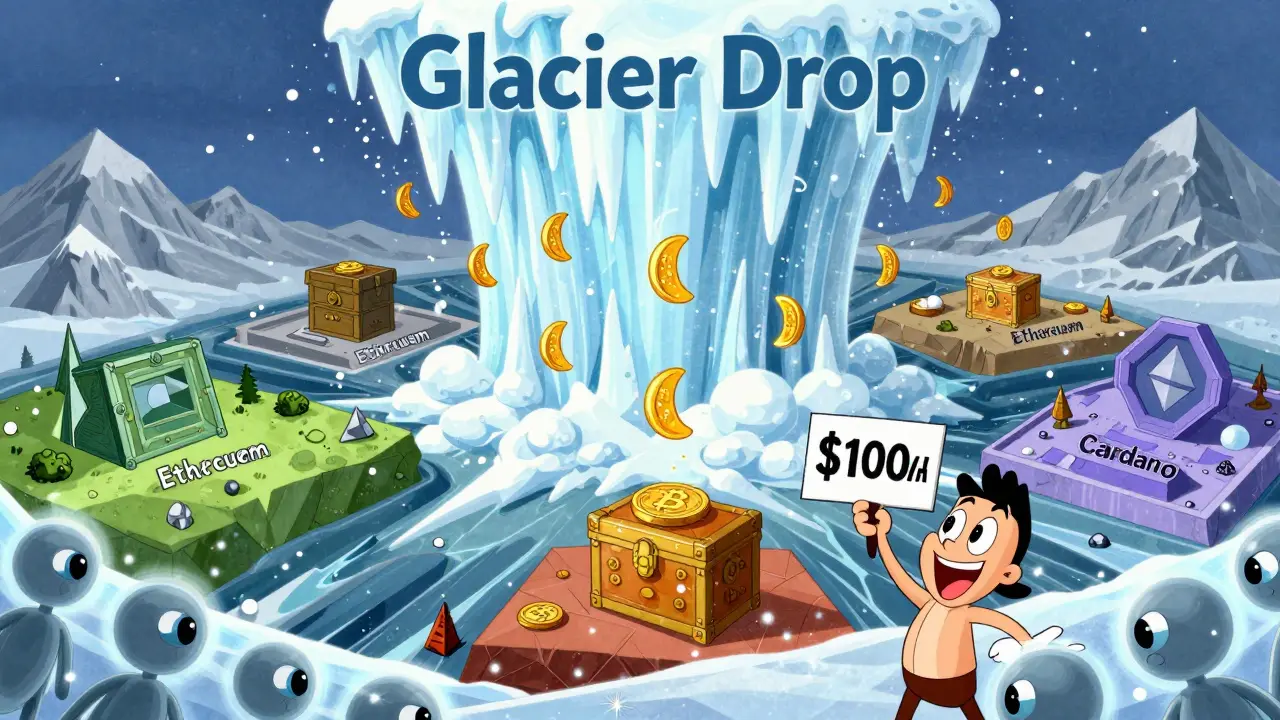
The "Glacier Drop" was the first phase of distributing 24 billion NIGHT tokens-the entire genesis mint. The project didn't just target Cardano users; they cast a wide net across eight major blockchain ecosystems. Here is how the eligibility and allocation broke down:
| Blockchain Ecosystem | Allocation Share | Approx. Tokens |
|---|---|---|
| Cardano (ADA) | 50% | 12 Billion |
| Bitcoin (BTC) | 20% | 4.8 Billion |
| Ethereum (ETH), XRP, Solana, AVAX, BNB, BAT | 30% (Shared Proportionally) | 7.2 Billion Total |
To qualify, you needed to hold at least $100 worth of cryptocurrency in the native asset of any supported chain at the time of the snapshot. The snapshot date was June 11, 2025. This dollar-value threshold was key. It meant if Bitcoin was trading at $50,000, you only needed about 0.002 BTC. If Cardano was at $2.50, you needed roughly 40 ADA. This approach filtered out bot accounts while remaining accessible to genuine retail holders.
The Claiming Process: Why It Was Strict
Claiming wasn't as simple as connecting a wallet and clicking "claim." The process required two cryptographic proofs to ensure security and prevent Sybil attacks (where one person creates multiple fake identities). The portal opened in July-August 2025 and closed firmly on October 4, 2025.
- Wallet Connection: Users connected their source wallet (e.g., MetaMask for Ethereum, Yoroi for Cardano) to the official claim portal.
- Custody Proof: You had to sign a message proving you controlled the private keys. This automatically excluded most centralized exchange users (like those on Coinbase or Binance) unless the exchange specifically acted as a custodian, which rarely happened.
- Destination Address: You provided a fresh, unused Cardano wallet address to receive the NIGHT tokens. Even if you claimed via your Bitcoin wallet, the tokens arrived on the Cardano network.
This requirement for self-custody wallets was a major friction point. Many people held crypto on exchanges and missed out because they couldn't provide the necessary signature proof. Additionally, non-Cardano users had to set up a new Cardano wallet, adding a layer of complexity for those unfamiliar with the ecosystem.
Vesting Schedule: No Immediate Dumping
If you successfully claimed your tokens, you didn't get full access immediately. Midnight implemented a strict vesting schedule to prevent speculative dumping. This is a common tactic in modern tokenomics to align incentives with long-term network health.
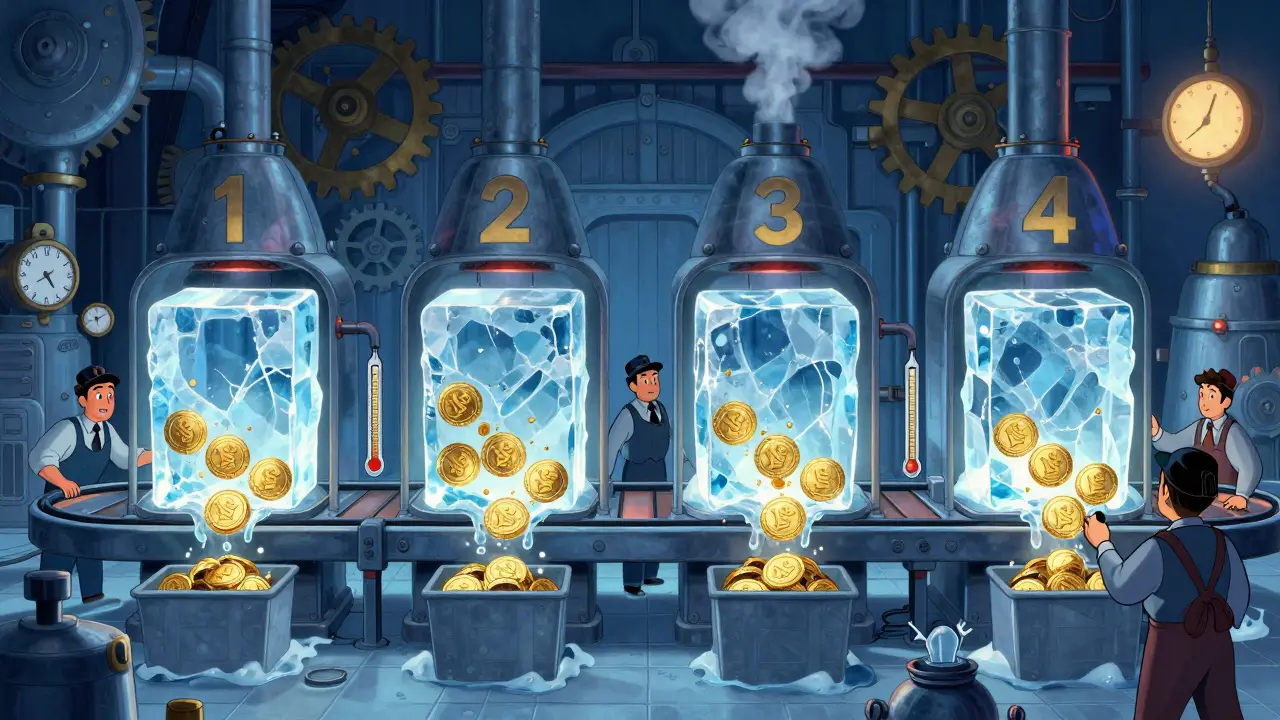
- Total Vesting Period: 360 days from the Midnight mainnet launch.
- Unlock Structure: Four equal phases, unlocking 25% of tokens every 90 days.
- Randomization: Unlock times are randomized within each 90-day window to prevent coordinated selling events.
Since the mainnet launch date triggers the start of this clock, the exact dates when tokens become tradable depend on when the network goes live. This "gradual thawing" mechanism ensures that early participants are incentivized to engage in governance and block production rather than just selling for profit.
What Happens to Unclaimed Tokens?
You might be wondering, "I missed the deadline. Is my money gone?" Not exactly. The 24 billion NIGHT supply must enter circulation through community participation. Unclaimed tokens from the Glacier Drop roll into subsequent phases:
Phase 2: Scavenger Mine
Tokens not claimed during the initial window are redistributed here. Participants earn shares by solving public-good computational puzzles. This serves a dual purpose: distributing tokens to engaged community members and bootstrapping network infrastructure through useful computation.
Phase 3: Lost-and-Found
Any remaining tokens after the Scavenger Mine become available in this final recovery phase post-mainnet launch. This three-phase cascade ensures no tokens remain locked forever, maximizing decentralization.
Current Status as of June 2026
As we sit in mid-2026, the Glacier Drop is history. The primary claiming window closed months ago. The focus has shifted entirely to the development of the Midnight mainnet and the ongoing Scavenger Mine phase. For those who claimed, the wait continues until the mainnet launch triggers the vesting clock. For those who missed out, the Scavenger Mine offers a secondary, albeit more labor-intensive, path to acquiring NIGHT tokens.
The success of Midnight will ultimately depend on whether "rational privacy" gains traction among developers and enterprises. If the dual-token model holds and the privacy features prove usable without compromising compliance, NIGHT could become a cornerstone of the Cardano ecosystem's expansion beyond simple value transfer.
Can I still claim my Midnight NIGHT tokens?
No, the primary Glacier Drop claiming window closed on October 4, 2025. If you did not claim your tokens by this date, you missed the initial distribution. However, unclaimed tokens are moving into the "Scavenger Mine" phase, where they can be earned through computational puzzles.
Why did I need a Cardano wallet to claim tokens if I held Bitcoin?
Midnight is a sidechain built on the Cardano ecosystem. While eligibility was checked across eight blockchains including Bitcoin, the NIGHT tokens themselves exist on the Cardano network. Therefore, all recipients must provide a valid Cardano wallet address to receive their allocation.
Are NIGHT tokens immediately tradable after claiming?
No. NIGHT tokens follow a 360-day vesting schedule starting from the Midnight mainnet launch. Tokens unlock in four equal phases of 25% every 90 days. This prevents immediate selling pressure and encourages long-term participation.
Who was eligible for the Glacier Drop?
Eligible users were those who held at least $100 worth of native assets (such as ADA, BTC, ETH, SOL, etc.) in self-custody wallets at the time of the snapshot on June 11, 2025. Addresses flagged on OFAC sanctions lists were excluded.
What is the difference between NIGHT and DUST tokens?
NIGHT is the utility and governance token used for staking and voting within the Midnight network. DUST is the resource token used to pay for transaction fees. This separation helps stabilize the economic model by decoupling governance value from operational costs.