What is OpenVPP (OVPP) Crypto? The Internet of Energy Explained
Oct, 25 2026
Imagine if your electric car paid you for the electricity it stored in its battery, or if your home solar panels settled their earnings with the utility company instantly, rather than waiting weeks for a check. That’s the promise behind OpenVPP, often abbreviated as OVPP. It isn’t just another meme coin chasing hype cycles; it’s a specialized cryptocurrency token designed to act as the financial and communication backbone for the "Internet of Energy." As of late 2026, this project has shifted its focus from Ethereum to the Base network, aiming to solve one of the biggest bottlenecks in modern power grids: how to pay millions of small devices quickly and cheaply.
If you’ve been wondering whether this niche token has real substance or if it’s just vaporware wrapped in green energy buzzwords, you’re asking the right questions. The energy sector is messy. It’s full of legacy systems, slow payments, and fragmented data. OpenVPP claims to fix this by creating a standardized way for devices like EVs, batteries, and smart thermostats to talk to each other and settle transactions on-chain. But does it work? And what should you actually look for before putting money into OVPP?
The Core Problem: Why Energy Needs Blockchain
Traditional utilities operate on old rules. If you sell excess solar power back to the grid, you might wait 30 to 90 days for settlement. If an aggregator manages a fleet of electric vehicles, they often use proprietary, closed-door software that doesn’t play nice with others. This fragmentation costs money and time. OpenVPP proposes a solution called the "Internet of Energy," which functions like a domain-name system for distributed energy resources (DERs).
Think of DERs as anything that can generate, store, or shift electricity usage-your roof solar, your Tesla, your home battery. Right now, these devices are islands. OpenVPP tries to build bridges between them using two main layers:
- The Consumer Layer: Running on Base, this handles fast, low-cost everyday transactions. It’s where your device gets rewarded for helping the grid.
- The Utility Layer: Proposed to run on Arc (Circle’s enterprise environment), this targets big players like grid operators and large fleets who need robust, high-volume settlement capabilities.
The goal is simple: replace gift-card-style rewards and slow bank transfers with direct, programmable stablecoin payments and transparent on-chain records. Instead of trusting a central database, you trust the code.
How OVPP Works: Tokens, Oracles, and Rewards
At the heart of the system is the OVPP token. With a maximum supply capped at 1 billion tokens, OVPP serves multiple purposes within the ecosystem. It’s not just a speculative asset; it’s meant to be used for governance, paying gas fees within the platform, and participating in utility programs.
One interesting feature is the concept of "energy-native units." In standard crypto, you trade dollars or ETH. In OpenVPP, the protocol aims to tokenize things like 1 kWh of electricity or 1 kilogram of CO2 offset. This allows for more precise trading and accounting. For example, a utility could buy exactly 500 kWh of demand response from a neighborhood’s aggregated batteries, settling the transaction instantly in OVPP or a linked stablecoin.
| Feature | Traditional Utilities | OpenVPP Protocol |
|---|---|---|
| Settlement Time | 30-90 Days | Instant (On-chain) |
| Payment Method | Checks / Bank Transfers | Stablecoins / OVPP Tokens |
| Data Transparency | Private Silos | Public Ledger Records |
| Integration | Proprietary APIs | Standardized Open Standards |
This model relies heavily on oracles-services that feed real-world data (like meter readings) onto the blockchain. If the oracle fails or reports bad data, the whole settlement mechanism breaks. So, while the idea is sleek, the technical execution is tricky.
The Migration: From Ethereum to Base
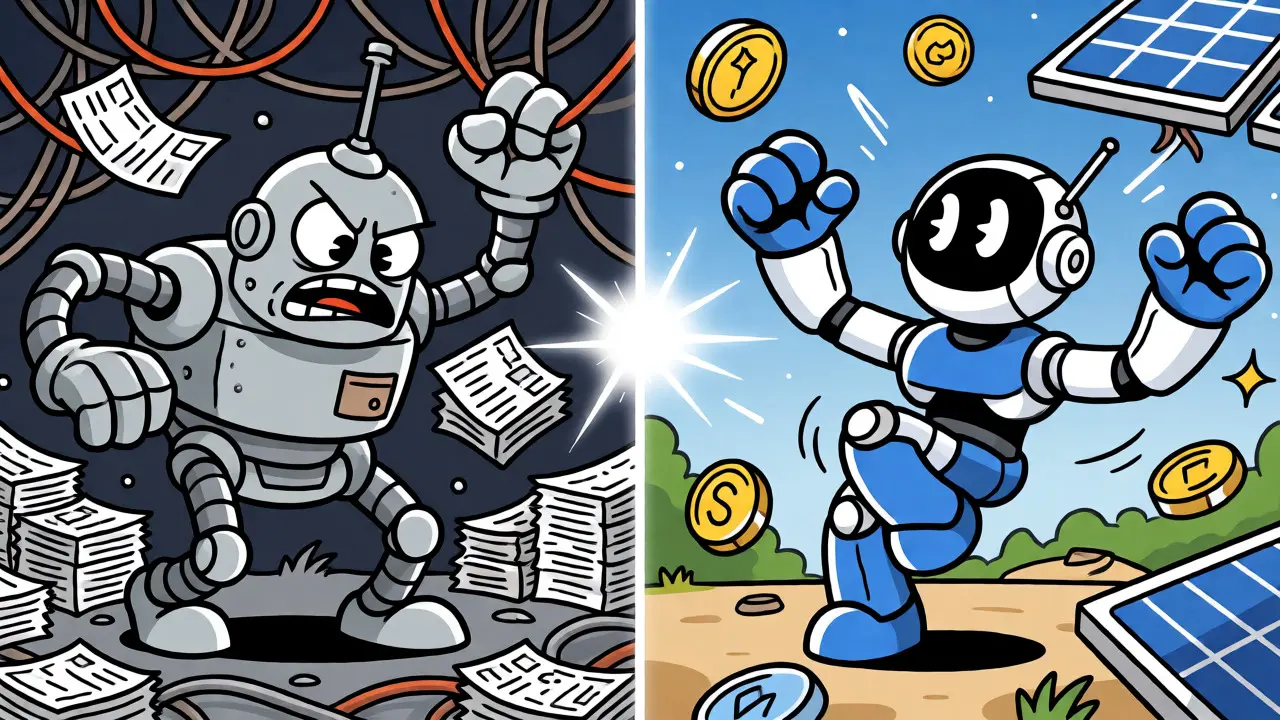
A critical detail for anyone looking at OVPP history is its move from Ethereum to Base. Originally, the token lived on Ethereum, but high gas fees made micropayments impractical. You can’t afford to pay $5 in gas fees to earn $0.10 from your solar panel. By migrating to Base, an Ethereum Layer-2 network, OpenVPP slashed transaction costs significantly.
In March 2026, the project announced this migration, instructing holders to switch to the new contract address on Base. If you held OVPP on Ethereum, you were supposed to receive a 1:1 airdrop on Base. However, this transition introduced risks. Many users still hold the "old" token on Ethereum, which trades separately and has much lower liquidity. Always verify the contract address before sending funds. The current active contract on Base is essential for interacting with the live dashboard and earning rewards.
Market Reality: Price, Liquidity, and Risks
Let’s look at the numbers. As of October 2026, OVPP is a small-cap token. Market data varies wildly depending on where you look, which is typical for thin markets. Some trackers show a market cap around $500,000, while others report closer to $900,000. This discrepancy often comes down to how different sites calculate circulating supply versus total supply, especially after a migration.
Trading volume is also modest. Most activity happens on decentralized exchanges like Aerodrome on Base, with some support on centralized platforms like MEXC. Low volume means high slippage-if you try to sell a large amount of OVPP, you might crash the price temporarily. It’s a classic micro-cap scenario: high potential upside if adoption takes off, but severe downside risk if liquidity dries up.
Here are the key risks you need to weigh:
- Adoption Gap: The tech exists, but have major utilities signed on? The official website shows a demo dashboard with hundreds of devices, but independent verification of production-scale utility contracts is scarce.
- Tokenomics Clarity: While the total supply is fixed at 1 billion, detailed vesting schedules for team and investor allocations aren’t always fully public. This raises concerns about future sell pressure.
- Regulatory Uncertainty: Tokenizing energy commodities puts OpenVPP in a gray area between securities law and commodity regulation.
- Competition: Established players like AutoGrid or Schneider Electric are already working on similar solutions, sometimes without the crypto component.

Who Is Behind OpenVPP?
Transparency matters in crypto. OpenVPP identifies Parth K as its CEO and founder. His background includes roles at AutoGrid (a Schneider Electric company) and Exelon Corporation, giving him relevant industry experience. Michael G, the founder of Grid Rails, is listed as an advisor. These connections suggest the team understands the energy sector, even if the crypto implementation is still young.
However, unlike Bitcoin or Ethereum, there are no massive, publicly traded parent companies backing OpenVPP directly. It operates under the OpenVPP Energy Foundation. Due diligence here means checking social media activity, GitHub commits, and community engagement levels. A quiet GitHub repo or stagnant Discord server can be red flags for abandoned projects.
Should You Buy OVPP? A Checklist
If you’re considering adding OVPP to your portfolio, treat it as a high-risk venture capital bet, not a safe haven. Here’s a practical checklist before you buy:
- Verify the Contract: Ensure you are buying the Base version of OVPP, not the obsolete Ethereum one.
- Check Liquidity Pools: Look at Aerodrome or other DEXes to see if there’s enough depth to enter and exit positions without huge losses.
- Read the Whitepaper Updates: Has the team updated their roadmap since the Base migration? Are they delivering on promises?
- Monitor Utility Partnerships: Keep an eye out for press releases confirming actual integrations with named utility companies or device manufacturers.
OpenVPP addresses a genuine problem in the energy sector. Decentralized energy needs decentralized payment rails. But solving the technical challenge is only half the battle; winning over conservative utility providers is the other half. Until we see real-world settlements happening daily across thousands of homes, OVPP remains a speculative play on the future of green energy infrastructure.
Is OpenVPP a scam?
There is no evidence suggesting OpenVPP is a scam. It has a functional product, a known team with industry backgrounds, and a live token on the Base network. However, it is a very small-cap project with limited verified commercial adoption, so it carries significant investment risk compared to established cryptocurrencies.
Where can I buy OVPP tokens?
The primary venue for trading OVPP is currently Aerodrome Finance on the Base network. Some centralized exchanges like MEXC may also list the token, but liquidity is generally higher on decentralized exchanges due to the token's small size.
Did OpenVPP migrate from Ethereum?
Yes, in early 2026, OpenVPP migrated its primary operations and token contract from Ethereum to Base to reduce transaction fees. Holders were instructed to claim a 1:1 airdrop of the new Base tokens. The old Ethereum contract still exists but has negligible liquidity and activity.
What is the total supply of OVPP?
The maximum total supply of OVPP is fixed at 1,000,000,000 tokens. Circulating supply estimates vary between 800 million and 820 million as of late 2026, depending on the data provider and how they account for locked or burned tokens.
Does OpenVPP have a wallet?
OpenVPP integrates with standard EVM-compatible wallets like MetaMask and Coinbase Wallet. Since it runs on Base, any wallet that supports Base network transactions can hold and interact with OVPP tokens.