What is Treble (TREB) Crypto? A Deep Dive into the Base Chain DeFi Hub

Oct, 6 2026
You’re scrolling through your wallet, seeing a new token called TREB popping up on the Base network. You’ve heard whispers about it being the "next big DeFi play," but you have no idea what it actually does or why anyone cares. Is it another meme coin with zero utility, or is there real tech underneath the hype?
Here’s the reality: Treble is a decentralized finance platform native to the Base blockchain, officially described as the first modular V4 DEX providing a full-suite DeFi Hub. It’s not just another swap interface. It’s trying to be everything for everyone-retail users who want to pay rent with crypto without KYC, and institutional traders who need leverage and API access-all on one chain. If you’re wondering whether this low-market-cap gem has legs or if it’s just vaporware, stick around. We’re breaking down the tech, the tokenomics, and the risks without the fluff.
The Core Tech: Why V4 Matters on Base
Most people hear "DEX" and think of Uniswap V2. But Treble isn’t running old code. It’s built on V4 DEX technology, which is the latest evolution in automated market makers (AMMs). Think of V3 as a highway where liquidity providers (LPs) have to manually pick their lanes. V4 makes those lanes dynamic and efficient, reducing gas costs and improving capital efficiency. On the Base network-a Layer 2 scaling solution developed by Coinbase-this efficiency translates directly into cheaper trades and faster settlements.
Treble Swap features concentrated liquidity ranges, meaning LPs can focus their funds where they’re most needed, rather than spreading them thin across all price points. It also includes auto-compounding fees, so your earnings grow automatically without you having to claim them every day. Plus, it supports Base-native limit orders. This is huge because most DEXs only offer market swaps. With limit orders, you can set a buy or sell price and walk away, letting the smart contract handle the execution when the market hits your target. That’s a feature usually reserved for centralized exchanges like Binance or Coinbase Pro, now brought to decentralized rails.
Beyond Swaps: The Full-Service DeFi Hub
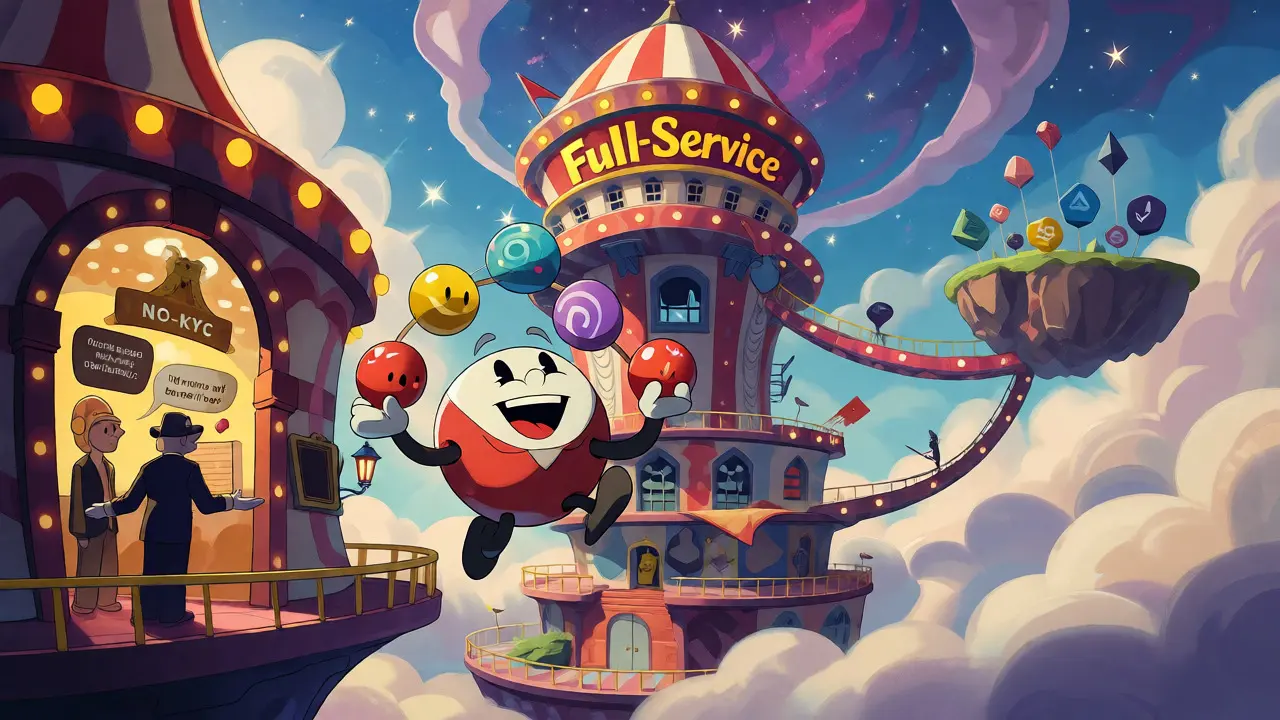
If Treble were just a swap site, it would compete with dozens of other DEXs on Base. Instead, it positions itself as a DeFi Hub that integrates multiple financial services into one interface. This modular design is its biggest differentiator. Let’s look at what’s actually inside the box:
- Cross-Chain Swaps: You don’t need to bridge assets manually using third-party tools. Treble allows you to move assets between Base, Arbitrum, Ethereum, Optimism, BSC, Polygon, and Avalanche directly within the app.
- Fiat On/Off Ramp: Buy crypto with your credit card or bank transfer directly in the app. Sell crypto back to fiat without leaving the ecosystem.
- No-KYC Spending: This is the killer feature for retail users. You can use your crypto to pay hundreds of merchants for things like rent or mortgage payments without going through traditional banking checks or identity verification hurdles.
- Farming and Staking: Earn passive income by providing liquidity or staking TREB tokens. The rewards are optimized for the Base environment, often yielding higher APYs than older chains due to lower overhead.
- Lending and Perpetuals (Upcoming): The roadmap includes lending protocols and leverage trading, aiming to capture institutional volume that currently flows to platforms like Aave or GMX.
This "all-in-one" approach reduces friction. In traditional DeFi, you might use Uniswap for swaps, Aave for lending, and a separate bridge service for cross-chain moves. Treble tries to collapse that workflow into a single session.

Tokenomics: Supply, Allocation, and Value
Understanding the TREB token requires looking at its supply structure and how it was distributed. The total supply is capped between 42.33 million and 43.32 million tokens. This fixed supply creates scarcity, unlike inflationary models where new tokens are minted endlessly.
The distribution strategy followed a tiered presale model. During the strategic presale in December 2024, tokens were sold at $0.09 per unit. The minimum contribution was $100, and the maximum cap was $5,000 per participant. This structure suggests an attempt to balance institutional backing with retail accessibility. Private and pre-sale allocations accounted for roughly 20.31% of the supply, while public sales took another 15.12%. The rest is likely reserved for team vesting, ecosystem incentives, and liquidity pools.
As of late 2026, the token has shown significant volatility. Data from various aggregators shows prices fluctuating between $0.04 and $0.22 depending on the exchange and timeframe. The fully diluted valuation (FDV) hovers around $5.10 million, with a circulating market cap near $1.35 million. For context, established DEXs on Base often command valuations in the tens or hundreds of millions. This gap represents both the potential upside and the risk. If Treble captures even a fraction of the trading volume on Base, the token price could see substantial appreciation. But if adoption stalls, the low liquidity could lead to sharp drawdowns.
| Feature | Treble (Base) | Traditional DEX (e.g., Uniswap V3) |
|---|---|---|
| Core Technology | Modular V4 DEX | V3 AMM |
| Limit Orders | Native Support | Third-party integration required |
| Fiat Integration | Built-in On/Off Ramp | External providers needed |
| KYC Requirements | No-KYC spending options | Generally none for swapping, but ramps vary |
| Cross-Chain | Multi-chain support via UI | Often limited to single chain or complex bridging |
Risks and Red Flags to Watch
No investment is without risk, and early-stage DeFi projects carry specific dangers. First, check the security audits. While Treble uses proven V4 architecture mechanisms pioneered by Uniswap, independent verification of its custom smart contracts is critical. Always look for reports from reputable firms like CertiK or Hacken before committing large sums.
Liquidity is another concern. With a market cap under $2 million, slippage can be high for larger trades. If you try to swap $50,000 worth of TREB, you might move the price significantly against yourself. This illiquidity works both ways-it amplifies gains during rallies but accelerates losses during dumps.
Competition is fierce. Base hosts major players like Aerodrome and Uniswap. These competitors have massive user bases and deep liquidity pools. Treble needs to prove that its "hub" convenience outweighs the network effects of these giants. Execution risk is real; promises of lending and perpetuals must materialize on schedule, or investors will lose confidence.
Who Should Invest in TREB?
Treble isn’t for everyone. If you’re a long-term holder looking for stable blue-chip assets, this might be too speculative. However, if you believe in the growth of the Base ecosystem and want exposure to a platform that solves actual user pain points-like paying bills with crypto or easy cross-chain moves-TREB offers asymmetric upside.
Retail users benefit from the no-KYC spending and simplified UX. Institutional traders might find value in the upcoming leverage tools and API integrations. The key is to view TREB not just as a currency, but as equity in a growing service provider. Your returns depend on the platform’s ability to attract users and generate fee revenue.
Is Treble safe to use?
Treble utilizes standard blockchain security models and builds upon the battle-tested V4 DEX architecture. However, as an early-stage project, always verify recent security audit reports and start with small amounts to test the platform's stability and liquidity depth before committing significant capital.
Where can I buy TREB tokens?
You can purchase TREB primarily through the official Treble Swap interface at app.trebleswap.com. Some centralized exchanges like MEXC may also list the token, but availability varies. Ensure you are using the correct contract address on the Base network to avoid scams.
What is the total supply of TREB?
The total supply of TREB is capped at approximately 42.33 to 43.32 million tokens. This fixed supply helps create scarcity, potentially driving value up as demand for the platform's services increases over time.
Does Treble require KYC?
For basic swapping and farming, no KYC is typically required. However, Treble offers a unique no-KYC spending feature that allows users to pay merchants directly with crypto without undergoing traditional identity verification processes, distinguishing it from many centralized payment solutions.
Which blockchains does Treble support?
While Treble is native to the Base blockchain, its cross-chain swap functionality allows users to interact with assets from Ethereum, Arbitrum, Optimism, Binance Smart Chain, Polygon, and Avalanche, providing broad interoperability within the DeFi ecosystem.