Crypto for Financial Inclusion: How Blockchain Bypasses Banking Restrictions in Developing Nations

Jun, 20 2026
Imagine trying to send money home to your family, only to lose 10% of it to fees and wait a week for the cash to arrive. Now imagine doing that while your local currency loses half its value every year. This is the daily reality for billions of people in developing nations. Traditional banking systems are built on physical branches, strict identity checks, and rigid borders-barriers that lock out the poor. But there is a new tool emerging from the shadows of these restrictions: cryptocurrency.
Crypto isn't just about getting rich quick or trading memes online. For the estimated 1.4 billion unbanked adults globally, it represents a lifeline. It is a way to access financial services without needing a bank account, a passport, or permission from a government official. As we move through 2026, the conversation has shifted from "is crypto real?" to "how can crypto fix broken financial systems?" Let's look at how this technology is actually working on the ground, where it fails, and what it means for the future of global finance.
The Barrier of Traditional Banking
To understand why crypto matters, you first have to see what traditional banking gets wrong. Banks are designed for stability and compliance, not accessibility. They require proof of address, minimum balances, and extensive documentation. In rural Sub-Saharan Africa, where only 49% of adults held bank accounts in recent surveys, these requirements are impossible hurdles. A farmer might live hours away from the nearest branch. If they get paid in cash, storing that money under a mattress is risky. Putting it in a local bank is often worse due to high inflation eating away at savings.
This exclusion creates a shadow economy. People trade goods and services informally because they cannot participate in the formal system. They cannot get loans to start businesses, they cannot save securely, and they cannot easily receive money from relatives abroad. The World Bank has long documented this gap, but traditional solutions like microfinance have hit a ceiling. They are expensive to run and still rely on physical infrastructure. Crypto changes the equation by removing the middleman entirely.
How Crypto Bypasses Infrastructure Limits
Blockchain technology is a decentralized digital ledger that records transactions across many computers so that the record cannot be altered retroactively. For the average user, this technical jargon translates into one simple benefit: access via smartphone. You do not need a brick-and-mortar bank. You need an internet connection and a phone. That’s it.
In countries like Nigeria, Kenya, and South Africa, mobile penetration is high even when banking penetration is low. Cryptocurrency wallets can be created instantly. There is no credit check. No manager needs to approve your application. This immediacy is powerful. It allows individuals to enter the global financial network with zero friction. Unlike traditional banks that operate within national borders, blockchains are borderless. A person in Manila can send value to someone in Lagos as easily as sending an email. This decentralization means no single entity can shut down your ability to transact, provided the network remains online.
Remittances: Cutting the Cost of Sending Home
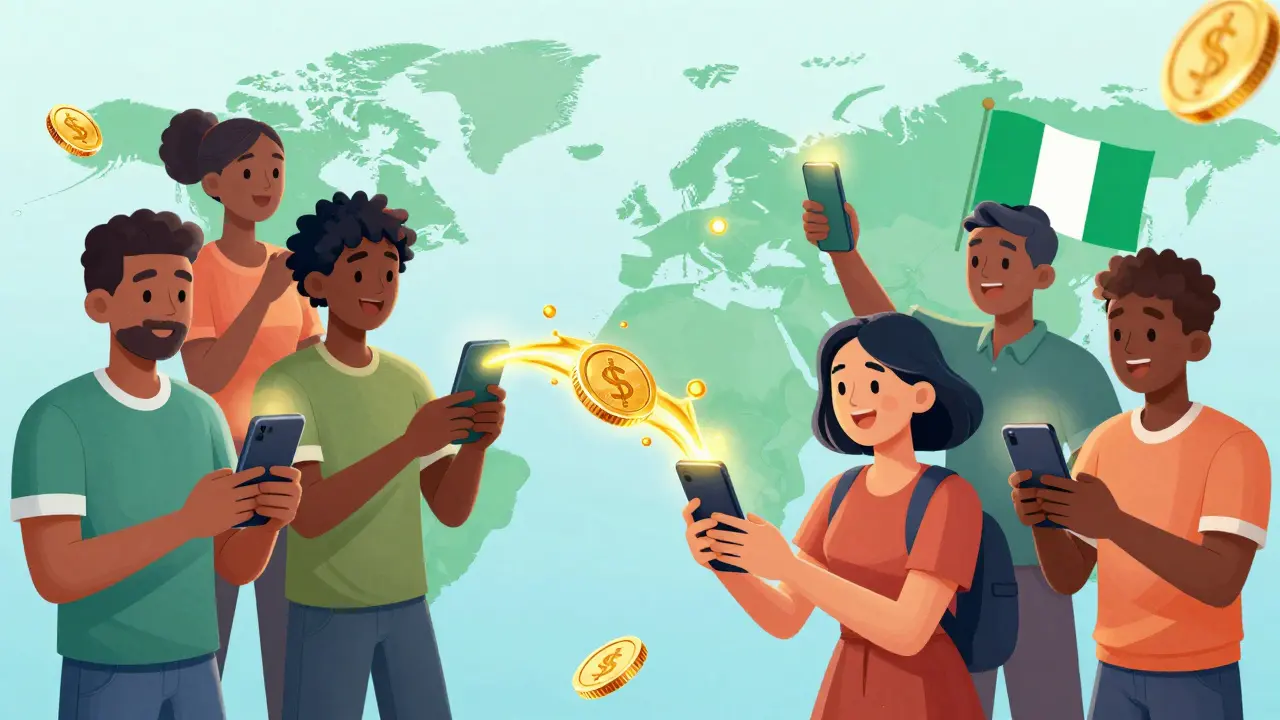
One of the most immediate impacts of crypto is on remittances. Migrant workers send hundreds of billions of dollars back to their home countries every year. Traditionally, services like Western Union charge fees ranging from 6% to 15%. On a $100 transfer, that’s $15 gone before the money arrives. Plus, the exchange rates are often unfavorable.
Crypto networks enable near-instant transfers for a fraction of the cost. Using stablecoins (crypto pegged to the US dollar) or Bitcoin Lightning Network, fees can drop below 1%. The transaction settles in minutes, not days. For a family relying on that monthly support, saving 10-14% is life-changing. It puts more food on the table and more resources into education. We are seeing this play out in real-time. In El Salvador, after adopting Bitcoin as legal tender, remittance costs dropped significantly for users who opted into the digital system. While adoption has been mixed, the potential is clear: crypto turns a luxury service into an affordable utility.
Hedging Against Hyperinflation
Inflation is a silent tax on the poor. When a country’s currency collapses, savings vanish overnight. We saw this in Venezuela, Zimbabwe, and more recently in Argentina and Turkey. Local banks offer little protection because the money itself is losing value. Central banks may print more to cover debts, further devaluing the currency.
Cryptocurrencies like Bitcoin offer a hedge against this chaos. Bitcoin has a fixed supply cap of 21 million coins. No government can print more. This scarcity gives it properties similar to digital gold. Citizens in crisis-hit nations are increasingly buying Bitcoin or stablecoins to preserve their wealth. Instead of holding pesos or bolívares that lose value daily, they hold assets priced in a global market. This doesn’t stop inflation, but it gives individuals a shield. It allows them to store value outside the failing national system. This is not speculation; for many, it is survival.
| Feature | Traditional Banking | Cryptocurrency |
|---|---|---|
| Access Requirement | ID, Proof of Address, Min. Balance | Smartphone, Internet Connection |
| Onboarding Time | Days to Weeks | Minutes |
| Cross-Border Fees | 6% - 15% | < 1% (typically) |
| Transaction Speed | 1-5 Business Days | Seconds to Minutes |
| Inflation Protection | Low (Local Currency Risk) | High (Global Asset Pricing) |
The Reality Check: Barriers to Entry
If crypto is so great, why isn’t everyone using it? The answer lies in the harsh realities of implementation. A 2025 literature review identified four major hurdles. First, regulatory uncertainty. Many governments fear losing control over monetary policy. They ban or restrict crypto, creating a legal gray area that scares off mainstream users. Second, technological barriers. Reliable internet is not guaranteed everywhere. Rural areas often suffer from poor connectivity, making blockchain transactions difficult or impossible.
Third, security and literacy. Managing private keys is hard. If you lose your password, your money is gone forever. There is no customer service line to call. For someone with limited digital literacy, this risk is terrifying. Scams are rampant. Without proper education, users can easily fall victim to phishing attacks or fake exchanges. Finally, volatility. Bitcoin’s price swings can wipe out savings if timed poorly. Low-income users cannot afford to gamble their livelihoods on market fluctuations. This is why stablecoins are gaining traction-they offer the benefits of crypto rails without the price risk.

Beyond Payments: Tokenization and Small Business
The story doesn’t end with sending money. Crypto is enabling new forms of economic participation through tokenization. This process converts rights to an asset into a digital token on a blockchain. Imagine a small business owner in Ghana who cannot get a loan from a bank because they lack collateral. Through tokenization, they could issue digital shares of their future revenue. Investors worldwide can buy these tokens, providing capital directly to the business.
This bypasses traditional lending institutions that deem small businesses too risky. It democratizes investment. The Center for Strategic and International Studies notes that this can expand financing options for enterprises traditionally excluded from formal markets. It creates jobs, generates tax revenue, and fosters growth. Central banks in countries like Nigeria and Ghana are testing Digital Currencies (CBDCs) to enhance inclusion, though these remain centralized tools compared to the open nature of public blockchains.
The Road Ahead: Regulation and Education
For crypto to truly fulfill its promise of financial inclusion, two things must happen. First, regulations must mature. Governments need to create frameworks that protect consumers without stifling innovation. Clear rules allow banks and tech companies to build safer interfaces for everyday users. Second, education is critical. Communities need to understand how to secure their funds, recognize scams, and use wallets effectively. NGOs and tech providers are starting to fill this gap, offering training programs in rural areas.
The goal is not to replace all traditional banking. Georgetown University researchers suggest a hybrid model. Crypto serves the unbanked and handles cross-border flows efficiently. Traditional banks serve those who need complex services like mortgages and insurance. Together, they form a more inclusive ecosystem. By 2026, we are seeing this convergence. Exchanges are integrating fiat on-ramps, and mobile money platforms are adding crypto features. The walls are coming down.
Is cryptocurrency legal in developing countries?
Legality varies widely. Countries like El Salvador and the UAE have embraced it, while others like China and India have imposed strict bans or heavy restrictions. Most nations are in a gray area, neither banning nor fully regulating it. Always check local laws before using crypto.
Do I need a lot of money to start using crypto for inclusion?
No. One of the biggest advantages of crypto is divisibility. You can buy fractions of a Bitcoin or Ethereum worth just a few dollars. This makes it accessible to low-income users who want to save small amounts regularly.
What happens if I lose my crypto wallet password?
Unlike a bank, there is no password reset button. If you lose your private key or seed phrase, your funds are permanently inaccessible. This is why writing down your recovery phrase on paper and storing it safely is crucial. Never share it with anyone.
Are stablecoins better than Bitcoin for daily use?
For daily transactions and saving against inflation, yes. Stablecoins like USDT or USDC maintain a steady value tied to the US dollar, avoiding the volatility of Bitcoin. They are ideal for merchants and workers who need predictable pricing.
Can crypto help me get a loan if I have no credit history?
Yes, through DeFi (Decentralized Finance) protocols. You can borrow against crypto collateral without a credit check. However, you must put up more value in crypto than you borrow. If the value drops, your collateral can be liquidated. It’s a different risk model than traditional banking.