Front-Running and MEV Exploitation: How Block Builders Profit From Your Trades
May, 28 2026
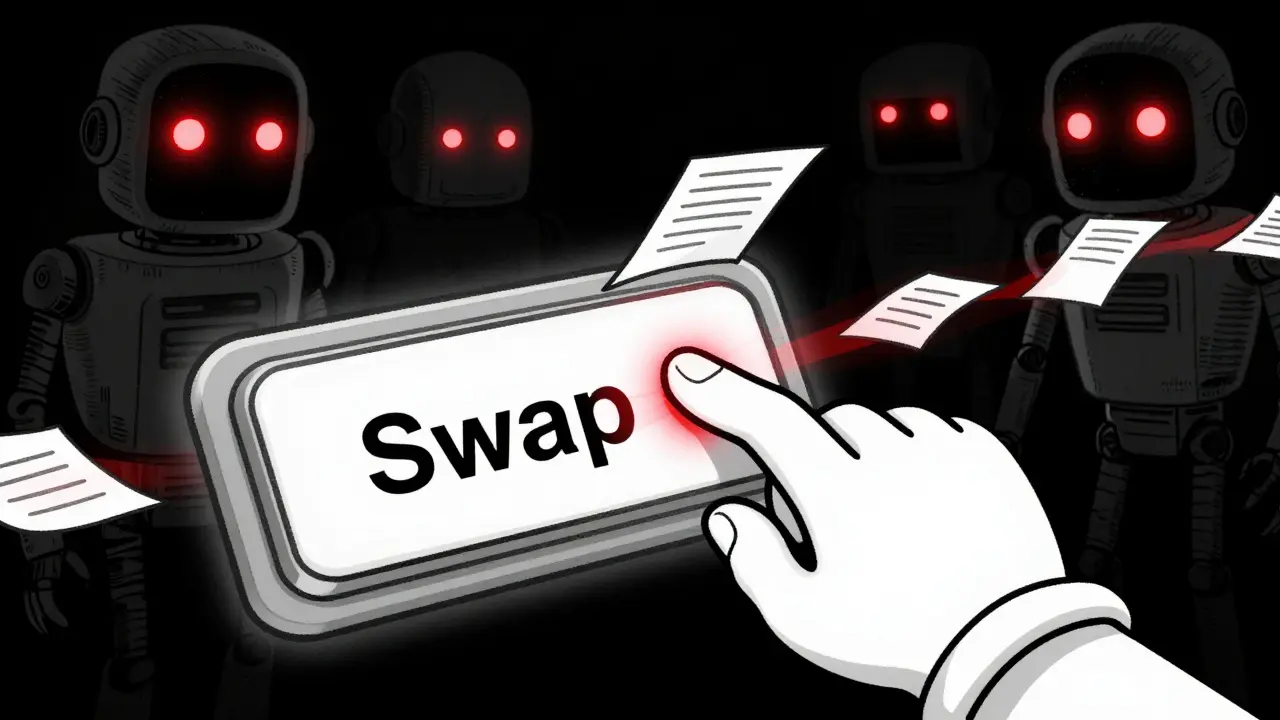
You click 'Swap' on your favorite decentralized exchange. You wait for the transaction to confirm. Then you check your wallet balance, and it’s slightly less than you expected. It wasn’t a gas fee spike. It wasn’t a slippage error on your end. Someone else just made money off your trade before it even settled.
This is Maximal Extractable Value, or MEV. It is the maximum value that can be extracted from block production in excess of the standard block reward and gas fees, by including, excluding, or changing the order of transactions in a block. In simpler terms, it is the profit miners and validators make by rearranging, censoring, or inserting their own transactions into the blocks they build. While some MEV activities are neutral arbitrage that helps keep prices aligned across exchanges, other forms-like front-running and sandwich attacks-are predatory. They exploit the transparency of public blockchains to extract value directly from regular users.
The Mechanics of Front-Running and Sandwich Attacks
To understand how these exploits work, you need to look at the mempool, which is a waiting area where pending transactions sit before being included in a block by a validator or miner. When you send a transaction, it doesn't happen instantly. It sits in this public queue, visible to everyone. This visibility is the core vulnerability.
Front-running occurs when a malicious actor sees a large incoming transaction in the mempool and places their own transaction immediately before it. Imagine Alice wants to buy 10,000 tokens of a small-cap project. Her buy order will push the price up. A bot sees this pending order, buys the same tokens first (paying a higher gas fee to ensure priority), and then lets Alice's transaction execute. The price goes up because of Alice's volume, but the bot already holds the tokens at the lower pre-trade price. The bot then sells those tokens to Alice or shortly after, pocketing the difference.
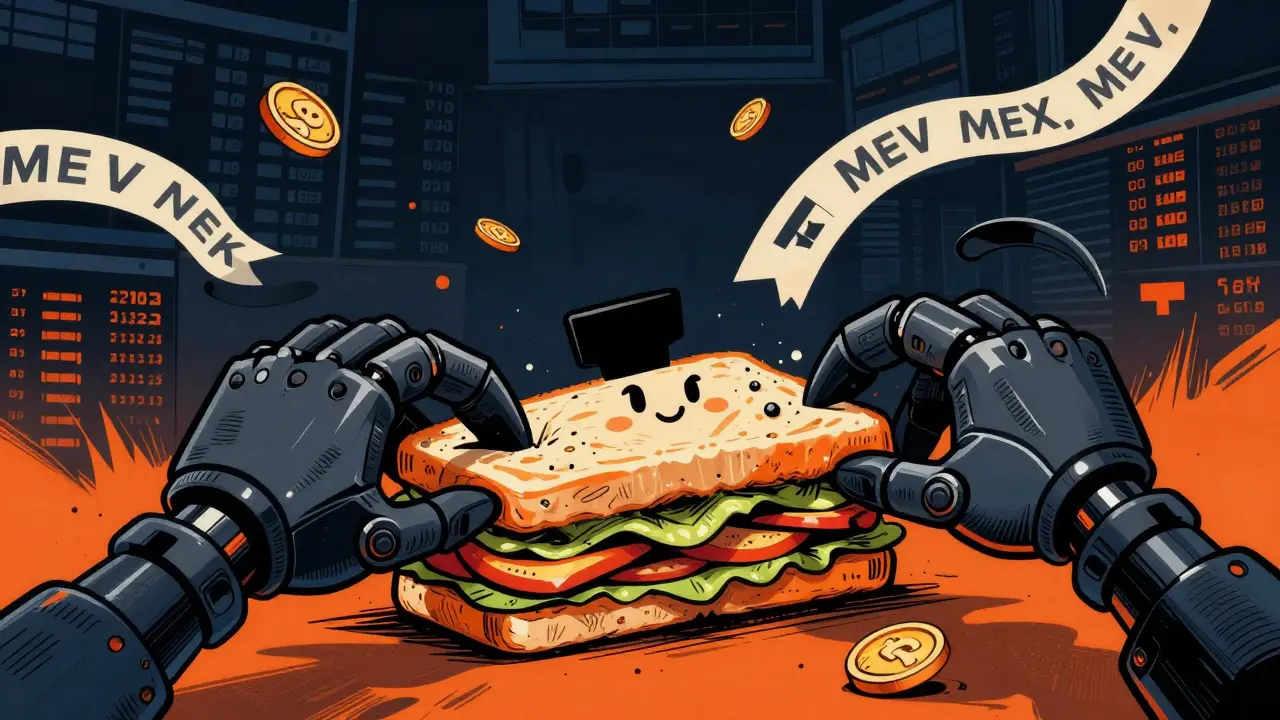
A more aggressive variation is the sandwich attack. This combines front-running with back-running. The attacker buys before the victim (front-run) and sells immediately after the victim (back-run). This traps the victim between two trades, ensuring the attacker captures the entire price impact generated by the victim's trade. According to data from Flashbots, an organization dedicated to MEV research, sandwich attacks alone have cost Ethereum users hundreds of millions of dollars since 2021. These aren't theoretical risks; they are automated, high-frequency operations running 24/7.
How MEV Bots Operate
You might wonder who is behind these attacks. It is rarely a single hacker in a hoodie. It is mostly MEV bots, which are automated software programs designed to monitor the mempool for profitable opportunities and execute transactions faster than human traders. These bots operate on speed and capital efficiency.
Here is how a typical MEV search process works:
- Mempool Monitoring: The bot connects to a node with low latency, scanning every pending transaction in real-time.
- Simulation: Before sending a transaction, the bot simulates the outcome locally. If buying before Alice results in a $500 profit, the bot proceeds. If not, it discards the idea.
- Bundling: To guarantee execution, the bot often uses private transaction pools like Flashbots Protect. This allows them to send a bundle of transactions (their buy, Alice's trade, their sell) directly to a block builder, bypassing the public mempool entirely. This reduces the risk of someone else front-running the bot.
- Gas War: If competing with other bots, they engage in a bidding war, increasing the tip paid to the validator to ensure their transaction is placed first.
The barrier to entry is high. You need sophisticated infrastructure, deep knowledge of smart contract logic, and significant capital to cover failed simulations and gas costs. This has led to a consolidation of power among a few large MEV searchers and block builders.
| Strategy | Method | Impact on User | Profit Source |
|---|---|---|---|
| Arbitrage | Buying low on Exchange A, selling high on Exchange B | Neutral/Positive (aligns prices) | Price discrepancy between venues |
| Front-Running | Inserting trade before a target user's trade | Negative (worse execution price) | Price movement caused by target |
| Sandwich Attack | Trade before AND after a target user | Highly Negative (maximized slippage) | Total price impact of target trade |
| Liquidation | Closing undercollateralized DeFi positions early | Neutral (protocol safety) | Liquidation bonus/reward |
The Shift from Proof-of-Work to Proof-of-Stake
The landscape of MEV changed dramatically with Ethereum's transition from Proof-of-Work (PoW) to Proof-of-Stake (PoS) in September 2022. Originally called "Miner Extractable Value," the term evolved to "Maximal Extractable Value" to reflect that anyone staking ETH as a validator could now participate.
In PoW, mining was somewhat distributed. In PoS, the role of block production has become highly centralized around Block Builders and Relays. Validators no longer build blocks themselves; they outsource this to specialized builders who compete to create the most profitable blocks. This separation introduced MEV-Boost, a protocol that allows validators to accept blocks built by third-party builders, enabling competitive bidding for block space.
While MEV-Boost increased competition and potentially reduced censorship risks, it also intensified the race for MEV. Builders are now incentivized to pack blocks with high-value MEV transactions, sometimes at the expense of regular user transactions. This creates a hidden tax on everyday users, whose transactions may be delayed or executed at worse prices to accommodate profitable MEV bundles.

Protecting Yourself from MEV Exploits
Can you stop MEV? Not entirely. As long as there is a public mempool and price-sensitive transactions, bots will exist. However, you can significantly reduce your exposure.
- Use Private Transaction Services: Tools like Flashbots Protect allow you to send transactions directly to block builders without exposing them to the public mempool. This prevents bots from seeing your trade before it executes. Many wallets, such as MetaMask and Rabby, now integrate this feature natively.
- Adjust Slippage Tolerance: High slippage tolerance makes you a bigger target. Keep it tight unless necessary. If a trade fails due to slippage, it’s better than getting sandwiched.
- Split Large Orders: Breaking a large trade into smaller chunks reduces the price impact each individual transaction has, making it less attractive for sandwich attackers.
- Choose MEV-Resistant Protocols: Some newer AMMs and DEXs are designing mechanisms to mitigate MEV, such as fair sequencing services or commit-reveal schemes. Look for protocols that explicitly address MEV protection in their documentation.
The Future of MEV Regulation and Mitigation
Regulators are beginning to take notice. In traditional finance, front-running is illegal. In crypto, it exists in a gray area. Some argue that MEV is a natural market force that improves liquidity and price discovery. Others, including many DeFi developers, view predatory MEV as a form of market manipulation that undermines trust in decentralized systems.
Future developments may include:
- Fair Sequencing Services (FSS): Independent entities that order transactions fairly, removing the incentive for block builders to reorder for profit.
- Layer 2 Solutions: Rollups and other L2 networks may change the dynamics of MEV by batching transactions differently, though new MEV vectors may emerge.
- Regulatory Clarity: Governments may classify certain MEV strategies as illegal market manipulation, forcing exchanges and protocols to implement stricter safeguards.
Until then, awareness is your best defense. Understanding that your transaction is not private and that actors are actively watching for profit opportunities changes how you interact with DeFi. Always assume your trade is visible until it is confirmed.
What is the difference between front-running and sandwich attacks?
Front-running involves placing a transaction before a target transaction to profit from the expected price change. A sandwich attack is more aggressive: it places one transaction before the target and another immediately after, trapping the victim and capturing the full price impact of their trade.
Is all MEV bad for blockchain users?
No. Some MEV, like arbitrage, helps keep prices consistent across different exchanges, which benefits market efficiency. However, predatory MEV like sandwich attacks harms users by worsening their trade execution and extracting value unfairly.
How can I prevent my transactions from being front-run?
The most effective method is using private transaction services like Flashbots Protect, which bypass the public mempool. Additionally, splitting large orders, keeping slippage tight, and using wallets with built-in MEV protection can reduce your risk.
What role do MEV bots play in the ecosystem?
MEV bots automate the detection and execution of profitable transaction sequences. While they provide liquidity and arbitrage, they also drive competition that leads to predatory practices like sandwich attacks, creating a complex dynamic between market efficiency and user harm.
Did the shift to Proof-of-Stake increase or decrease MEV?
It democratized access to MEV extraction but also intensified competition through the rise of professional block builders and relays. While more participants can now extract MEV, the concentration of power among top builders has made sophisticated extraction more efficient and prevalent.