Large-Cap vs Small-Cap Crypto: Risk, Reward, and How to Choose
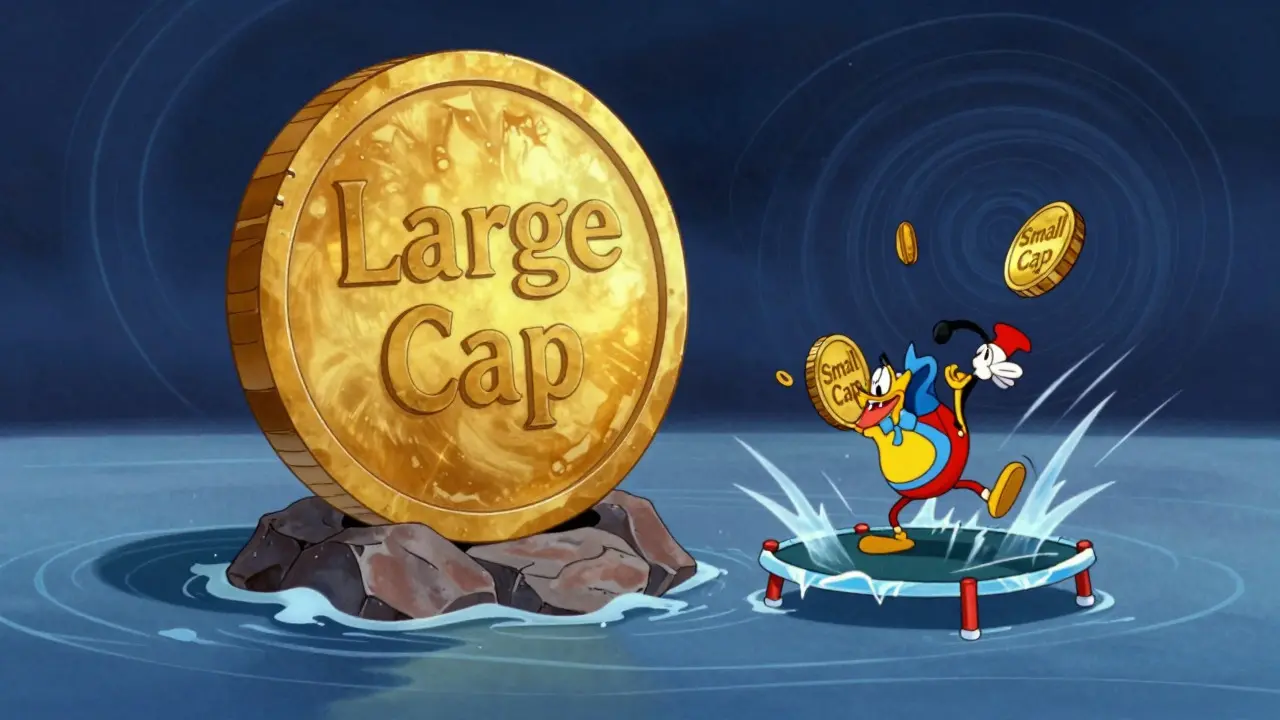
Aug, 14 2026
Imagine you’re looking at two coins. One is worth $100,000 per unit, and the other is just $0.50. Which one looks cheaper? Most people instinctively point to the $0.50 coin. But here’s the trap: that cheap coin might have billions of units in circulation, making its total value massive, while the expensive coin might be scarce, giving it a smaller total market footprint. This confusion is exactly why market cap matters more than price when you’re trying to understand what you actually own.
In the world of cryptocurrency, market capitalization is your primary tool for gauging size, stability, and potential. It’s not just a number on a chart; it’s a signal of how established a project is, how easy it will be to sell your tokens later, and how much volatility you should expect. Whether you are looking for steady growth or a moonshot gamble, understanding the difference between large-cap and small-cap assets is the first step in building a portfolio that doesn’t blow up overnight.
What Is Market Cap and Why Does Price Lie?
Market capitalization, or market cap, is calculated using a simple formula: Current Price multiplied by Circulating Supply. If Bitcoin is trading at $70,000 and there are 19.6 million coins in circulation, the math gives us a market cap of roughly $1.37 trillion. That single number tells you the total value investors have placed on the entire network.
The reason price alone is misleading becomes clear when you compare different assets. A token with a low price often has a high supply. If a project has 10 billion tokens and each costs $1, the market cap is $10 billion. Another project might have only 1 million tokens at $10 each, resulting in a $10 million market cap. Even though the second token is "more expensive" per unit, it is significantly smaller in overall economic weight. Investors who focus only on price often end up buying into projects that are already too big to move quickly, or they miss out on genuinely undervalued opportunities because the per-unit cost seems high.
To get the full picture, you also need to look at Fully Diluted Valuation (FDV). While market cap uses only the coins currently available to trade, FDV assumes all future tokens-those locked in contracts, reserved for teams, or yet to be mined-are in circulation today. For newer projects with large amounts of tokens still locked, the FDV can be much higher than the current market cap. This gap signals potential inflation risk. If a coin has a $100 million market cap but a $1 billion FDV, it means nine times that amount could eventually flood the market, potentially driving the price down as new sellers enter.
Large-Cap Crypto: The Blue-Chip Standard
In the crypto ecosystem, large-cap assets are generally defined as those with a market capitalization exceeding $1 billion. These are the digital equivalents of blue-chip stocks like Apple or Microsoft. You know them well: Bitcoin, Ethereum, Binance Coin, and Solana often sit in this tier. They are characterized by widespread adoption, deep liquidity, and a long track record of surviving market cycles.
The primary advantage of large-cap crypto is stability relative to the rest of the market. Because their market size is so vast, it takes enormous amounts of capital to move their prices significantly. This makes them less susceptible to manipulation by individual whales or coordinated pump-and-dump schemes. When you buy a large-cap asset, you are usually buying into a network with real-world usage, institutional support, and robust security infrastructure.
Liquidity is another critical factor. Large caps are listed on virtually every major exchange, from Coinbase to Kraken. Their order books are deep, meaning you can buy or sell millions of dollars worth of tokens without causing a drastic slippage in price. For an investor, this means ease of entry and exit. You don’t have to worry about being stuck holding a bag that no one else wants to buy.
However, stability comes with a trade-off: limited upside potential. For Bitcoin to double in price, it needs to absorb hundreds of billions of dollars in new investment. While possible, these percentage gains happen slower and less frequently than in smaller markets. Large caps are ideal for investors seeking to preserve capital while gaining exposure to the broader growth of the blockchain industry, rather than chasing quick riches.

Small-Cap Crypto: High Risk, High Reward
On the other end of the spectrum, small-cap cryptocurrencies typically have market valuations between $1 million and $50 million. Some analysts even classify anything under $100 million as small or micro-cap. These projects are often in their early stages, testing new technologies, or targeting niche communities. They lack the brand recognition and user base of their larger counterparts.
The allure of small caps is obvious: exponential growth potential. If a $5 million project gains traction and reaches a $500 million valuation, early investors see a 100x return. This is the "gem hunting" mentality that drives much of the retail crypto market. Traders scour decentralized exchanges and obscure listings for tokens that might become the next big thing before the mainstream crowd arrives.
But this potential comes with severe risks. The most immediate danger is illiquidity. Small caps often have thin order books. You might see a token priced at $1.00, but if you try to sell $10,000 worth, you could crash the price to $0.50 because there aren’t enough buyers at that level. This phenomenon, known as slippage, can erase profits instantly. In extreme cases, you may find yourself unable to sell at all if interest dries up.
Vulnerability to manipulation is another major concern. With fewer participants and lower trading volumes, a single large holder-or a group of coordinated traders-can easily inflate the price artificially. This creates false signals of demand, luring in retail investors who then suffer losses when the manipulators dump their holdings. Additionally, many small-cap projects fail entirely. Without a proven team, working product, or sustainable tokenomics, these assets can go to zero, leaving investors with nothing.
Comparing the Two: A Side-by-Side Look
| Feature | Large-Cap Crypto | Small-Cap Crypto |
|---|---|---|
| Market Cap Range | > $1 Billion | $1 Million - $50 Million |
| Risk Level | Lower (Relative to sector) | Very High |
| Liquidity | High; easy to buy/sell large amounts | Low; risk of slippage and inability to exit |
| Volatility | Moderate; moves with macro trends | Extreme; sharp spikes and crashes common |
| Growth Potential | Steady, percentage gains are smaller | Explosive, potential for 10x-100x returns |
| Adoption Stage | Mainstream, institutional support | Niche, experimental, or pre-adoption |

How to Build a Balanced Crypto Portfolio
Smart investors rarely put all their eggs in one basket, especially in a volatile market like crypto. The most effective strategy often involves blending both categories to balance stability with growth. Think of large-cap assets as the foundation of your house-they provide structure and safety. Small-cap assets are like the decorative elements or upgrades-they add value and excitement but require careful maintenance and carry the risk of damage.
A common approach among experienced traders is the core-satellite strategy. The "core" consists of 70-80% of the portfolio allocated to large-cap cryptocurrencies like Bitcoin and Ethereum. This portion aims to capture the general upward trend of the blockchain industry while minimizing the chance of total loss. The remaining 20-30% is the "satellite" allocation, distributed across several small-cap projects. This allows you to chase higher returns without jeopardizing your entire financial position if one or two small bets fail.
When selecting small caps, due diligence is non-negotiable. Don’t just look at the chart. Investigate the team behind the project. Is the code open-source? Are there active developers on GitHub? Check the tokenomics carefully. Look for the circulating supply versus the max supply. If a huge percentage of tokens is scheduled to unlock soon, expect selling pressure. Use tools like CoinMarketCap or CoinGecko to verify liquidity metrics and ensure the project isn’t a honeypot scam where you can buy but not sell.
Also, consider the narrative. Crypto markets move in cycles driven by themes-decentralized finance (DeFi), non-fungible tokens (NFTs), artificial intelligence, or gaming. Small caps that align with emerging trends often see rapid inflows of capital. However, once the hype fades, these same coins can lose 90% of their value. Timing your entry and exit based on market sentiment is crucial when dealing with speculative assets.
Common Mistakes to Avoid
One of the biggest errors new investors make is confusing market cap with intrinsic value. Just because a coin has a $10 billion market cap doesn’t mean it’s worth that much fundamentally. Prices are driven by supply and demand, which can be influenced by fear, greed, and speculation. Always cross-reference market cap with trading volume. A high market cap with low daily volume suggests a stagnant market where prices are set by few participants, making it vulnerable to sudden swings.
Another pitfall is ignoring fully diluted valuation (FDV). As mentioned earlier, a project might look affordable based on its current market cap, but if the FDV is astronomical, future inflation could dilute your holdings. For example, if a new Layer 1 blockchain launches with a $100 million market cap but a $10 billion FDV, it implies that 99% of the value is yet to be realized through token releases. This is a red flag for long-term holders.
Finally, avoid emotional trading. Small caps are designed to trigger FOMO (Fear Of Missing Out) during rallies and panic during dips. Stick to your plan. If you’ve allocated 10% of your portfolio to small caps, stick to that limit. Don’t increase your exposure just because one coin is pumping, and don’t sell your large caps to cover losses in small caps unless your overall financial situation requires it.
Is Bitcoin considered a large-cap or small-cap cryptocurrency?
Bitcoin is the quintessential large-cap cryptocurrency. With a market capitalization consistently exceeding $1 trillion, it is the largest digital asset by value. Its size provides it with significant stability compared to smaller altcoins, making it a preferred choice for institutional investors and conservative retail traders seeking lower relative risk within the crypto space.
Can a small-cap crypto become a large-cap?
Yes, absolutely. Many of today's large-cap assets, such as Ethereum and Solana, started as small or mid-cap projects. Transitioning to large-cap status requires sustained adoption, technological utility, and community trust. However, this journey is rare; for every small-cap that succeeds, thousands fail or remain irrelevant. Investors betting on this transition must accept the high probability of total loss.
Why is liquidity important when choosing between large and small caps?
Liquidity refers to how easily you can buy or sell an asset without affecting its price. Large caps have high liquidity, meaning you can enter or exit positions quickly with minimal price impact. Small caps often have low liquidity, leading to high slippage. In a crisis, you might find yourself unable to sell a small-cap token at a fair price, effectively trapping your capital until market conditions improve or buyers re-emerge.
What is the difference between market cap and fully diluted valuation (FDV)?
Market cap calculates value based on the number of tokens currently in circulation. Fully Diluted Valuation (FDV) assumes all tokens that will ever exist are already circulating. FDV is crucial for assessing long-term inflation risk. If a coin has a low market cap but a very high FDV, it indicates that a large number of tokens will likely be released in the future, which could drive the price down due to increased supply.
How should beginners allocate their portfolio between large and small caps?
Beginners are generally advised to keep the majority of their portfolio, around 80-90%, in large-cap cryptocurrencies like Bitcoin and Ethereum. This minimizes exposure to extreme volatility and project failure. The remaining 10-20% can be allocated to small-cap assets for speculative growth, but only after thorough research. This balanced approach protects capital while allowing for participation in high-growth opportunities.