The Future of Rollup Technology: Scaling Blockchain in 2026

Jun, 9 2026
Remember when sending a simple transaction on Ethereum cost more than the coffee you were buying? That era is fading fast, thanks to one specific technological shift. We are standing at the edge of a new phase in blockchain history, driven entirely by Rollup technology, which is a Layer-2 scaling solution that batches multiple transactions into a single data piece for submission to the main blockchain. As we move through 2026, this isn't just a niche developer topic anymore. It is the backbone of how decentralized applications actually work today.
You might wonder why we need all this complexity. The answer is simple: blockchains like Bitcoin and Ethereum were built to be secure and decentralized, but those features come with a steep price-slow speed and high fees. Rollups solve this by doing the heavy lifting off-chain while keeping the security guarantees of the main chain. In this guide, we’ll break down how these systems work, why the battle between Zero-Knowledge and Optimistic approaches matters to you, and what the next few years hold for the entire crypto ecosystem.
How Rollups Actually Work
To understand where rollups are going, you first need to grasp what they are doing right now. Think of the main blockchain (Layer-1) as a busy highway during rush hour. Every car (transaction) takes up space, and if everyone tries to enter at once, traffic grinds to a halt. Fees skyrocket because people start bidding higher to get their cars onto the road.
Rollups act like a shuttle bus service. Instead of every driver taking their own car onto the highway, a shuttle picks up hundreds of passengers (transactions) from a local stop (off-chain). The shuttle then drives onto the highway as a single vehicle. When it reaches the destination, it submits one record saying, "I carried 500 people safely." The highway doesn't need to check each passenger individually; it just trusts the shuttle's report based on cryptographic proof.
This process involves two main steps:
- Off-chain aggregation: Transactions are collected and executed outside the main network. This happens much faster because it isn't constrained by the main chain's block time or gas limits.
- On-chain verification: The rollup operator bundles these transactions into a single compressed data packet and submits it to the parent chain. The mainnet verifies this bundle, inheriting its security without processing every individual action.
The result? A standard Bitcoin transfer that might have cost 5,000 satoshis can drop to around 50 satoshis. That is a 99% reduction in cost. For users, this means micro-transactions become viable. Imagine paying $0.01 for a digital sticker or streaming music directly via blockchain payments. Without rollups, the fees would eat up the entire value of those transactions.
ZK-Rollups vs. Optimistic Rollups: The Great Divide
Not all rollups are created equal. In 2026, the landscape is dominated by two distinct architectures. Understanding the difference between them is crucial because they serve different use cases and offer different trade-offs.
| Feature | ZK-Rollups | Optimistic Rollups |
|---|---|---|
| Verification Method | Cryptographic proofs (Zero-Knowledge) | Fraud proofs (Challenge period) |
| Finality Speed | Near-instant (seconds) | Slow (days for dispute window) |
| Security Model | Mathematically guaranteed validity | Assumed valid unless challenged |
| Complexity | High (requires specialized hardware/circuits) | Low (EVM compatible, easier to build) |
| Best For | Privacy, high-frequency trading, DeFi | Gaming, social apps, general purpose |
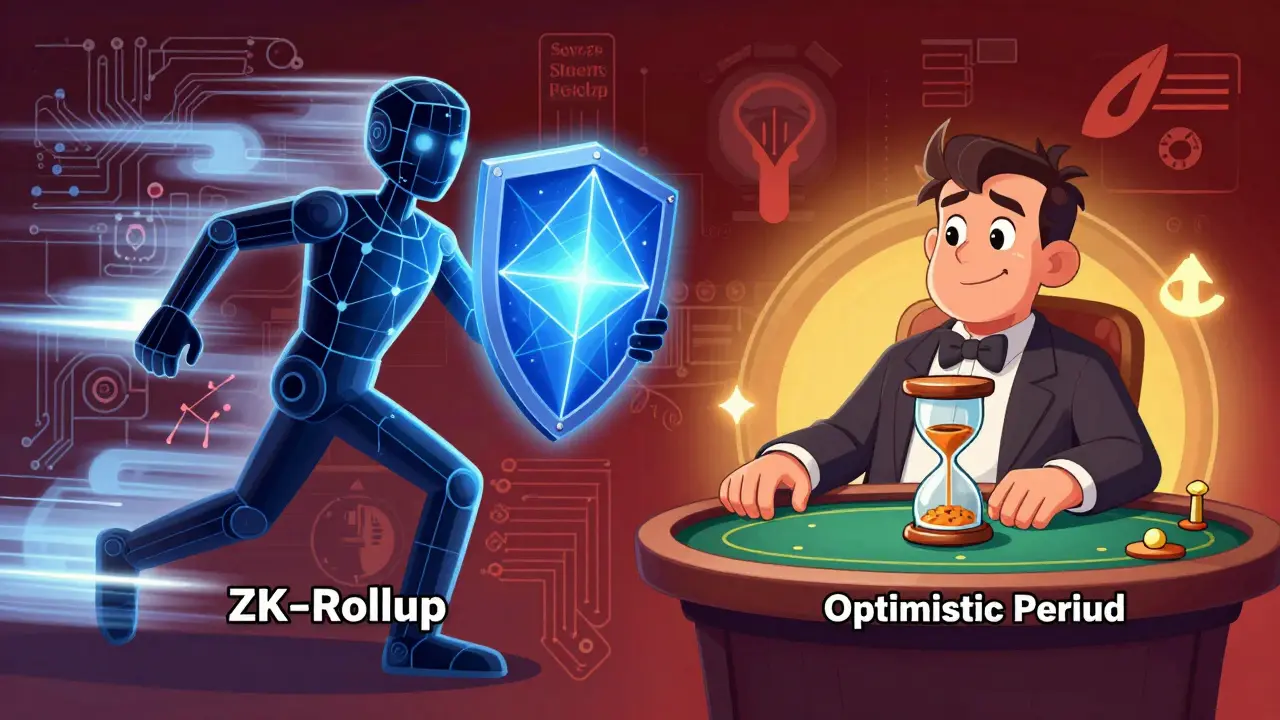
Zero-Knowledge Rollups (ZK-rollups) use advanced mathematics to prove that a set of transactions is valid without revealing the details of each transaction. They generate a succinct proof-a tiny snippet of code-that convinces the main blockchain everything is correct. The beauty here is privacy and speed. You don't have to wait for anyone to challenge your transaction. If the math checks out, it’s done. However, creating these proofs requires significant computational power, which has historically been a bottleneck.
Optimistic Rollups, on the other hand, take a gamble. They assume transactions are valid by default. They post the results to the main chain immediately. But there’s a catch: a "challenge period" lasts anywhere from 7 to 14 days. During this time, anyone can step up and say, "Wait, that transaction was fraudulent," and provide a fraud proof. If no one challenges it, the funds are finalized. This approach is cheaper to implement and fully compatible with existing smart contracts, making it popular for early adopters. But the delay in finality makes it less ideal for things like high-speed trading or instant gaming interactions.
The Rise of Bitcoin Rollups
For years, Bitcoin was seen as a store of value-a digital gold bar that sat quietly in wallets. But in 2025 and 2026, something changed. Developers realized that Bitcoin’s massive hash rate and security could be leveraged for computation too, not just storage.
Bitcoin Rollups are emerging as a powerful new frontier. While the Lightning Network handles small peer-to-peer payments, rollups bring smart contract functionality to Bitcoin. Projects are building Layer-2 networks that settle on Bitcoin using techniques similar to ZK-proofs. This allows developers to build decentralized exchanges, lending protocols, and NFT marketplaces on Bitcoin itself.
Why does this matter? Because Bitcoin has the largest user base and the most recognized brand in crypto. By enabling complex applications on top of Bitcoin, rollups unlock liquidity that was previously trapped in simple hodling strategies. Imagine borrowing against your Bitcoin holdings without selling them, or playing a decentralized game where the assets are backed by Bitcoin’s security. These aren’t sci-fi concepts anymore; they are live testnets moving toward mainnet deployment.
Data Availability: The Hidden Bottleneck
As rollups scale, a new problem emerges: Data Availability (DA). Remember the shuttle bus analogy? What if the shuttle breaks down, and the manifest of passengers is lost? The main chain needs access to the raw transaction data to reconstruct the state if necessary.
In the past, rollups posted all this data directly onto Ethereum. But as transaction volumes exploded, Ethereum’s storage became expensive and congested again. This led to the rise of dedicated Data Availability Layers. These are specialized networks designed solely to store transaction data cheaply and reliably. Protocols like Celestia and EigenDA are gaining traction in 2026, offering modular DA solutions.
By separating data availability from execution, rollups can scale infinitely. The execution layer processes transactions, the DA layer stores the data, and the settlement layer (like Ethereum or Bitcoin) ensures security. This modular architecture is becoming the standard for next-generation rollups. It means lower fees and higher throughput without compromising security.
Interoperability: Connecting the Silos
One of the biggest frustrations for users in 2026 is fragmentation. You might have assets on an Optimistic Rollup, tokens on a ZK-Rollup, and Bitcoin on a separate Layer-2. Moving money between these chains feels like changing airports mid-flight.
The future of rollup technology lies in Cross-Chain Interoperability. New protocols are being built to create seamless bridges between different rollups. Instead of trusting a centralized bridge operator (who might steal your funds), these new systems use cryptographic proofs to verify asset transfers across chains instantly.
Imagine swapping an ERC-20 token on Arbitrum for a Bitcoin-backed token on Stacks without leaving your wallet interface. The underlying technology uses shared sequencers and universal messaging layers to make this possible. This interoperability is critical for mass adoption. Users shouldn't need to understand which rollup they are on; they should just experience a fast, cheap, and unified blockchain network.
Challenges Ahead: Centralization Risks
It’s not all smooth sailing. One major criticism of current rollup implementations is centralization. Many rollups rely on a single entity-the sequencer-to order transactions and submit proofs. If this sequencer goes offline or acts maliciously, the network suffers.
In 2026, the industry is pushing hard toward Decentralized Sequencing. Solutions like Shared Sequencers allow multiple rollups to share the same sequencing infrastructure, reducing costs and increasing reliability. Furthermore, technologies like Intent-Centric Architectures are shifting the focus from who orders transactions to what outcome the user wants. This reduces reliance on any single point of failure.
Another challenge is the complexity of zero-knowledge circuits. Building ZK-applications requires specialized knowledge that most developers don’t have. To fix this, tooling is improving rapidly. High-level programming languages are now compiling directly to ZK-circuits, allowing regular web developers to build secure, scalable apps without needing a PhD in cryptography.
What Comes Next?
The trajectory for rollup technology in the late 2020s points toward invisibility. The best technology is the kind you don’t notice. Users will interact with dApps, games, and financial services without ever knowing they are transacting on a Layer-2 network. The abstraction layers will handle the complexity of bridging, proving, and settling.
We will also see the convergence of AI and blockchain. AI agents will manage rollup interactions autonomously, optimizing gas fees and routing transactions across the most efficient paths. This will drive further demand for low-cost, high-throughput environments that only rollups can provide.
Ultimately, rollups are transforming blockchain from a experimental ledger into a global computing platform. They are solving the trilemma of scalability, security, and decentralization better than any previous solution. As these technologies mature, we will see a surge in real-world applications-from supply chain tracking to decentralized identity-that were previously impossible due to cost and speed constraints.
What is the main difference between ZK-rollups and Optimistic rollups?
The core difference lies in how they verify transactions. ZK-rollups use cryptographic proofs to validate transactions instantly before posting them to the main chain, ensuring immediate finality and privacy. Optimistic rollups assume transactions are valid and post them immediately, but include a challenge period (usually 7-14 days) where anyone can dispute invalid transactions. ZK-rollups are faster and more secure but computationally heavier; Optimistic rollups are easier to implement but slower to finalize.
Are rollups safe? Can I lose my money?
Rollups inherit the security of the underlying Layer-1 blockchain (like Ethereum or Bitcoin). This means that for an attacker to steal funds, they would need to compromise the main blockchain itself, which is extremely difficult. However, risks exist in the smart contracts used by the rollup or the bridges connecting to it. Always use reputable, audited rollup networks and never share your private keys.
Will Bitcoin ever support smart contracts like Ethereum?
Yes, through Layer-2 rollups. While the Bitcoin mainchain remains focused on simple value transfer for maximum security, rollups built on top of Bitcoin enable smart contract functionality. These rollups settle disputes and store data on Bitcoin, leveraging its security while providing the computational power needed for complex applications like DeFi and NFTs.
What is Data Availability in the context of rollups?
Data Availability refers to the guarantee that the transaction data processed by a rollup is publicly accessible and cannot be hidden. If data is missing, the rollup cannot be reconstructed, leading to potential loss of funds. Dedicated Data Availability Layers (like Celestia) are emerging to store this data cheaply and efficiently, separating it from the execution and settlement layers to improve scalability.
How do rollups reduce transaction fees?
Rollups batch hundreds or thousands of transactions into a single data packet submitted to the main chain. Since the main chain only processes one entry instead of thousands, the gas fee is split among all participants in the batch. This economies-of-scale effect can reduce individual transaction costs by up to 99%, making micro-transactions economically viable.