What is Wonderman Nation (WNDR)? Tokenomics, Gameplay & Risks Explained
Jul, 16 2026
You’ve seen the ticker WNDR pop up on a chart or in a Discord chat. You might be wondering if this is the next big play-to-earn goldmine or just another forgotten project from the 2021 bull run. The short answer? It’s complicated. Wonderman Nation is a Web3 gaming and creator ecosystem built on the BNB Smart Chain that combines play-to-earn mechanics with NFT-based characters. While it has survived the harsh winter of the crypto market since its 2022 launch, it remains a micro-cap asset with significant risks.
If you are looking to buy, trade, or simply understand what this project actually does, you need to look past the hype. This guide breaks down the tokenomics, the gameplay loop, the dual-token structure, and the real-world data available as of mid-2026. We’ll cover how the game works, why the price has dropped so much from its initial offering, and whether there is any actual utility left for holders today.
The Core Concept: What Is Wonderman Nation?
At its heart, Wonderman Nation tries to merge three distinct ideas into one platform: the economic model of Axie Infinity, the battle mechanics of Final Fantasy, and the breeding system of CryptoKitties. Launched officially in April 2022, the project was registered in Melbourne, Australia, positioning itself as a community-driven Web3 platform.
The goal is simple on paper: players earn rewards by battling, breeding digital creatures, and participating in tournaments. Unlike traditional games where your progress stays on a server owned by a company, here your assets are Non-Fungible Tokens (NFTs) on the blockchain. You own them. You can sell them. But, like most projects in this sector, the promise of ownership comes with the volatility of cryptocurrency markets.
It is important to note that while the marketing speaks of a "vibrant community" and "creator empowerment," the actual user base appears small compared to industry giants. There are no public metrics for daily active users or monthly transaction volumes that rival top-tier gaming tokens. For the average investor, this means liquidity can be thin, and moving large amounts of WNDR without affecting the price is difficult.
Understanding the Dual-Token Economy: WNDR vs. NKTR
One of the most confusing parts for new users is that Wonderman Nation uses two different tokens. This is a common design in Web3 gaming to separate governance value from daily spending utility. Here is how they differ:
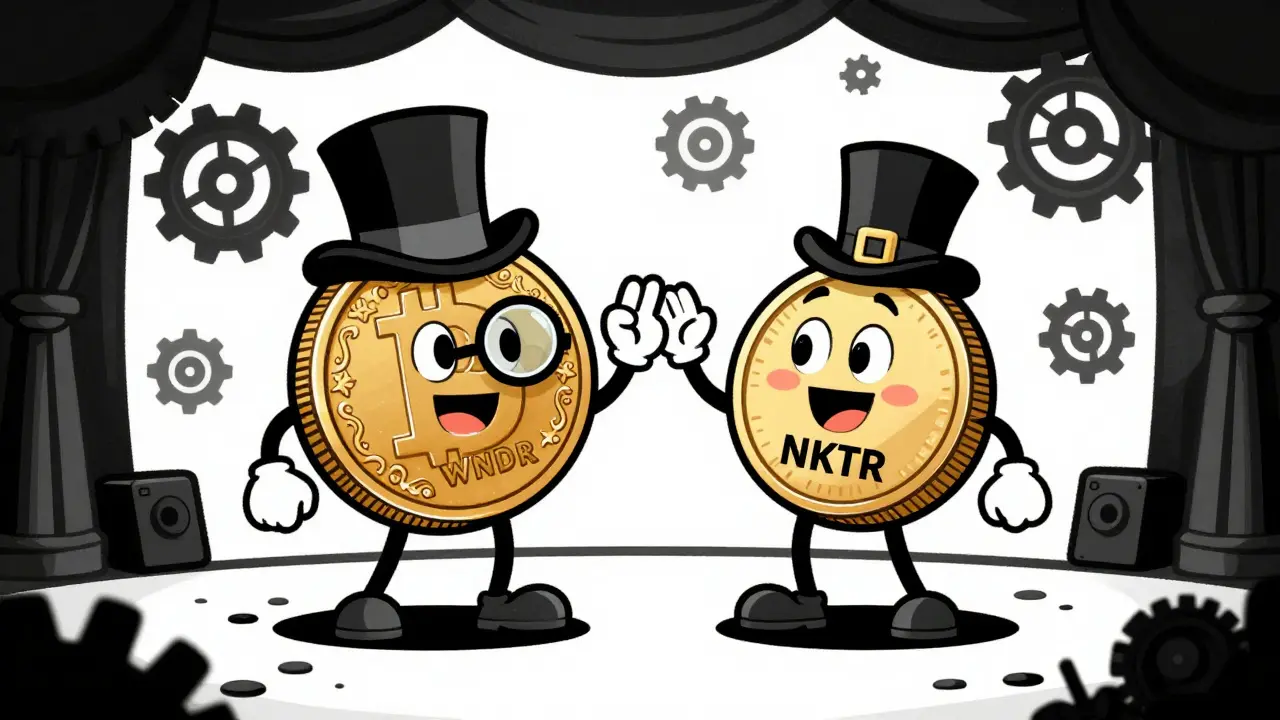
- WNDR (Wonderman Token): This is the governance and primary utility token. You use it to vote on the future of the platform, stake for rewards, buy rare NFTs, pay for tournament entry fees, and "fuel" your in-game spaceship. It is meant to hold long-term value.
- NKTR: This functions as the secondary in-game currency. It is used for routine transactions during gameplay, such as basic upgrades or minor purchases. By separating these, the developers aim to prevent inflation from daily gameplay grinding from crashing the value of the main governance token.
This separation is theoretically sound. If every sword swing printed millions of tokens, the price would collapse. However, in practice, the demand for NKTR depends entirely on whether people are actively playing the game. If player numbers drop, the utility of both tokens diminishes.
Tokenomics: Supply, Vesting, and Distribution
To understand the potential upside-or downside-of holding WNDR, you have to look at the supply dynamics. The total supply is fixed at 500,000,000 WNDR. There is no infinite minting, which is a positive sign for scarcity. However, not all of those tokens are in circulation right now.
As of mid-2026, circulating supply figures vary across exchanges but generally hover around 14.2 million WNDR. Some listings show higher numbers due to derivative symbols like WNDR2 on certain platforms. The gap between the circulating supply (approx. 14M) and total supply (500M) is massive. Where are the other 485 million tokens?
They are locked in vesting schedules. At launch, the distribution was heavily weighted toward ecosystem rewards:
- 21% reserved for Play-to-Earn rewards
- 16% for Staking Rewards
- 21% for an Ecosystem Fund
- 20% for the Team
- Only 2.6% allocated to the Public Sale
This means that over the coming years, more tokens will be unlocked. CryptoRank data indicates that community airdrops and other allocations have unlock events scheduled as far out as January 9, 2031. For investors, this is a critical risk factor. As more tokens enter the market, selling pressure increases unless demand grows proportionately. If the game doesn’t attract new players to absorb this supply, the price could face steady downward pressure.
Market Performance and Liquidity Reality Check
Let’s talk about the numbers, because they tell a stark story. When Wonderman Nation launched via IDOs on ChainBoost and Polkastarter in April 2022, the token price was set at $0.099 USD. The project raised approximately $1.6 million, implying a fully diluted valuation of nearly $50 million at the time.
Fast forward to July 2026. The reality is quite different. Market data aggregators show WNDR trading in a narrow band between $0.008 and $0.015. Depending on the exchange and the specific day, the market capitalization ranges from roughly $128,000 to $600,000. This places Wonderman Nation firmly in the "micro-cap" category, often ranking below #2700 globally.
| Metric | Value / Range | Note |
|---|---|---|
| Price Range | $0.008 - $0.015 | Highly volatile, low volume |
| Market Cap | $128k - $600k | Micro-cap status |
| 24h Volume | $1,000 - $20,000 | Liquidity is very thin |
| Circulating Supply | ~14.2 Million | Out of 500M Total |
| Blockchain | BNB Smart Chain | BEP-20 Standard |
The most concerning metric for traders is the 24-hour trading volume. On many days, volume drops below $2,000. This means if you try to sell even a few thousand dollars worth of WNDR, you could crash the price significantly due to slippage. There is no deep order book here. This is not a place for institutional money; it is a speculative playground for retail investors who understand the risks of illiquid assets.
How to Actually Use WNDR: Gameplay and Utility
If you decide to acquire WNDR, what do you do with it? The utility is tied directly to the Wonderman Nation ecosystem. Here is the practical workflow for a user:
- Wallet Setup: Since WNDR is a BEP-20 token on the BNB Smart Chain, you need a compatible wallet like Trust Wallet or MetaMask configured for BSC.
- Acquisition: Buy WNDR from a decentralized exchange (DEX) or a centralized exchange that lists it. Be aware of the smart contract address (
0xDfd7b0dD7Bf1012DfDf3307a964c36b972300Ac8) to avoid scams. - NFT Purchases: Use WNDR to buy "creatures" or "food" NFTs from the marketplace. These are required to play the game effectively.
- Gameplay: Enter battles, complete challenges, or rent out your creatures to other players. Winning tournaments and completing quests earns you WNDR and NKTR.
- Staking: Lock your WNDR tokens to earn staking rewards, which helps secure the network and gives you voting power in the DAO.
The learning curve is moderate. You need to understand gas fees on BNB Chain, how to approve token spending, and how to navigate NFT marketplaces. However, documentation for developers is sparse. There are no public SDKs or GitHub repositories listed on major aggregators, meaning integration for third-party tools is limited. For players, the support relies heavily on community channels rather than formal help desks.
Risks and Red Flags: What Investors Should Know
Before you put any money into WNDR, consider these specific risks that define the current state of the project:
- Low Transparency: Major platforms like CoinMarketCap and CoinGecko do not list individual founders or lead developers. The team remains anonymous or unbranded, which makes accountability difficult if things go wrong.
- No Security Audits: There are no widely cited third-party security audits for the smart contracts. In the world of DeFi and gaming, unaudited code is a significant risk vector for exploits or bugs.
- Vesting Pressure: With unlocks scheduled until 2031, early investors and the team will gradually release their holdings. Without massive growth in player adoption, this supply influx will likely suppress price appreciation.
- Liquidity Traps: The low trading volume means getting in is easy, but getting out quickly without loss is hard. Price swings of 10-20% can happen on tiny trades.
- Regulatory Uncertainty: There is no clear information on regulatory compliance or licensing. As global regulations tighten around play-to-earn models, smaller projects may struggle to adapt.
While the project has not been abandoned-it still lists on multiple exchanges and maintains a website-the lack of innovation in gameplay mechanics and the failure to recover from its initial IDO price suggest it is stuck in a niche experimental tier. It competes with giants like Axie Infinity and newer, more polished Web3 games, yet holds a fraction of their market share.
Conclusion: Is Wonderman Nation Worth Your Time?
Wonderman Nation represents a classic case of a high-hype launch followed by a long, slow grind. The vision of combining Final Fantasy-style battles with Axie-like economics is appealing, but execution has lagged behind expectations. As of mid-2026, it is a micro-cap token with thin liquidity and significant supply overhang.
If you are a gamer interested in the concept, you can experiment with small amounts to test the gameplay mechanics. If you are an investor seeking returns, be extremely cautious. The risk-reward ratio is skewed heavily toward risk due to the lack of transparency, low volume, and impending token unlocks. Always do your own research, verify contract addresses, and never invest more than you can afford to lose in this segment of the crypto market.
Is Wonderman Nation (WNDR) a scam?
There is no definitive evidence labeling Wonderman Nation as a outright scam, as the project has maintained listings on multiple exchanges and continues to operate since 2022. However, it exhibits several red flags common in risky crypto projects, including anonymous leadership, lack of published security audits, and extremely low liquidity. Investors should proceed with extreme caution and treat it as a high-risk speculative asset.
What is the difference between WNDR and NKTR?
WNDR is the primary governance and utility token used for voting, staking, buying NFTs, and paying tournament fees. NKTR is the secondary in-game currency used for routine gameplay transactions. This dual-token system aims to separate long-term value storage (WNDR) from daily spending inflation (NKTR).
Where can I buy WNDR tokens?
WNDR is a BEP-20 token on the BNB Smart Chain. It can be traded on various decentralized exchanges (DEXs) connected to BSC, such as PancakeSwap, and some centralized exchanges that list micro-cap assets. Always verify the official contract address (0xDfd7b0dD7Bf1012DfDf3307a964c36b972300Ac8) before swapping to avoid fake tokens.
Why is the price of WNDR so low compared to its launch?
WNDR launched at $0.099 in 2022 but has since dropped to under $0.015. This decline is typical for many play-to-earn projects that failed to sustain user growth post-hype. Factors include low liquidity, lack of mainstream adoption, competition from larger gaming tokens, and the gradual unlocking of vested tokens which increases supply pressure.
When will more WNDR tokens be unlocked?
The token vesting schedule extends over many years. According to available data, community airdrops and other allocations have unlock events scheduled through at least January 2031. This means the circulating supply will increase gradually, potentially putting downward pressure on the price if demand does not grow accordingly.
Can I mine WNDR tokens?
No, WNDR is not mineable. It is a BEP-20 utility token that cannot be produced via proof-of-work mining. Tokens are distributed through initial sales, staking rewards, play-to-earn gameplay mechanisms, and pre-mined allocations to the team and ecosystem funds.