GENIUS Act Explained: New US Federal Stablecoin Rules and Restrictions
Jun, 28 2026
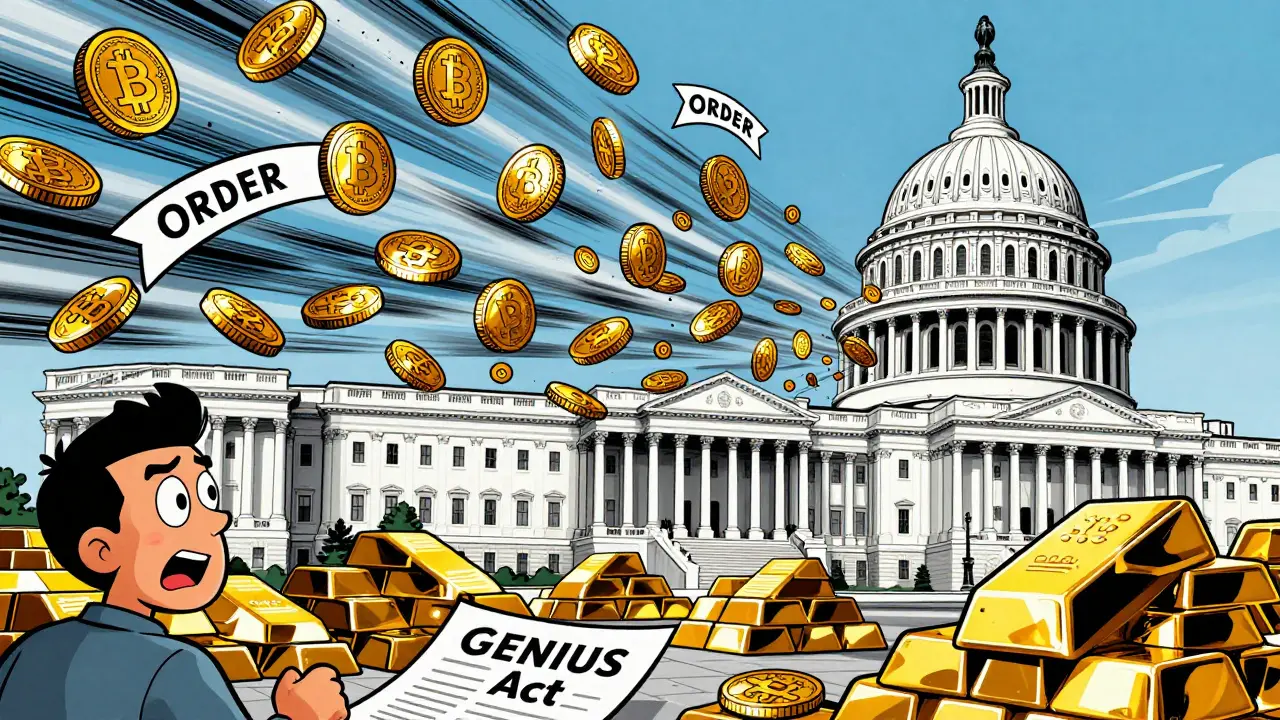
The landscape of digital assets in the United States just shifted on its axis. For years, stablecoins operated in a gray area, with rules varying wildly from state to state or being ignored entirely. That ends now. The GENIUS Act is the Guiding and Establishing National Innovation for U.S. Stablecoins Act of 2025, the first comprehensive federal regulatory framework for stablecoins in the US, signed into law by President Donald J. Trump on July 18, 2025, brings order to chaos. But what does this actually mean for you, whether you are an investor, a developer, or just someone who uses crypto for payments?
This isn't just another piece of paperwork. It creates strict operational limits, mandates bank-level oversight, and redefines who can issue these digital tokens. If you thought the days of wild west crypto were over, this legislation confirms it. Here is exactly how the new federal framework works, who it affects, and when you need to be compliant.
What Is the GENIUS Act?
To understand the impact, we first need to define the scope. The Guiding and Establishing National Innovation for U.S. Stablecoins Act specifically targets payment stablecoins. These are defined as digital assets designed to be used as a means of payment or settlement, where the issuer is obligated to redeem them for a fixed amount of monetary value (usually the US dollar) and maintains a stable value relative to that currency.
Think of your everyday USDT or USDC. If they are used for buying coffee or settling invoices, they fall under this act. The law aims to protect consumers, strengthen the US dollar's status as the global reserve currency, and bolster national security. It passed with bipartisan support, signaling that regulating this sector is no longer a partisan debate but a financial necessity.
The act takes effect on January 18, 2027, or 120 days after implementing regulations are issued, whichever comes first. This gives market participants roughly 18 months to adjust their infrastructure and compliance mechanisms.
Who Can Issue Stablecoins Under the New Law?
This is the biggest hurdle for existing players. The GENIUS Act restricts stablecoin issuance to specific entities known as "permitted payment stablecoin issuers." You cannot just set up a company in a basement and mint tokens anymore.
Issuers must be one of the following:
- Insured depository institutions: Traditional banks and credit unions.
- Bank subsidiaries: Companies owned by banks.
- Nonbank financial institutions: Private companies that receive explicit approval from the Federal Reserve and demonstrate they have the capability to comply with all regulations.
If you are a startup looking to launch a stablecoin, you now need to partner with a bank or go through a rigorous Fed approval process. This effectively bars unregulated tech firms from issuing their own payment stablecoins unless they integrate deeply with the traditional banking system.
Strict Reserve Requirements and Audits
Trust issues have plagued the stablecoin industry since the collapse of TerraUSD in 2022. The GENIUS Act addresses this head-on with ironclad reserve rules. All issuers must maintain a 1:1 reserve ratio for every stablecoin in circulation.
These reserves cannot be invested in risky assets like corporate bonds or equities. They must be held in:
- Physical currency (cash)
- US Treasury bills
- Repurchase agreements (repos)
- Other low-risk assets approved by regulators
Transparency is mandatory. Issuers must report their reserve composition regularly and undergo audits by registered public accounting firms. This ensures that if you hold $1,000 worth of stablecoins, there is actually $1,000 in safe, liquid assets backing it up.
| Feature | Before GENIUS Act | After GENIUS Act (Effective 2027) |
|---|---|---|
| Issuer Eligibility | Any entity (tech firms, startups) | Banks, credit unions, or Fed-approved nonbanks only |
| Reserve Backing | Varies (often opaque mix of cash/bonds) | Strict 1:1 in cash, T-bills, or approved low-risk assets |
| Auditing | Voluntary attestations (not full audits) | Mandatory regular audits by public accounting firms |
| Regulatory Oversight | Fragmented state laws or none | Unified federal framework via SCRC |
| AML/CFT Compliance | Inconsistent application | Full Bank Secrecy Act compliance required |

Operational Limits and Custody Rules
The act doesn't just control who issues tokens; it controls what they can do with them. Permitted activities for issuers are strictly limited to:
- Issuing and redeeming stablecoins.
- Managing reserves.
- Providing custodial and safekeeping services for stablecoins or private keys.
Custody is a critical component. Assets backing stablecoins must be segregated. You cannot commingle customer funds with the issuer's operating capital. Furthermore, custodial services for reserves or private keys can only be performed by entities under federal or state banking regulator oversight.
There is a notable exception for self-custody. The act excludes persons providing hardware or software that facilitates customer self-custody. This means wallet providers like Ledger or Trezor, or software wallets like MetaMask, are not considered custodians under this framework, preserving the right for users to hold their own keys.
Rehypothecation-using collateral as security for another transaction-is generally prohibited. However, issuers can pledge Treasury bill reserves for short-term repurchase agreements if cleared by approved central clearing counterparties or with prior regulatory approval. This allows for liquidity management without risking the stability of the reserve.
The Role of the Stablecoin Certification Review Committee (SCRC)
Enforcement and consistency are managed by the Stablecoin Certification Review Committee (SCRC). Chaired by the Secretary of the US Department of the Treasury, this committee includes the Federal Reserve Chair and the FDIC Chair.
The SCRC has significant power. It determines whether state-level stablecoin regulatory frameworks are "substantially similar" to the federal requirements. This mechanism aims to prevent a patchwork of conflicting state laws while allowing states some flexibility. However, critics note that state-issued stablecoins are exempt from certain federal provisions, which could lead to fragmentation if states adopt divergent approaches.
The goal is uniformity. By setting consistent standards for fraud prevention and consumer protection, the SCRC seeks to create a predictable environment for innovation while safeguarding the financial system.

Impact on Consumers and Businesses
For the average user, the GENIUS Act should mean greater safety. If a stablecoin issuer fails, your funds are backed by audited, low-risk reserves held in regulated institutions. This reduces the risk of a "run on the bank" scenario that has destroyed other crypto projects.
For businesses accepting stablecoins, the legal clarity is a boon. Previously, merchants worried about regulatory backlash or sudden bans. Now, using a permitted payment stablecoin is legally recognized and protected under federal law. This encourages wider adoption in commerce and cross-border payments.
However, costs may rise. Compliance with AML/KYC rules, auditing, and banking partnerships adds overhead. These costs might be passed on to users through slightly higher transaction fees or reduced yields on savings products tied to stablecoins.
Global Context and Future Outlook
The US is not alone in this move. Hong Kong passed its Stablecoin Ordinance in May 2025, showing a global trend toward stricter oversight. The GENIUS Act positions the US to compete with other financial centers for stablecoin innovation while maintaining high standards.
By anchoring stablecoins to the US dollar and enforcing strict reserves, the legislation reinforces the dollar's dominance in international trade and finance. As the implementation deadline of 2027 approaches, expect major issuers to rush for Fed approval and smaller players to either merge with banks or exit the payment stablecoin market.
When does the GENIUS Act take effect?
The GENIUS Act is scheduled to take effect on January 18, 2027, or 120 days after final implementing regulations are issued, whichever occurs first. This provides an approximate 18-month window for compliance.
Can I still use my current stablecoins like USDC or USDT?
Yes, but the issuers of these tokens must adapt to meet the new federal standards by the effective date. If they fail to become "permitted payment stablecoin issuers" or secure necessary banking partnerships, they may cease operations in the US market.
Does the GENIUS Act affect Bitcoin or Ethereum?
No. The GENIUS Act specifically targets "payment stablecoins"-digital assets pegged to a fiat currency like the US dollar. It does not regulate decentralized cryptocurrencies like Bitcoin or Ethereum, which operate under different regulatory considerations.
Who oversees compliance with the GENIUS Act?
Compliance is overseen by the Stablecoin Certification Review Committee (SCRC), chaired by the Treasury Secretary, along with the Federal Reserve and FDIC. Issuers must also comply with the Bank Secrecy Act for AML/CFT measures.
Are self-custody wallets banned under the GENIUS Act?
No. The act explicitly excludes persons providing hardware or software for customer self-custody. You can continue to use non-custodial wallets to store your stablecoins and private keys without violating the law.