Kuwait's Complete Ban on Banking and Crypto Mining: What You Need to Know

Mar, 7 2026
When Kuwait shut down all cryptocurrency mining and banned banks from touching crypto, it didn’t just make a policy change - it made a statement. As of March 2026, the country has one of the strictest digital asset policies in the entire Gulf region. No mining rigs. No bank accounts for crypto transactions. No trading platforms. Not even a gray area. If you’re caught running a miner in your basement, you could face up to five years in prison and a fine of $164,000. This isn’t a rumor. It’s the law.
Why Kuwait Banned Crypto Mining and Banking
Kuwait’s regulators didn’t act on a whim. The Central Bank of Kuwait, the Capital Markets Authority, and the Ministry of Interior all moved together in July 2023 to shut down every form of cryptocurrency activity. Their main reason? Protecting the national power grid and stopping money laundering.
Crypto mining eats electricity. A lot of it. In Al-Wafra alone, authorities detected over 100 homes using 20 times more power than normal - a dead giveaway for mining rigs running 24/7. These rigs weren’t just costing residents money; they were causing blackouts in entire neighborhoods. With Kuwait relying almost entirely on oil-fired power plants, burning fuel to mine Bitcoin didn’t make economic or environmental sense.
On top of that, the country was under pressure from the Financial Action Task Force (FATF). Kuwait had to prove it was serious about fighting money laundering. Crypto’s anonymity made it a perfect tool for criminals. So instead of trying to regulate it, Kuwait chose to eliminate it entirely.
How the Ban Works in Practice
The ban isn’t just a warning - it’s enforced with real teeth.
- Banks can’t touch crypto. All 45 licensed banks in Kuwait are forbidden from holding, transferring, or even processing payments related to Bitcoin, Ethereum, or any other digital asset. If you try to deposit crypto earnings into your account, your bank will freeze it - and report you.
- Miners are hunted down. The Ministry of Interior has specialized units that scan power usage data to find illegal mining operations. In 2024 alone, they conducted 89 raids. Many of these operations were hidden inside warehouses, garages, or even small businesses pretending to be data centers.
- Internet access is blocked. In May 2025, Kuwait’s telecom regulators forced local providers to block access to 137 international crypto exchanges. That includes Binance, Kraken, and Coinbase. If you try to visit them, you’ll get a hard wall.
- Fines and jail time. Under the 2025 Financial Technology Amendment Law, mining can now cost you up to 50,000 KD ($164,000) and five years in prison. That’s more than double the penalty from just two years ago.
The system isn’t perfect. Some people still find ways around it - using Telegram groups to trade crypto peer-to-peer, or buying gift cards from international platforms. But each time they do, they risk getting caught.
What Happens When You Get Caught?
One Kuwaiti man, Ahmed, learned the hard way in late 2024. He had six ASIC miners running in his garage, powered by a separate meter he’d installed. He thought he was being smart - until the electricity company flagged his usage and the police showed up. His equipment was seized. His bank accounts were frozen. And he got fined 35,000 KD ($115,000).
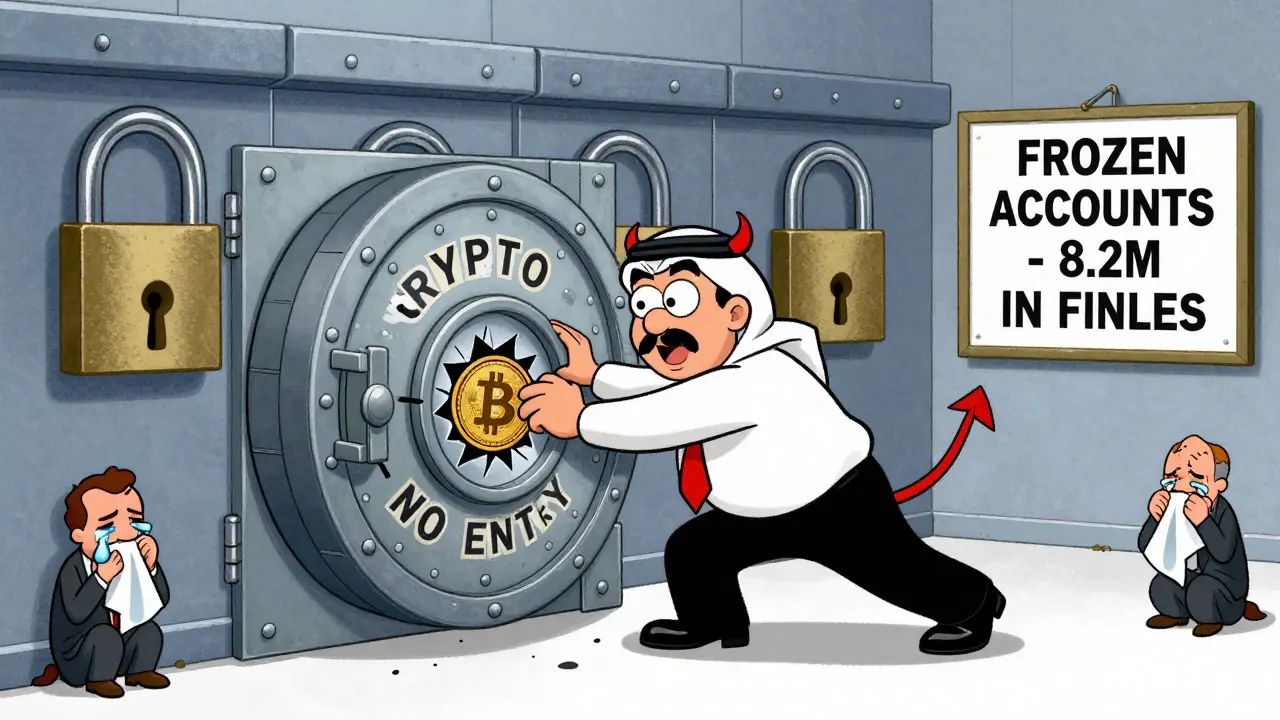
He wasn’t alone. In 2024, Kuwaiti authorities recorded 147 violations by financial institutions that tried to process crypto-related transfers. Most were small money transfer services that didn’t realize they were breaking the law. Each one paid fines totaling $8.2 million.
Even accidental involvement can be dangerous. One woman received a $2,000 crypto payment from a freelance client abroad. Her bank flagged it as suspicious, froze her account for six months, and reported her to the National Committee for Combatting Money Laundering. She had to prove the money wasn’t from a scam - a process that took six months and cost her thousands in legal fees.
How Kuwait Compares to Its Neighbors
While Kuwait locked the door on crypto, its neighbors opened windows.
The UAE created the Dubai Virtual Assets Regulatory Authority (VARA) in 2022. It now licenses over 250 crypto firms. Bahrain has issued 12 licenses. Saudi Arabia has approved 7 firms under its regulatory sandbox. Even Qatar is preparing to launch a crypto framework by mid-2025.
Kuwait chose the opposite path. It didn’t just avoid crypto - it actively pushed it underground. The result? An estimated $1.2 billion in lost blockchain investment between 2023 and 2025. Meanwhile, Dubai’s blockchain sector added $2.1 billion to its GDP in 2024 and created 15,000 jobs.
Experts are split. Dr. Abdulhadi Al-Khouri of the Kuwait Institute for Scientific Research says Kuwait’s approach is “cautious and justified.” But Dr. Noura Al Dhaheri from Khalifa University argues the ban is “creating more risk than it prevents.” With crypto activity moving to unregulated Telegram groups, Kuwaitis are now more vulnerable to scams - like the $40 million fraud from a fake token called “Bitcoin Kuwait” in early 2025.
The Hidden Cost: Economic and Technological Stagnation
Behind the scenes, Kuwait’s ban is hurting more than just crypto users.
Businesses that want to use blockchain for supply chain tracking, smart contracts, or secure record-keeping can’t. No licenses. No legal clarity. No innovation. That’s why only 0.3% of the Gulf’s $1.8 billion blockchain market comes from Kuwait - even though it’s one of the wealthiest countries in the region.
Compare that to the UAE, where 37% of logistics companies now use blockchain. Or Saudi Arabia, where banks are testing blockchain-based trade finance. Kuwait’s companies? They’re stuck using outdated systems because they can’t legally upgrade.
The National Digital Transformation Strategy, launched in 2024 with a $500 million budget, explicitly bans cryptocurrency applications. That means even if a startup builds a blockchain tool for healthcare records or land titles, they can’t use crypto tokens to pay for it - or even link it to a digital wallet.
The long-term cost? Kuwait is falling behind. The World Bank ranked it 127th out of 140 countries for crypto regulatory environment. The UAE? 28th.

What’s Next for Kuwait?
There’s no sign the ban is lifting. The Central Bank of Kuwait says it has “no plans to reconsider” its stance. The Ministry of Interior is doubling down, with a 40% increase in mining seizures in Q1 2025 compared to the last quarter of 2024.
But pressure is building. With over 45,000 Kuwaitis estimated to be using crypto underground - mostly through peer-to-peer apps - the government can’t ignore the demand. And with 67% of Kuwaiti Twitter users expressing negative sentiment about the ban, public opinion is shifting.
Some analysts believe Kuwait may allow non-crypto blockchain use by 2027 - like digital IDs or government record systems. But any move toward legalizing Bitcoin or Ethereum? That’s not expected before 2030.
For now, the message is clear: If you want to mine crypto or use digital assets in Kuwait, you’re doing it illegally. And the cost of getting caught just got a lot higher.
What Should You Do If You’re in Kuwait?
If you’re a resident, here’s the reality:
- Don’t mine. Even if you think you’re hidden, power usage data is monitored. The risk isn’t worth the reward.
- Don’t use local banks for crypto. Your account will be frozen. You’ll be reported. You might lose access to your own money.
- Don’t trust Telegram groups. Scams are rampant. The $40 million “Bitcoin Kuwait” fraud is proof.
- Stay informed. Regulations change - but not here. Not yet. What’s true today will likely be true for years.
If you’re a business owner, skip crypto entirely. Focus on traditional finance. If you’re tempted to experiment with blockchain for efficiency, talk to a lawyer first - because in Kuwait, there’s no gray zone. Only black and white.
Is cryptocurrency mining illegal in Kuwait?
Yes, cryptocurrency mining is completely illegal in Kuwait. All forms of mining - whether using home rigs, data centers, or business equipment - are banned under Ministerial Circular No. (1) of 2023. Violators face fines up to 50,000 KD ($164,000) and prison sentences of up to five years. Authorities actively monitor electricity usage to detect mining operations.
Can I use cryptocurrency in Kuwaiti banks?
No. Kuwaiti banks, financing companies, and exchange firms are strictly prohibited from handling any cryptocurrency transactions. This includes deposits, withdrawals, trading, or even facilitating transfers. If you try to deposit crypto earnings into your bank account, the bank will freeze it and report you to financial regulators.
What happens if I’m caught mining crypto in Kuwait?
If you’re caught mining crypto, authorities will seize your equipment, freeze your bank accounts, and file criminal charges. Penalties include fines of up to 50,000 KD ($164,000) and up to five years in prison. The Ministry of Interior has dedicated units that use power consumption data to identify mining locations, and they’ve conducted over 89 raids since 2024.
Can I trade crypto using international exchanges from Kuwait?
Access to 137 international crypto exchanges, including Binance and Coinbase, has been blocked by Kuwaiti telecom providers since May 2025. While some users bypass this with VPNs, doing so still violates local law. Any transaction involving crypto - even if conducted overseas - can still lead to legal consequences if linked to a Kuwaiti bank account or IP address.
Why does Kuwait ban crypto when other Gulf countries allow it?
Kuwait prioritizes financial stability and energy security over innovation. Unlike the UAE or Bahrain, which created regulatory sandboxes to control crypto risks, Kuwait chose a total ban to eliminate exposure to fraud, money laundering, and grid overload. The country’s heavy reliance on oil for electricity makes crypto mining especially wasteful. While this approach has reduced fraud by 63% since 2023, it has also blocked billions in potential investment and innovation.