Merkle Trees in Bitcoin and Ethereum: How Hash Trees Secure Blockchains
Jun, 7 2026
Imagine you need to prove that a specific document is part of a massive archive containing millions of files. Do you hand over the entire archive? That would be inefficient, slow, and privacy-invasive. Instead, you use a cryptographic shortcut that proves the document exists without revealing anything else. This is exactly what Merkle Trees are for blockchain networks. They are the silent engines behind data integrity in both Bitcoin and Ethereum, allowing users to verify transactions with minimal computing power. Without them, lightweight wallets wouldn’t exist, and blockchains would be far less secure and scalable than they are today.
What Is a Merkle Tree?
A Merkle Tree is a binary tree data structure where each leaf node represents the hash of a data block, and every non-leaf node is the hash of its children. Invented by Ralph Merkle in 1988, this structure allows for efficient and secure verification of large datasets. The core idea is simple but powerful: you take two pieces of data, hash them together, and repeat the process up the tree until you reach a single value at the top called the Merkle Root.
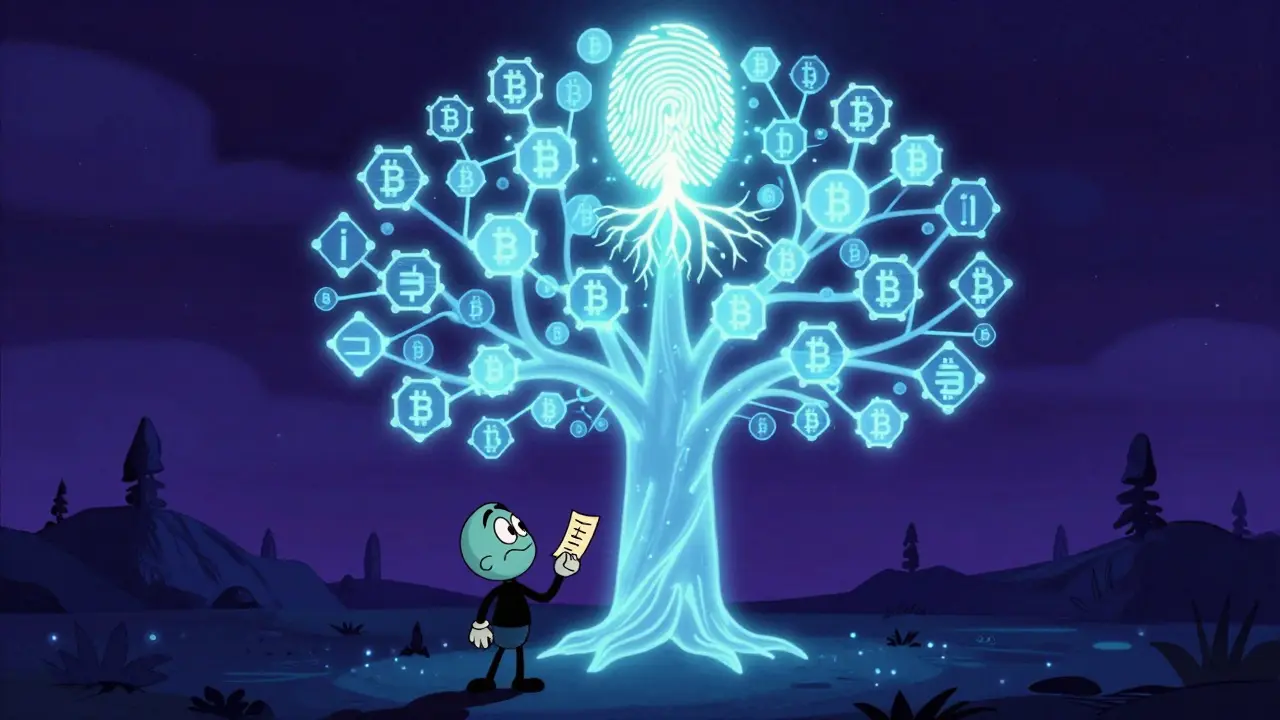
This root hash acts as a digital fingerprint for the entire dataset. If even one bit of data changes in any leaf node, the resulting Merkle Root will be completely different. This makes it computationally impossible to tamper with the underlying data without detection. For blockchain networks, which rely on trustless consensus, this property is non-negotiable. It ensures that when you see a transaction included in a block, you can mathematically prove it belongs there without downloading the entire history of the network.
Bitcoin’s Implementation: Simplicity and Verification
Bitcoin uses Merkle Trees primarily for transaction verification. Each Bitcoin block contains hundreds of transactions, all hashed into a single Merkle Root. This root is stored in the Block Header, which also includes the previous block hash, timestamp, nonce, and difficulty target. Full nodes download and store every transaction ever made, but most users don’t have the storage or bandwidth for that. Enter Simple Payment Verification (SPV) nodes.
SPV nodes, often used in mobile wallets, only download block headers. To verify if a specific transaction is in a block, an SPV client requests a Merkle Proof. This proof consists of just a few sibling hashes needed to reconstruct the path from the transaction to the Merkle Root. For example, if a block has 500 transactions, you only need about nine hashes (log₂500 ≈ 9) to verify your transaction’s inclusion. This exponential efficiency means your phone can securely interact with the Bitcoin network without storing terabytes of data.
- Leaf Nodes: Individual transaction hashes.
- Parent Nodes: Hashes of concatenated child hashes.
- Root Node: Stored in the block header; anchors the block’s validity.
- Efficiency: O(log n) verification time regardless of block size.

Ethereum’s Complexity: The Merkle Patricia Trie
Ethereum takes a more sophisticated approach because it isn’t just a ledger of payments; it’s a global state machine running smart contracts. A standard Merkle Tree isn’t enough to manage account balances, contract storage, and code. Instead, Ethereum uses a hybrid structure called the Merkle Patricia Trie. This structure combines the hashing properties of a Merkle Tree with the lookup efficiency of a Patricia Trie (a compressed radix tree).
The Ethereum execution layer maintains four distinct tries within each block:
- State Trie: Maps account addresses to their states (balance, nonce, code hash, storage root). This is the global snapshot of the network.
- Transaction Trie: Stores all transactions in a block, ordered by their position.
- Receipt Trie: Contains transaction receipts, including logs and gas usage, which are crucial for event tracking in dApps.
- Storage Tries: Individual tries for each smart contract, mapping storage slots to values.
This multi-layered architecture allows Ethereum to handle complex state transitions. When a smart contract executes, it may update multiple storage slots. The Merkle Patricia Trie efficiently updates only the affected paths, recalculating hashes up to the root. This ensures that the new state root accurately reflects all changes while maintaining cryptographic integrity. However, this complexity comes at a cost: higher computational overhead and larger state sizes compared to Bitcoin’s simpler model.
Key Differences Between Bitcoin and Ethereum
| Feature | Bitcoin | Ethereum |
|---|---|---|
| Data Structure | Standard Binary Merkle Tree | Merkle Patricia Trie (Hybrid) |
| Primary Purpose | Transaction Verification | State Management & Smart Contracts |
| Node Types | Full Nodes, SPV Nodes | Full Nodes, Light Clients, Archive Nodes |
| Verification Scope | Transaction Inclusion Only | Account Balances, Storage, Receipts |
| Complexity | Low (O(log n)) | High (Dynamic State Updates) |
Bitcoin prioritizes simplicity and security for financial transactions. Its Merkle Tree implementation is optimized for speed and minimal resource usage, enabling widespread adoption via mobile wallets. Ethereum, on the other hand, sacrifices some efficiency for flexibility. The Merkle Patricia Trie supports Turing-complete computation, allowing developers to build decentralized applications (dApps) with persistent state. This trade-off is fundamental to understanding why Ethereum feels "heavier" than Bitcoin.

Why Merkle Trees Matter for Users
You might wonder why you should care about hash trees. The answer lies in accessibility and security. Without Merkle Trees, verifying a Bitcoin transaction would require downloading the entire blockchain, which exceeds 500 GB. This barrier would exclude most users from self-custody. Thanks to SPV proofs, anyone with a smartphone can hold their own keys and verify transactions independently.
In Ethereum, Merkle Proofs enable Light Clients to sync with the network quickly. They also play a critical role in Zero-Knowledge Proofs (ZKPs) and rollups. Layer 2 solutions like Arbitrum and Optimism use Merkle Roots to post compressed transaction data to Ethereum mainnet. Users can dispute fraudulent withdrawals by providing Merkle Proofs that contradict the posted root. This mechanism underpins the scalability of modern Ethereum ecosystems.
Additionally, developers use Merkle Trees for off-chain computations. For instance, during token airdrops, projects store only the Merkle Root on-chain. Recipients generate proofs locally to claim tokens, saving thousands of dollars in gas fees compared to batch transfers. This practical application demonstrates how Merkle Trees extend beyond basic verification into economic optimization.
Future Evolution: Verkle Trees
As Ethereum’s state grows, so does the burden on light clients. Current Merkle Proofs require downloading many nodes to verify deep storage accesses. To address this, Ethereum is transitioning toward Verkle Trees. Unlike Merkle Trees, which use hashes, Verkle Trees use vector commitments. This change reduces proof sizes from kilobytes to bytes, making light client synchronization faster and cheaper. While still in development, Verkle Trees represent the next logical step in blockchain data structures, promising even greater efficiency for state-heavy networks.
Can I use a Merkle Tree to verify my Bitcoin wallet balance?
Yes, indirectly. Your wallet software uses Merkle Proofs to verify that transactions affecting your address are included in valid blocks. However, calculating your total balance requires scanning unspent transaction outputs (UTXOs), which may involve multiple proofs across different blocks.
Is the Merkle Root enough to trust a block?
The Merkle Root ensures the transactions inside the block haven’t been tampered with. But to trust the block itself, you must also verify the proof-of-work (or proof-of-stake) consensus and the link to the previous block hash. The Merkle Root is just one piece of the puzzle.
Why doesn’t Bitcoin use a Merkle Patricia Trie?
Bitcoin is designed as a peer-to-peer electronic cash system, not a general-purpose computer. It doesn’t need to manage complex state like smart contracts. A simple Merkle Tree is sufficient for verifying transaction sets, keeping the protocol lean and secure.
How do Merkle Trees help with privacy?
Merkle Trees allow you to prove knowledge of a specific entry without revealing other entries. For example, in confidential transactions or ring signatures, Merkle Proofs can demonstrate that a transaction is valid without exposing the sender or receiver’s full identity.
What happens if two transactions have the same hash?
In theory, a collision could occur, but SHA-256 (used in Bitcoin) and Keccak-256 (used in Ethereum) are cryptographically secure against collisions. The probability is so low that it’s considered negligible for all practical purposes. If a collision did happen, it would likely indicate a catastrophic failure in the hashing algorithm itself.