Blackhole (CLMM) Review: Is the Avalanche DEX Worth Your Liquidity in 2026?

Jun, 25 2026
Remember when liquidity mining felt like a simple plug-and-play game? You deposited assets, waited for a week, and cashed out. Those days are gone. In 2026, the decentralized finance landscape has shifted toward complex governance models and long-term commitment structures. Enter Blackhole (CLMM), a decentralized exchange on the Avalanche network that is rewriting the rules of how users interact with protocol revenue.
If you’ve been following crypto personalities Alex Becker and Ellio Trades, you know they don’t do things by half-measures. Blackhole isn’t just another copy-paste Uniswap fork. It’s built on an enhanced ve(3,3) tokenomics model designed to align incentives between liquidity providers, voters, and traders. But does this complexity translate into real profit, or is it just another layer of friction?
This review breaks down Blackhole’s mechanics, its impressive growth metrics, and whether your capital is better off here than in established competitors like Benqi or Trader Joe.
What Exactly Is Blackhole CLMM?
Blackhole is a community-owned decentralized cryptocurrency exchange operating on the Avalanche C-Chain. Launched in 2024, it positions itself as a next-generation DEX optimized for deep liquidity and sustainable emissions. Unlike centralized exchanges, Blackhole requires no KYC, holds no custody of your funds, and operates entirely through smart contracts.
The "CLMM" in the name stands for Concentrated Liquidity Market Maker. This technology allows liquidity providers to concentrate their capital within specific price ranges, increasing capital efficiency. Think of it like parking your car in a spot closer to the entrance rather than the back row-you get better access (yield) but have to manage where you park more carefully.
Currently, the platform supports around 41 coins and 67 trading pairs, though data sources vary slightly due to rapid expansion. The key differentiator isn't just the tech stack; it's the ownership structure. Blackhole is incorporated in the Cayman Islands but operates as a fully community-owned entity. All team tokens were burned into Supermassive veNFTs, eliminating future sell pressure from insiders-a rare move in DeFi.
The ve(3,3) Model: Governance Meets Yield
To understand Blackhole, you must understand its native token, $BLACK. This token serves multiple functions: it rewards liquidity providers, grants governance rights when locked, and distributes protocol revenue. However, you don’t just hold $BLACK; you lock it to create value.
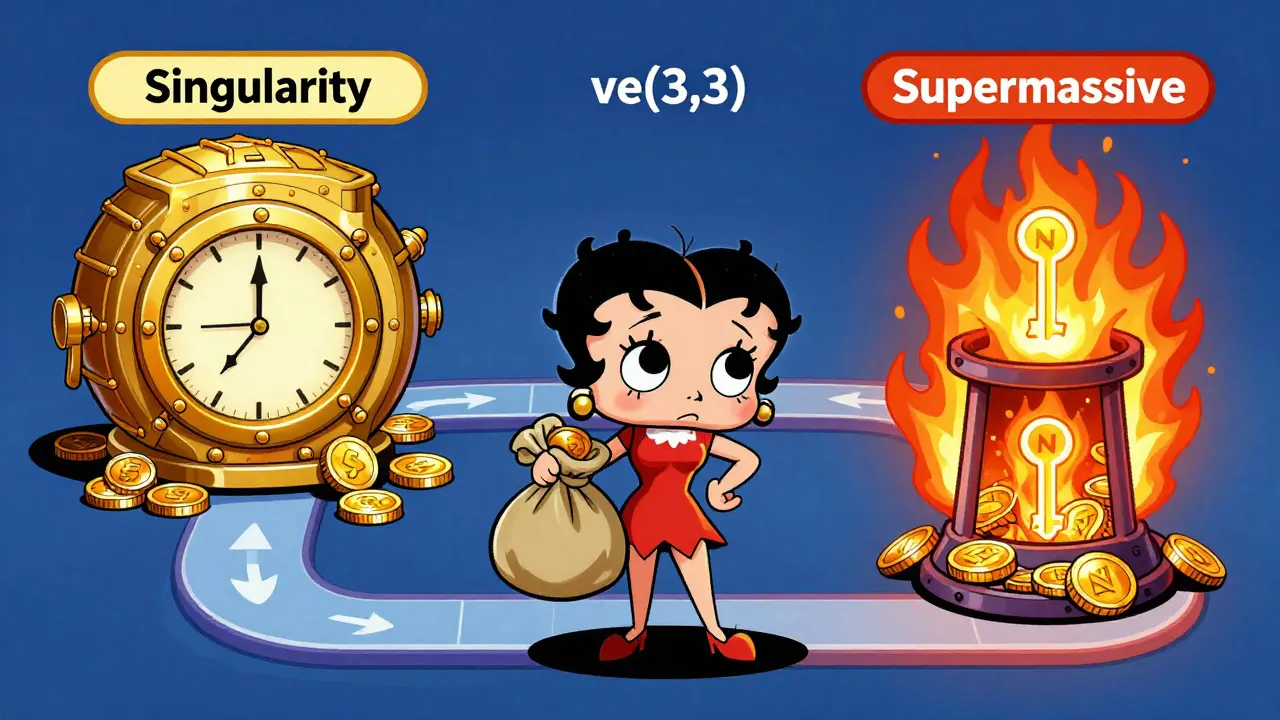
The platform uses a two-tier governance system based on vote-escrowed NFTs (veNFTs). Here is how it works:
- Singularity veNFTs: You lock $BLACK tokens for up to 4 years. The longer you lock, the more voting power and rewards you earn. This voting power decays over time if not renewed, encouraging active participation.
- Supermassive veNFTs: You permanently burn $BLACK tokens to mint these NFTs. They offer non-decaying voting power, enhanced rewards, and a 10% rebase bonus. This is for whales or believers who want permanent alignment with the protocol.
This structure creates a dynamic ecosystem where liquidity providers compete for votes from veNFT holders. Holders vote on "gauges," which determine which liquidity pools receive emission rewards. If you provide liquidity to a popular pool, you might earn less because too many people are voting there. If you find an undervoted pool, you can capture higher yields. It’s a strategic game of chicken played with millions of dollars in TVL.
Growth Metrics and Financial Health
Numbers don’t lie, but they can be misleading if taken out of context. Let’s look at the hard data as of mid-2026.
| Metric | Value | Context |
|---|---|---|
| Total Value Locked (TVL) | $47.66 Million | Entirely on Avalanche network |
| 24-Hour DEX Volume | $68.44 Million | Indicates high user activity |
| 7-Day Revenue | $104,917 | Generated from trading fees |
| Average Bid-Ask Spread | 0.611% | Competitive for mid-cap pairs |
| Annualized Fees Projection | $1.34 Million | Based on current fee generation rates |
These figures show a healthy, growing protocol. Blackhole experienced explosive growth early on, jumping from $11.2 million to $177 million in TVL in roughly one week during its peak hype cycle. While TVL has since stabilized around $47 million, the consistent daily volume of nearly $70 million suggests strong organic usage rather than just speculative locking.
The revenue generation is particularly notable. With over $150,000 in cumulative fees, the protocol is proving it can sustain itself without relying solely on inflationary token emissions. This is crucial for long-term viability in the current market climate.
User Experience: Simple Entry, Complex Strategy
Getting started on Blackhole is straightforward if you’re familiar with DeFi basics. You connect your wallet (preferably one compatible with Avalanche, like MetaMask or Core Wallet), swap ETH for AVAX, and then trade for $BLACK. From there, you can choose to provide liquidity directly or lock tokens for governance.
However, the user experience becomes nuanced quickly. New users often report confusion regarding the difference between Singularity and Supermassive veNFTs. The interface doesn’t always make it clear what the opportunity cost is of locking for 4 years versus burning permanently. Community tutorials and YouTube guides from creators like Alex Becker fill this gap, but the onboarding process could be smoother.
One common complaint is the modest initial returns. As one user noted, "literally earning pennies per day despite having put a few thousand dollars." This isn’t necessarily a flaw; it’s a feature of the ve(3,3) model. Yields are distributed based on voting weight and liquidity depth. If you enter a saturated pool without significant voting support, your APY will be low. To maximize earnings, you need to actively participate in governance or target niche pairs with less competition.
Blackhole vs. Competitors: Where Does It Stand?
Avalanche’s DeFi ecosystem is crowded. How does Blackhole compare to giants like Trader Joe, Pangolin, or lending protocols like Benqi?
| Feature | Blackhole CLMM | Trader Joe | Benqi |
|---|---|---|---|
| Primary Function | DEX + Governance Rewards | DEX + Lending | Lending Protocol |
| Tokenomics Model | ve(3,3) with Burn/Lock | Standard Staking/Yield | Interest Rate Based |
| Team Allocation | 100% Burned (Community Owned) | Private Sale Allocation Exists | Private Sale Allocation Exists |
| Complexity Level | High (Requires Voting) | Medium | Low (Simple Deposit) |
| Best For | Active DeFi Participants | General Traders | Passive Savers |
Blackhole’s biggest advantage is its community ownership structure. By burning all team tokens, the founders have eliminated the risk of insider dumps. This contrasts sharply with many other projects where large private allocations vest over time, creating constant sell pressure. For investors worried about rug pulls or malicious insider behavior, Blackhole offers a unique safety net.
However, this comes at the cost of simplicity. If you want passive income without reading whitepapers or watching governance calls, Benqi or standard staking pools might be easier. Blackhole demands engagement. It rewards those who understand the mechanics and participate in the ecosystem.

Risks and Considerations
No investment is without risk. Before depositing significant capital into Blackhole, consider these factors:
- Smart Contract Risk: Like any DeFi protocol, Blackhole relies on code. While audits are standard, bugs can still exist. Always start with small amounts to test the waters.
- Impermanent Loss: Providing liquidity to CLMM pools exposes you to impermanent loss, especially in volatile markets. Concentrated liquidity amplifies this risk if the price moves outside your range.
- Token Volatility: The value of your rewards depends on the price of $BLACK. If the token price drops significantly, your nominal yield may not offset the loss in principal value.
- Regulatory Uncertainty: While Blackhole is decentralized, regulatory landscapes for DeFi are evolving. The Cayman Islands incorporation provides some legal clarity, but global regulations remain unpredictable.
Additionally, the learning curve is steep. Misunderstanding the lock-up periods or voting mechanisms can lead to suboptimal returns. Don’t lock 4 years’ worth of tokens unless you are confident in the project’s long-term vision.
Verdict: Who Should Use Blackhole?
Blackhole CLMM is not for everyone. If you are looking for a set-and-forget savings account, look elsewhere. But if you are an active DeFi participant who enjoys optimizing yields, participating in governance, and supporting community-owned projects, Blackhole offers a compelling proposition.
Its innovative ve(3,3) model, combined with the security of burned team tokens, makes it one of the most aligned protocols on Avalanche. The growth metrics suggest strong adoption, and the revenue generation indicates sustainability. Just remember: do your own research, understand the risks of concentrated liquidity, and never invest more than you can afford to lose.
What is the minimum amount to start using Blackhole CLMM?
There is no strict minimum, but due to gas fees on the Avalanche network and the costs associated with minting veNFTs, it is practical to start with at least $100-$500 to see meaningful returns. Smaller amounts may result in negligible rewards after accounting for transaction costs.
Is Blackhole safe to use?
Blackhole undergoes regular security audits and operates on the secure Avalanche blockchain. However, all DeFi platforms carry inherent smart contract risks. The fact that team tokens are burned reduces insider threat, but users should always exercise caution and verify contract addresses.
How do I earn rewards on Blackhole?
You can earn rewards by providing liquidity to trading pairs, locking $BLACK tokens to create veNFTs for governance voting power, or staking tokens to earn protocol revenue. Higher rewards are available for those who vote strategically on gauges to direct emissions to less competitive pools.
What is the difference between Singularity and Supermassive veNFTs?
Singularity veNFTs are created by locking $BLACK for up to 4 years, offering temporary voting power and rewards. Supermassive veNFTs are created by permanently burning $BLACK, providing non-decaying voting power, enhanced rewards, and a 10% rebase bonus. Supermassive is for long-term believers, while Singularity offers flexibility.
Can I withdraw my funds anytime from Blackhole?
Liquidity provided to pools can generally be withdrawn at any time, subject to impermanent loss. However, if you have locked $BLACK tokens in veNFTs, you cannot withdraw them until the lock period expires (for Singularity) or ever (for Supermassive, as they are burned). Plan your liquidity accordingly.