What Is Bitcoin Pro (BTCP)? A Complete Guide to the Coin, Tokenomics, and Risks
Jul, 9 2026
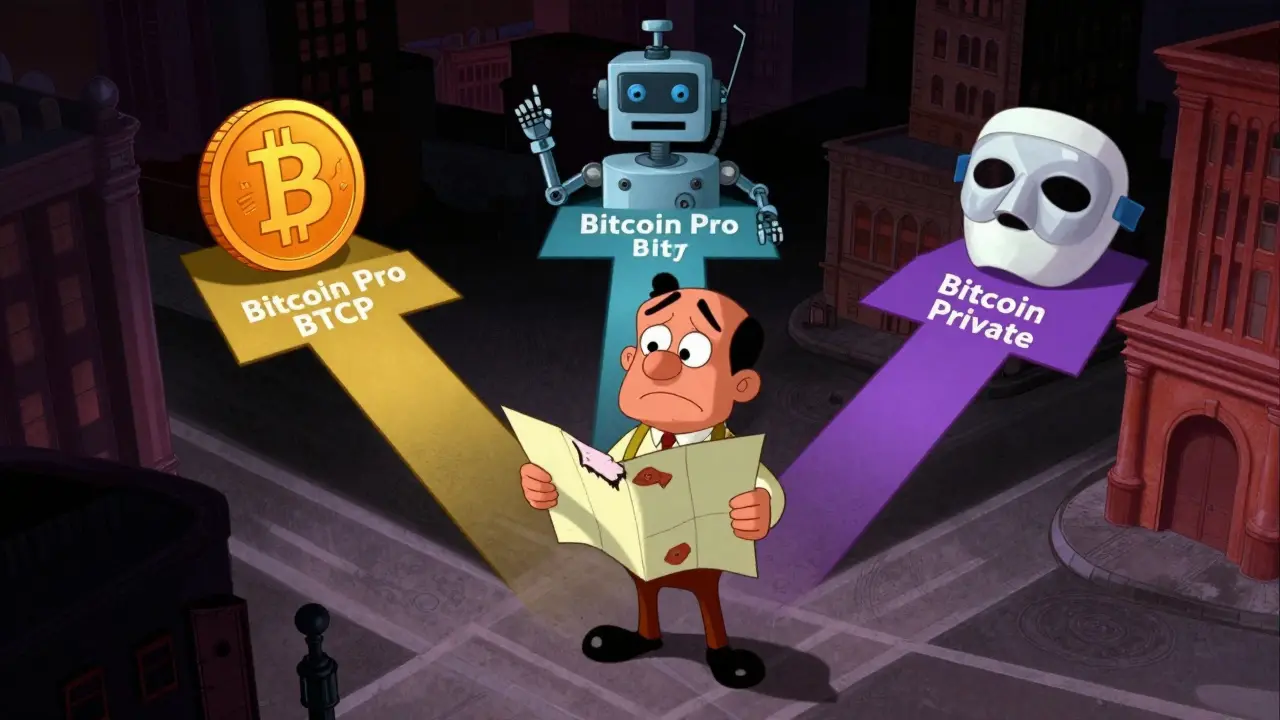
There is a lot of noise in the crypto world. You see headlines about new coins promising massive returns, but half the time, you can’t even tell what the project actually does. If you are looking at Bitcoin Pro, you might be wondering if it is the next big thing or just another confusing ticker symbol floating around exchanges. The short answer? It is complicated. There is a coin called Bitcoin Pro with the ticker BTCP, but there is also an automated trading platform with the same name. Mixing them up could cost you money.
This article cuts through the confusion. We will look at exactly what the Bitcoin Pro (BTCP) coin is, how its supply works, why prices vary so wildly between websites, and how it differs from other projects using the same abbreviation. By the end, you will know whether this scarce, multi-chain token fits your portfolio-or if you should walk away.
Quick Summary / Key Takeaways
- Bitcoin Pro (BTCP) is a scarce, multi-chain cryptocurrency launched in 2017, not a standalone blockchain.
- It has a fixed total supply of only 2,100,000 tokens, which is one-tenth of Bitcoin’s cap.
- The token operates on Ethereum, BNB Chain, and Polygon as a smart contract, meaning it relies on these networks for security and speed.
- Prices are highly volatile and inconsistent across platforms, ranging from roughly $8 to $58 depending on where you look.
- Do not confuse the BTCP coin with the "Bitcoin Pro" automated trading bot or the unrelated "Bitcoin Private" fork.
What Exactly Is Bitcoin Pro (BTCP)?
To understand Bitcoin Pro is a decentralized digital currency designed as a high-performance alternative to Bitcoin, you first have to ignore the name for a second. Despite sounding like an upgrade to the original Bitcoin, BTCP is not a Layer-1 blockchain with its own miners or nodes. Instead, it started life in 2017 as an ERC-20 token on the Ethereum network. Over time, the developers expanded its reach to include BNB Chain and Polygon.
Think of it less like a country with its own laws and more like a currency that circulates within several different countries. Because it runs on these established Proof-of-Stake networks, BTCP benefits from their security and speed without needing to build its own infrastructure from scratch. The project describes itself as a peer-to-peer electronic cash system and a store of value. Its main selling point isn't complex technology, but rather extreme scarcity and low transaction fees compared to the original Bitcoin.
A key feature here is the concept of "renounced contracts." This means the creators gave up control over the smart code. No single person or company can change the rules, mint new tokens, or freeze accounts. For some investors, this immutability is a huge plus-it signals true decentralization. For others, it raises questions: if something goes wrong, who do you call? In the case of BTCP, the answer is no one. You are on your own.
Tokenomics: The Power of Scarcity
If you have ever heard the phrase "supply and demand," this is where Bitcoin Pro leans heavily into the supply side. Most cryptocurrencies have millions or billions of tokens in circulation. Bitcoin Pro is different. The total supply is capped at exactly 2,100,000 BTCP. That is precisely one-tenth of the 21 million limit set for Bitcoin (BTC).
This scarcity is the core of the investment thesis. The idea is that by making the token rare, it becomes more valuable over time, acting as "digital gold." However, looking at the numbers reveals a messy reality. While the total supply is fixed, the circulating supply-the amount actually available for trading-is much lower and disputed.
| Data Source | Total Supply | Circulating Supply | Market Cap Estimate |
|---|---|---|---|
| CoinGecko | 2,100,000 | ~130,000 | ~$1.2 Million |
| Coinbase | 2,100,000 | ~129,000 | ~$6.5 Million |
| Bitget | 2,100,000 | 0 (Reported) | $0.00 |
As you can see, the data doesn't line up. Some platforms report a circulating supply of around 130,000 tokens, while others say zero. This discrepancy suggests that a large portion of the tokens may be locked in wallets, held by early investors, or simply not actively traded. When you buy BTCP, you are entering a market with very low liquidity. This means even small trades can cause the price to swing dramatically.

Pricing Volatility and Data Confusion
Let's talk about the elephant in the room: the price. If you check the price of Bitcoin Pro today, you might see $8.49. Refresh the page or check a different site, and it might say $57.92. How is that possible?
In mature markets like stocks, prices are relatively consistent because there is high volume and many buyers and sellers. In niche crypto markets like BTCP, liquidity is thin. Different exchanges have different pools of users. One exchange might have a few large holders buying up supply, spiking the local price, while another exchange has almost no activity, keeping the price low.
Additionally, tracking services often struggle with low-cap tokens. CoinGecko might list the price based on actual recent trades, while LiveCoinWatch might use a different calculation method or older data points. As of early July 2026, reports show an All-Time High (ATH) anywhere from $261 to over $600, depending on the source. These wild discrepancies are a red flag for casual investors. It highlights that BTCP is not a stable asset. It is highly speculative. Before you buy, you need to check multiple sources and understand that the "real" price is hard to pin down.
Technical Architecture: Multi-Chain Liquidity
Why does Bitcoin Pro exist on three different chains? The goal is "multi-chain liquidity." By deploying the token on Ethereum, BNB Chain, and Polygon, the project aims to make it easier for people to move value across ecosystems. If you hold assets on Polygon, you don't need to bridge everything to Ethereum to trade BTCP; you can use the version native to Polygon.
This architecture offers two main advantages:
- Speed: Transactions on Polygon or BNB Chain settle in seconds, unlike Bitcoin's 10-minute average block time.
- Cost: Fees on these Proof-of-Stake networks are fractions of a cent, making micro-transactions feasible.
However, this setup introduces complexity for the user. To truly leverage BTCP, you need to understand cross-chain bridges. If you send your Ethereum-based BTCP to a wallet address expecting to receive Polygon-based BTCP, you will lose your funds. You must ensure you are sending tokens on the correct network. This technical barrier keeps many retail users out, limiting adoption to those comfortable with Web3 tools.

The Identity Crisis: BTCP vs. Other Projects
This is the most dangerous part of researching Bitcoin Pro. The ticker symbol "BTCP" is shared by at least three different entities. If you buy the wrong one, you are investing in a completely different project with different risks.
1. Bitcoin Pro (BTCP): The scarce, multi-chain token we are discussing here. Launched in 2017. Focuses on store-of-value and low fees.
2. Bitcoin Private (BTCP): This is a privacy-focused fork created in March 2018. It merged the codebases of Zclassic and Bitcoin. It uses zk-SNARKs technology to hide transaction details. It has a larger supply (over 22 million) and a different market cap. Do not confuse this privacy coin with the scarcity-focused Bitcoin Pro.
3. Bitcoin Pro Trading Platform: This is not a coin at all. It is an automated trading bot service. Many online reviews discuss "making profits" with Bitcoin Pro, referring to this software. The software claims AI-driven accuracy and requires a deposit. The BTCP coin has nothing to do with this platform. Using the coin does not give you access to the bot, and vice versa.
Always check the contract address before you buy. On Ethereum, for example, every token has a unique string of characters. Verify this against official listings on trusted aggregators like CoinGecko or Etherscan. Never trust a link sent to you via email or social media.
Risks and Considerations for Investors
Investing in Bitcoin Pro comes with significant risks that go beyond normal market volatility. First, there is the issue of anonymity. Unlike major projects with public teams and audited code repositories, Bitcoin Pro has no named founders. The renounced contract means there is no central authority to fix bugs or respond to exploits. If a vulnerability is found in the underlying smart contract, there is no patch coming.
Second, consider the regulatory landscape. As of 2026, regulators in the US and EU are tightening rules on unregistered securities. While BTCP presents itself as a utility token, its lack of clear documentation and active development team could draw scrutiny. Institutional investors generally avoid such opaque assets, which limits the potential for massive institutional inflows that drive up prices in other cryptos.
Finally, look at the competition. Why would someone choose BTCP over established assets? Bitcoin offers proven security. Ethereum offers a vast ecosystem. Stablecoins offer predictability. BTCP offers scarcity, but it is a scarce asset with limited utility. Without real-world use cases-like payments being widely accepted or integration into DeFi protocols-the value proposition rests entirely on speculation. People buy it hoping someone else will pay more later. That is a risky game.
How to Buy and Store Bitcoin Pro Safely
If you decide to proceed despite the risks, here is how to handle it practically. You cannot buy BTCP directly with credit cards on most major centralized exchanges due to its low volume. You typically need to use a crypto-to-crypto pair.
- Choose an Exchange: Look for platforms that list BTCP, such as Bitget or smaller DEXs (Decentralized Exchanges). Check if they support the specific chain you want (ERC-20, BEP-20, or Polygon).
- Use a Compatible Wallet: Do not leave your coins on the exchange. Use a non-custodial wallet like MetaMask or Trust Wallet. Configure the wallet to add the custom token using the correct contract address for the network you are on.
- Verify the Network: Double-check the network fee and the destination address. Sending ERC-20 tokens to a Polygon address will result in permanent loss.
- Start Small: Given the illiquidity, start with an amount you can afford to lose completely. Test the withdrawal process with a tiny amount first.
Remember, once you transfer tokens to a private wallet, you are responsible for your seed phrase. Write it down on paper and store it safely. There is no customer support to reset your password.
Is Bitcoin Pro (BTCP) the same as Bitcoin?
No. Bitcoin (BTC) is the original cryptocurrency with its own blockchain. Bitcoin Pro (BTCP) is a separate token that runs on top of other blockchains like Ethereum and Polygon. They are not interchangeable.
Why are there different prices for BTCP on different websites?
BTCP has low liquidity, meaning there aren't many buyers and sellers at any given moment. Different exchanges have isolated order books, leading to price discrepancies. Additionally, some data providers may use outdated metrics.
Can I mine Bitcoin Pro?
No. BTCP is not mined. It was pre-mined and distributed as a smart contract token. The total supply is fixed at 2.1 million, and no new tokens can be created.
Is the "Bitcoin Pro" trading bot related to the BTCP coin?
No. The Bitcoin Pro trading bot is a separate automated software service. Holding the BTCP coin does not grant you access to the bot, nor does the bot generate BTCP rewards. They share a name but are distinct entities.
What is the difference between Bitcoin Pro and Bitcoin Private?
Both use the ticker BTCP, but they are different. Bitcoin Pro is a scarce multi-chain token focused on store-of-value. Bitcoin Private is a privacy-focused fork of Bitcoin and Zclassic with a larger supply and different technology.